

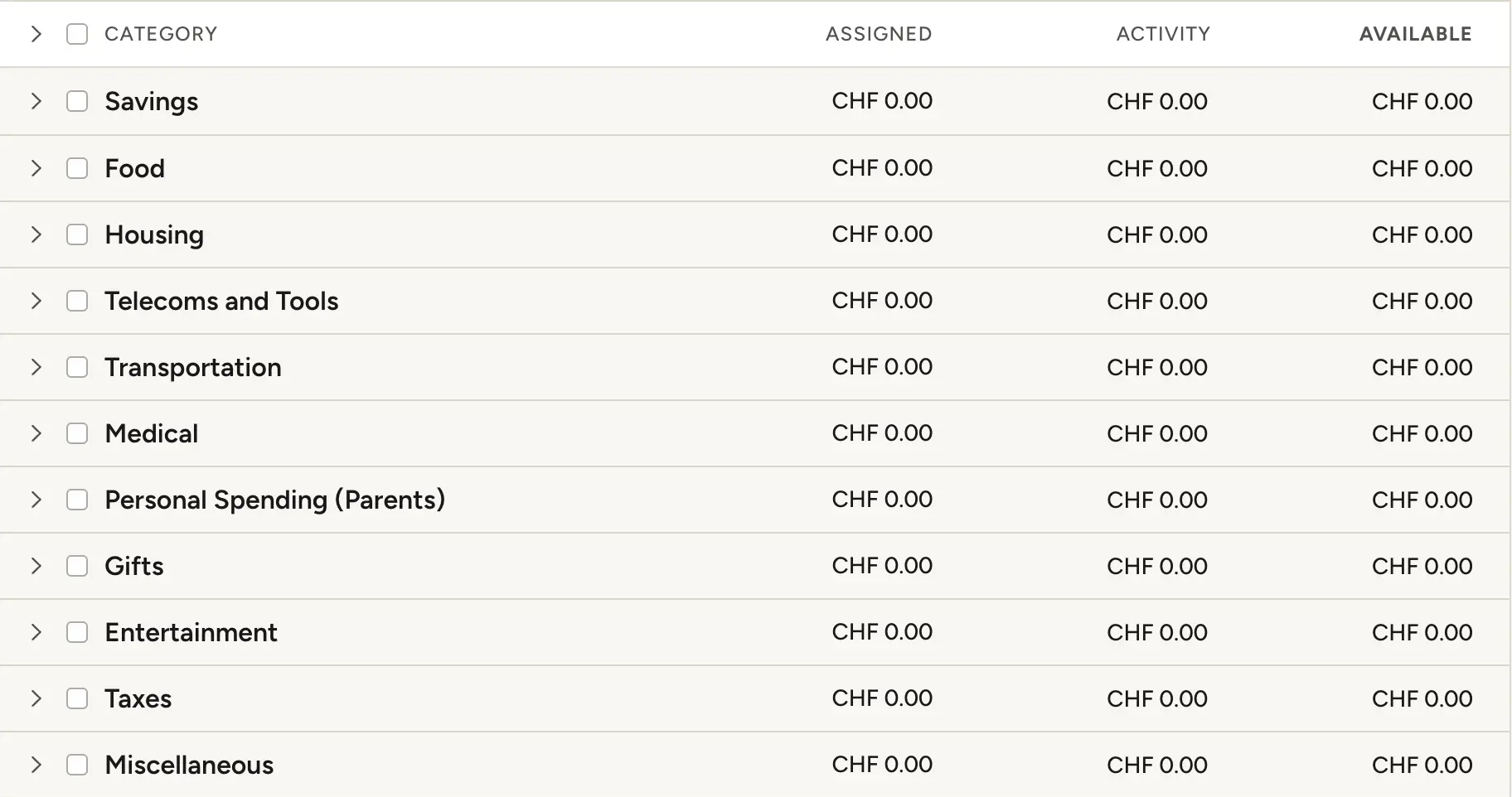
TL;DR: here’s my list of YNAB budget categories (You Need a Budget), organized into 11 groups. We’ve iterated on it quite a bit to land on this version, tested by our Swiss family with kids. You can copy it as-is into YNAB or any other budget app. It includes various Swiss specifics: LAMal, 3a, cantonal insurance, Serafe, car tax, motorway vignette, etc.
A reader wrote to me recently:
Could you share the expense categories from your budget? I’d like to start with a solid, proven classification for Switzerland. Because I also want to stop stressing at the end of every month with my budget (AND put aside 40-50% every month ;)).
If you’re also setting up YNAB (see my YNAB review) or another budget app, here’s my detailed answer.
You can start from this system, then adapt it to your personal situation.
Because budgeting by giving every CHF a job is the first step toward financial independence. Otherwise, you’re flying blind.
And as the saying goes: “You can only improve what you measure.”
Why I came back to standard groups
I changed my categorization system 2-3 times in my YNAB budget.
At first, I had category groups by frequency:
- “Planned expenses”
- With categories inside to separate housing-related items (electricity bill for example), kids, etc.
- “Unplanned or irregular expenses”
- Same idea, I had categories for each type of unplanned expense (weddings, donations, hobbies, movies, or the gift for Aunt Martine’s Sunday lunch, etc.)
- “Savings”
I’d followed this beginner budget strategy that seemed fine to start with, since basically it was everything predictable on one side, and everything unpredictable on the other.
It seemed clever at the time. Except at year-end, when I wanted to do my review, I had zero readability… because food-related items were split across both planned grocery runs and unplanned outings.
Everything was mixed up…
So a few years back, I decided to go back to something more classic, by nature of expense.
That gave me three main benefits:
- An annual review readable in 2 minutes
- A budget easily comparable year over year
- A budget comparable to benchmarks (FSO, other budgets you read in magazines like “Bon à savoir”)
Note for YNAB users: each title below corresponds to a ‘Category Group’ in YNAB.
And each item in the list under that title represents a ‘Category’ inside it.
If you use another app, the principle stays the same.
So here’s what I use as budget categories in 2026:
Savings
I put this category at the very top of my budget, to respect one of the golden rules of Mustachianism: “Pay yourself first.”
- 3rd pillar (MP)
- 3rd pillar (Mrs. MP)
- Investments
- Emergency fund
The “Emergency fund” is a great category when you’re starting to budget: you put CHF X/month in it, and when the day comes, you pull out the cash without panicking over an unexpected expense.
That said, cash sitting idle in an account isn’t ideal over the long term. Once your frugal muscle is well trained and your net worth has grown thanks to your budget, here’s what I do now: I invest it in the stock market, and when I need to pull funds out, I do it via an IBKR margin loan (or by selling ETFs).
Food
- Groceries
- Restaurants
- Snacks and others (MP)
- Snacks and others (Mrs. MP)
We split “Snacks” by person to make each of us aware of our own spending, and to avoid the “bottomless pit” category where you end up paying less attention.
Housing
“Renter” mode
- Rent
- Utility charges (monthly prepayments + annual reconciliation)
“Owner” mode
- Mortgage interest
- Amortization (if you amortize directly, otherwise via your 3a above)
- Maintenance and repairs
- Janitorial (cleaning of common areas in PPE for example)
- Electricity (private, and common areas if in PPE)
- Cold water (if billed separately)
- Hot water (if billed separately)
- Heating (if billed separately)
- Cantonal building insurance (external envelope and common areas)
- Subscriptions (telephony for elevator emergency system, boiler maintenance, etc.)
- Bank fees (for the PPE account)
- PPE administration (if applicable)
- Sewage tax
- Property tax
- Garbage tax
- Renovation fund
Common to renters and owners
- Cantonal contents insurance (fire/natural elements)
- Furnishings, furniture
- Other one-off expenses (move, installation, etc.)
Telecom and tools
- Phone + internet plans
- Geek (subscriptions, software like YNAB, others)
- Reserve for new laptop and smartphone (or further down in the Projects section)
At the MPs’, the “Geek” section covers various subscriptions like ChatGPT or Dropbox. And also the cost of website hosting, for example.
You can put it under Entertainment if you prefer, but it grows fast and deserves its own line in our budget.
Transport
- Car insurance
- Car tax
- Vehicle inspection
- Car repairs and maintenance
- Gas
- Parking and motorway vignette
- Public transport
- Reserve for new car (or if it breaks down)
The “Reserve for new car” follows the same reasoning as the “Emergency fund” above: useful when you’re starting out with budgeting, worth revisiting once your wealth is well established. And above all, no consumer loan (or worse, car leasing, never!).
Medical
- LAMal health insurance (we have one category for us parents, and a separate one for the kids)
- Supplementary health insurance (same: one for the parents, and one for the kids)
- Doctors and pharmacies
Personal spending (parents)
One category per adult family member:
- Clothes and shoes
- Beauty and care
- Sports/hobbies
- Freedom (cf. the story behind this category in this article)
Like with “Snacks”, it gives each person a personal envelope without having to justify every purchase. It’s the foundation of a couple’s budget that lasts ;-)
Gifts
- Birthdays
- Christmas
- Other (flowers when invited somewhere, etc.)
At the start of our budgeting journey, we had one category per person we gave a gift to each year for their birthday and Christmas.
Then, with time, we derived a global yearly envelope for birthdays and the same for Christmas, so it’s easier (and faster, mostly!) to enter into YNAB each month.
Entertainment
- Leisure and travel (theme parks, museums, etc.)
- Media (home movie rentals, books, Netflix, etc.)
- Serafe
We put Serafe (the Swiss radio-TV fee) under “Entertainment” because conceptually that’s what it is, even though it’s mandatory and you have no choice but to pay it in Switzerland.
Taxes
- Taxes (monthly prepayments + final reconciliation)
Miscellaneous
- Donations
- Home contents and personal liability insurance
- Other
We do our best to keep the “Other” catch-all as small as possible. And if it grows year over year, that’s the signal we’re missing a category.
Optional groups (depending on your situation)
The groups above cover most Swiss households. Depending on your situation, add one or more of the following groups.
Projects
You set aside CHF X/month for a future goal like:
- Primary residence purchase (apartment or house)
- Secondary residence purchase (mountain apartment)
- Travel (vacations, weekends, long trip)
- Big purchase (bike, appliances, computer)
- Renovation/remodel
- Education (courses, certification)
- Wedding / family celebration
- Other one-off project
As you can see, I prefer putting my projects directly in the right category group (new laptop, renovation, etc.), but both work.
Debt
I almost didn’t include this category, since any good Mustachian aims to live debt-free.
Then I remembered that in my early frugal days, I still had a consumer loan to pay off for a car… (nobody’s perfect haha!)
- Consumer loan
- Leasing (car, bike, appliances)
- Credit card payments
- Personal loans
As usual, you’ll want to pay off the highest-interest debt first, until it’s gone entirely.
And if you’re a homeowner, I personally keep my mortgage costs in the “Housing” category, not here.
Pets
If you have a four-legged companion (or more, or fewer ^^):
- Food
- Vet and care
- Pet insurance
- Grooming, accessories, toys
- Boarding/pet-sitting (vacations)
Variants by life stage
The 11 budget category groups above are my current version in “Couple without kids” mode.
I deliberately removed the “Kids” category group to make several variants below, since it evolves with age (and not in the right direction, trust me haha…). I also added the “Retired” variant for when we slow down (or not).
Depending on your stage, certain categories appear or disappear.
Young kids (0-4 years)
- Childcare fees (daycare, home-based daycare, after-school)
- Baby gear
School-age kids (4-14 years)
Drop childcare fees gradually (phew!), and add (nooo!):
- Clothes, shoes
- School (cafeteria, activities and others)
- Extracurricular (incl. sports)
- Haircuts
- Pocket money kid 1
- Pocket money kid 2
- Pocket money kid 3, etc.
Teens (14-18 years)
- Driver’s license
- Phone plan (if you pay it instead of their pocket money)
Retired
- Remove: 3rd pillar from Savings
- Add: Supplementary health, travel, support for kids/grandkids
Budget categories FAQ
How many categories total in this budget system?
Around 40-50 categories spread across 11 groups, depending on your family life and detail level. That’s already plenty! My advice: stay under 60, since beyond that you’ll spend more time categorizing than analyzing.
Do I need a category per subscription (Netflix, Spotify, etc.)?
No, I don’t recommend a category per subscription. Group them under “Geek” (or “Subscriptions”), unless you actively want to track a single subscription to decide whether to cut it (because you can see it’s eating too much).
How long does it take to set up these categories?
30 minutes to create the structure, then 3-6 months to stabilize (you’ll add or merge categories as you see what works for you).
Should couples split expenses by person?
Yes, but only personal expenses (snacks, clothes, hobbies). Shared expenses (groceries, housing, family car) stay common, otherwise you’ll waste hours splitting every receipt. On the same theme, I recommend this article: Common budget for couples: simplify and centralize everything
What if an expense doesn’t fit any category?
Put it in “Miscellaneous > Other” the first time. Create a dedicated category if that expense comes back 2-3 times, or leave it in “Miscellaneous” if it’s a one-off.
What’s next? Over to you!
11 groups. Around 45 categories. A Swiss family with kids that no longer stresses about its budget at the end of the month. And that puts 40-50% aside every month.
It’s not magic. It’s just being intentional.
So there you go Benoît, you have my answer. Copy my categories into YNAB in 30 minutes, live with them for 3-6 months, then adapt as you go. In a year, your setup won’t quite look like mine anymore. Good. The goal was never to copy my system, but to stop flying blind.
That said, don’t wait for the “perfect” setup before starting, because you’ll wait a long time.
And finally, a pro tip to make sure you take action: block 1 hour this weekend (or the next free one) in your calendar with a reminder to set up your first budget. That way, you won’t put off such an important step on your road to FI for many more months.
PS: if there’s a category I didn’t cover or a Swiss case that deserves its own variant, leave me a comment below.