
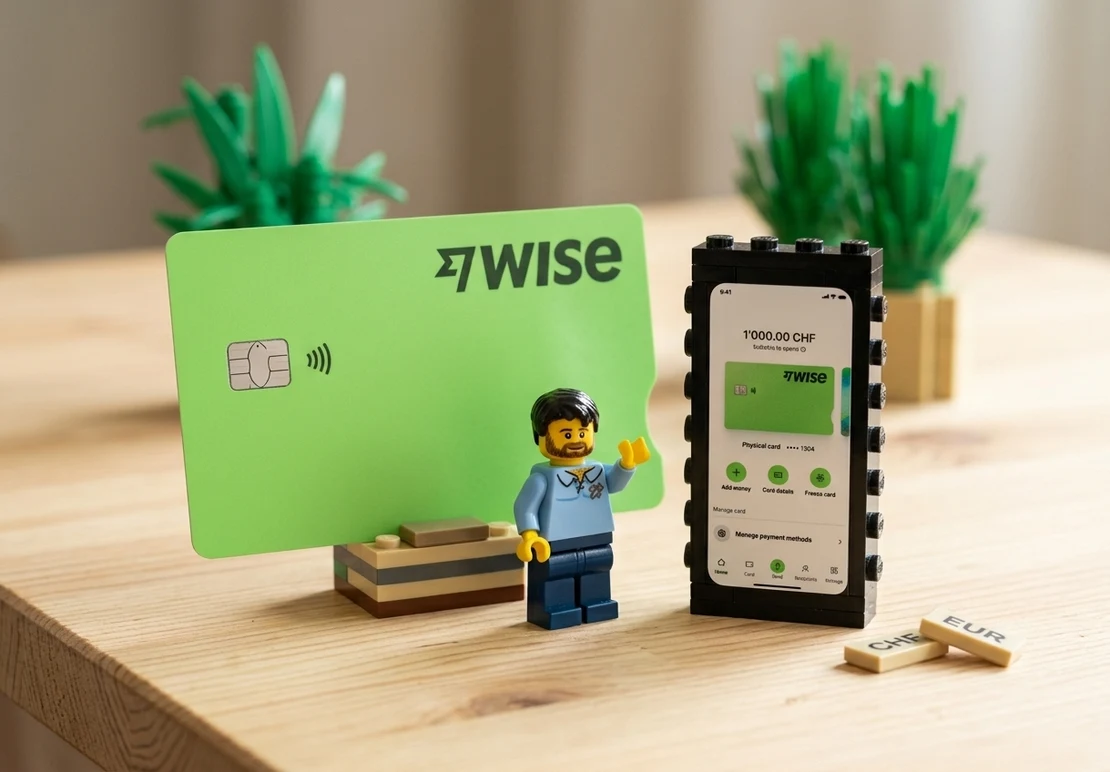
Wise referral code 2026
Wise doesn't offer a promo code as such. But if you want to support the blog, you can use my Wise partner link below to open your account, and start saving on your exchange fees and your transfers in foreign currencies. Thanks in advance.
I’ve been using Wise in Switzerland since 2020 as my multi-currency account. Both personally and with my company.
To be clear, Wise isn’t a bank, and it’s not my main bank either. It’s only my favorite service to exchange currencies up to CHF 10'000, and to send them to any bank account in the world (not only the ones in my name). Above CHF 10'000, the price difference makes me use Interactive Brokers (IBKR).
If you have the same need as an individual or as a company in Switzerland, then the rest of this article will interest you.
Wise review in a nutshell
In a few points, here’s why I’ve been using Wise (formerly TransferWise) for all these years, starting with the advantages:
What I like about Wise
- Exchange and transfer fees among the lowest. Only one other financial provider (hi IBKR!) is better, but with constraints on how long it takes, and also on the fact that you can only transfer money to an account of your own.
- The transparency of the fees. That’s THE point I love. Whether we’re talking about exchange fees, transfer fees, or volatility fees, you always know what to expect BEFORE you do anything, and you NEVER get a bad surprise afterwards.
- You can send funds to a third party, and not only to yourself as is the case with Interactive Brokers.
- Transfers are very fast, especially compared to traditional banks. Wise explains on its website (and I can confirm it) that more than 75% of transfers arrive within seconds, and more than 96% arrive within 24 hours or less.
- It’s a company that takes security seriously. Both for the protection of your account and for the protection of your money (I detail this below).
- Always at the cutting edge in terms of features. Whether it’s 2FA, Apple or Google Wallet, virtual cards, or just a Wise mobile app with no bugs that simply works, all the time, I find it also helps to trust their currency exchange solution.
What Wise could improve
- Become a real Swiss bank. With a CH IBAN in particular (today the IBAN of the CHF account starts with “GB”, because we’re under the UK entity). That would let us make it our main Swiss bank with QR-bill payments at no cost, TWINT built in, and all those typically Swiss things. Even if, as I explain in the conclusion, I’m not sure their exchange fees would survive it.
- Get a banking license that protects deposits. As I’ll explain below, I only use it as a transit account. But if the point above were to be solved, I’d need more guarantees for my CHF deposits.
MP’s recommendation
For personal use, I recommend (and use myself) Wise in Switzerland to anyone who needs to make transfers in other currencies (up to CHF 10'000), or who needs to send foreign currencies to themselves or to someone else (in almost any country in the world).
Same for the Wise Business account. I recommend it (and use it!) to any Swiss company that needs to receive, convert, or send money in foreign currencies (up to CHF 10'000), anywhere in the world.
It’s quite rare, but yes, Wise and Wise Business are both the most Mustachian solution in Switzerland for everything related to currency exchange and transfers.
My story with Wise since 2020
I don’t know if it’s because I had more time during COVID to compare currency exchange services, or if it was just the timing, but 2020 is when I switched to Wise to convert my currencies.
Personally, from Revolut to Wise
Like many Swiss people, I opened a Revolut account at the end of the 2010s. I have to say their offer was tempting, with zero exchange fees and no markup on the exchange rate. It really shook up the well-established banks…
Such a strategy was quite aggressive, and Revolut had to start raising its fees to become profitable.
Before 2020, you had no exchange fees up to about CHF 6'000. And we made good use of it for our various trips in Europe, to split the cost of a wedding gift for a friend in Berlin, etc. You didn’t have to think about it, because for “everyday” expenses, you never went over CHF 6'000 per month.
But after 2020, they lowered this limit to CHF 1'250 per month. So the day you went over it, you had to pick another option like TransferWise (which is now called Wise).
Time flew by, and Wise became much more competitive on its exchange rate for many currencies. On par with Revolut, or even cheaper.
And since I was using neon free at that time, I started using their very handy Wise integration (with convenience fees, but fairly low ones).
Today, for any currency conversion below CHF 10'000, or any transfer of foreign currencies to another country, I use Wise directly, because it’s the best trade-off between fees and convenience (I compare it with the alternatives below).

I had the Wise card personally back then, but since I wasn’t using it, I didn’t renew it. I do have it for my business account though. And speaking of which…
For business, my company’s multi-currency account
At the beginning, when I had my GmbH, I paid my expenses with my personal account, then made myself a transfer to get reimbursed.
Until I discovered that Wise Business existed :)
It really was a great discovery, because on the one hand it was a pain to make those transfers between my company and myself, and above all because it mixed everything up in my account tracking. I managed to get by in YNAB, but it was a pain.
Opening a Wise Business account let me centralize and manage all my expenses from one single account: travel, accommodation, various subscriptions, and even the printing of my book.
And I also use it to receive payments in foreign currencies, then I convert, and I send to my main account in CHF. Or if it’s money I want to invest on IBKR via my company, I send the USD I received directly, which saves me a useless currency conversion.
Why is Wise the best multi-currency account for a Mustachian in Switzerland?
Wise is the best multi-currency account in terms of rock-bottom exchange fees, convenience and speed for all your payments in foreign currencies and other conversions, up to CHF 10'000. Compared to the other solutions, Wise (and Wise Business too!) lets you send money in a foreign currency to people other than yourself, with the speed that made their reputation (from a few seconds to less than 24 hours).
My Mustachian criteria for a multi-currency account
Below you’ll find my criteria to define the best Swiss multi-currency account for a Mustachian:
| Mustachian criteria | Wise personal | Wise Business |
|---|---|---|
| Account with no basic fees | ✅ Free, no subscription | 🟠 CHF 55 one time to get the bank details |
| Top up your account in CHF by bank transfer | ✅ Free | ✅ Same |
| Hold money in several currencies | ✅ Free | ✅ Same |
| Exchange rate at the mid-market rate | ✅ Fees from 0.15% to 0.23% depending on the amount (CHF to EUR), in two parts (a variable one depending on the currency, and sometimes a fixed one, also depending on the currency) | ✅ Same |
| Transfers to third parties | ✅ To more than 140 countries | ✅ Same |
| Receive money with local account details (EUR, USD, GBP…) | ✅ Free, in 22 currencies | ✅ Same |
| Receive a Swift payment | 🟠 Fixed fees depending on the currency, for example 2.39€, GBP 2.16 or USD 6.11 | 🟠 Same |
| Speed of transfers | ✅ More than 75% arrive within seconds | ✅ Same |
| Free physical debit card | 🟠 CHF 8 one time, no subscription | ✅ First card free, then CHF 4 per additional card |
| Free virtual cards | ✅ Created instantly in the app | ✅ Same |
| Apple Pay and Google Pay | ✅ | ✅ Same |
| Cash withdrawals | 🟠 Free up to CHF 230 per month, then 2.69% of the amount over the limit | 🟠 Same |
| No monthly exchange limit | ✅ | ✅ Same |
| No weekend surcharge | ✅ | ✅ Same |
| Statements and accounting exports | ✅ Free, in PDF, XLSX, CSV, CAMT.053, MT940 and QIF | ✅ Same, plus an export to accounting software |
| App and website in French, German, Italian and English | ✅ | ✅ Same |
| Security | ✅ Two-factor authentication, customer funds kept separate | ✅ Same |
| Deposit protection | ❌ None, Wise isn’t a bank | ❌ Same |
| Personal Swiss IBAN | ❌ No local account details in CHF, the IBAN starts with “GB” | ❌ Same |
| Pay a QR-bill | 🟠 Possible, but with a fixed fee of CHF 1.34 per payment | 🟠 Same |
| eBill | ❌ | ❌ Same |
| Direct debit (LSV) | ❌ | ❌ Same |
| TWINT | ❌ | ❌ Same |
| Joint account | ❌ | n/a |
Wise fees and exchange rate in Switzerland
Wise doesn’t charge you any subscription or other recurring fees, and doesn’t hide any margin in its exchange rate. You convert at the mid-market rate, and you pay fees that Wise shows you before you confirm.
Here’s a concrete example (from November 2026 in case you read this later), where I simulated a conversion of CHF 500 to USD in my Wise app. The fees came to CHF 1.25, which is 0.25% of the amount. And I would have received USD 602.90, at the rate of 1 CHF = 1.2088 USD.
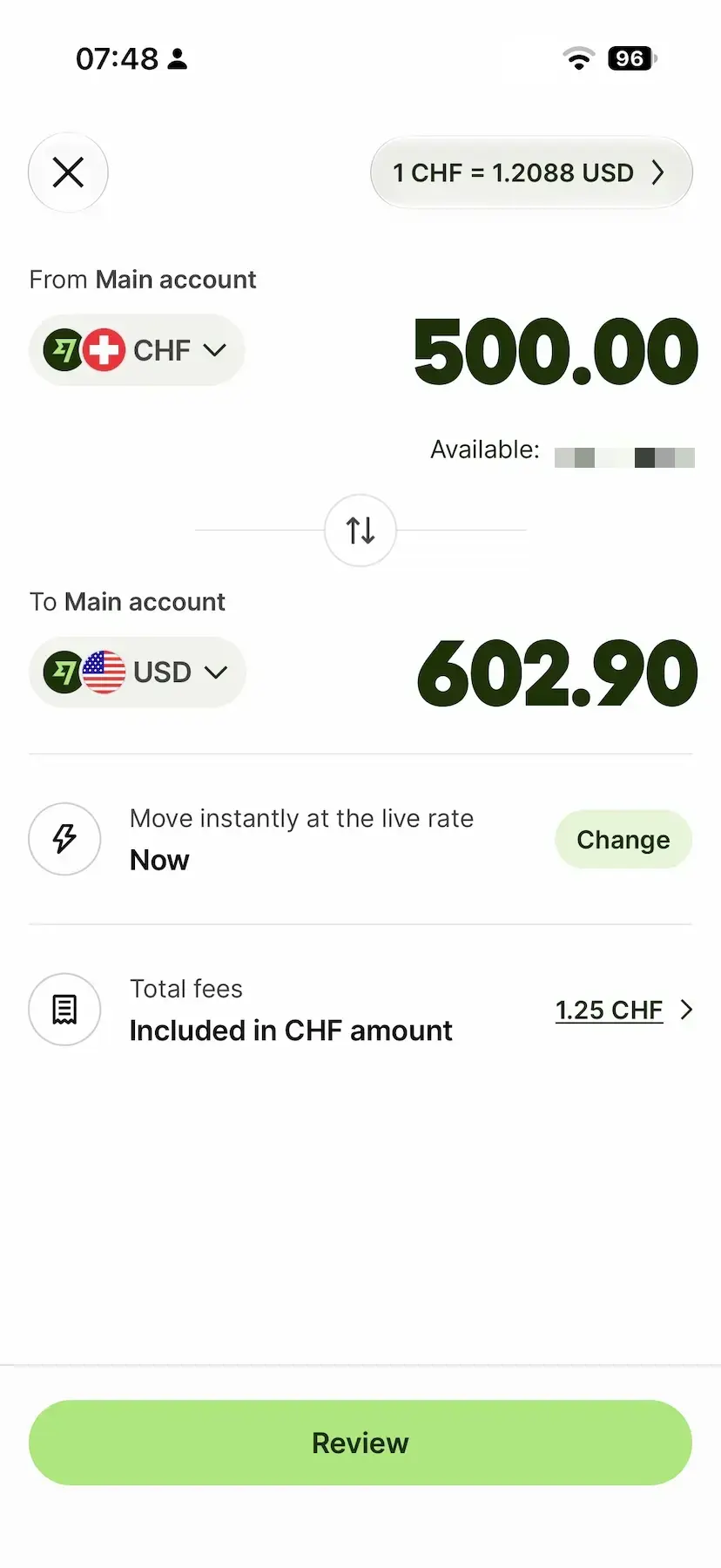
Wise's fees (CHF 1.25) to convert CHF 500 to USD, with the exchange rate used shown at the top right
In practice, Wise fees break down into four items:
- The exchange: fees go from 0.15% to 0.23% of the converted amount for CHF to EUR, and depend on the currency. They’re made of a variable part (a percentage), and sometimes a fixed part of a few cents. And the more you convert, the lower the percentage. And above all, the full detail is always visible!
- Transfers: topping up your account in CHF by bank transfer is free, just like receiving money on your local account details (EUR, USD, GBP, etc.). The only exception is Swift payments you receive, for which Wise takes a fixed fee. Expect for example 2.39€ for a Swift payment in EUR, GBP 2.16 for GBP or USD 6.11 for USD.
- The card: it costs CHF 8, one time.
- Using the Wise card: paying in a currency you don’t have on your account costs you the usual exchange fees, for example 0.23% for CHF to EUR (I explain this in the section about the card, just below). And cash withdrawals are free up to CHF 230 per month. Above that, Wise takes 2.69% of the amount over the limit. (N.B.: watch out abroad too, because the ATM operator can add its own fees, and it shows them on the screen before you confirm…)
So that’s for the most common use cases of your Wise account.
And there are other situations where they charge you some fees (quite fairly I think, and really as low as they can to stay profitable if you ask me):
- Topping up your account by card isn’t free. Not a big deal, since you can use a bank transfer from your Swiss account, and that has always been free.
- A transfer to a bank account outside of Wise (in your name or not) costs a bit more than a card payment. For CHF 1'000 sent in EUR, it comes to CHF 3.50 in fees (0.35%) for the transfer, versus CHF 2.30 (0.23%) with the card. So if you can pay by card, pay by card, and keep the transfer for when you only have the IBAN of the person or the company you’re paying.
- Volatility fees can be added when a currency moves sharply. It’s rare (it has never happened to me), and Wise shows them before you confirm in any case.
- The Wise Business account costs CHF 55, one time, to get your bank details.
The Wise card in Switzerland
The Wise card is a debit card (not a credit card). It debits your Wise balance directly, and never goes into overdraft. And you can add it to Apple Pay or Google Pay to pay contactless with your smartphone.
In addition to the physical card, you can create virtual cards in the app.
And you can freeze your physical card as well as your virtual cards in one click, which is super handy in case of fraud.
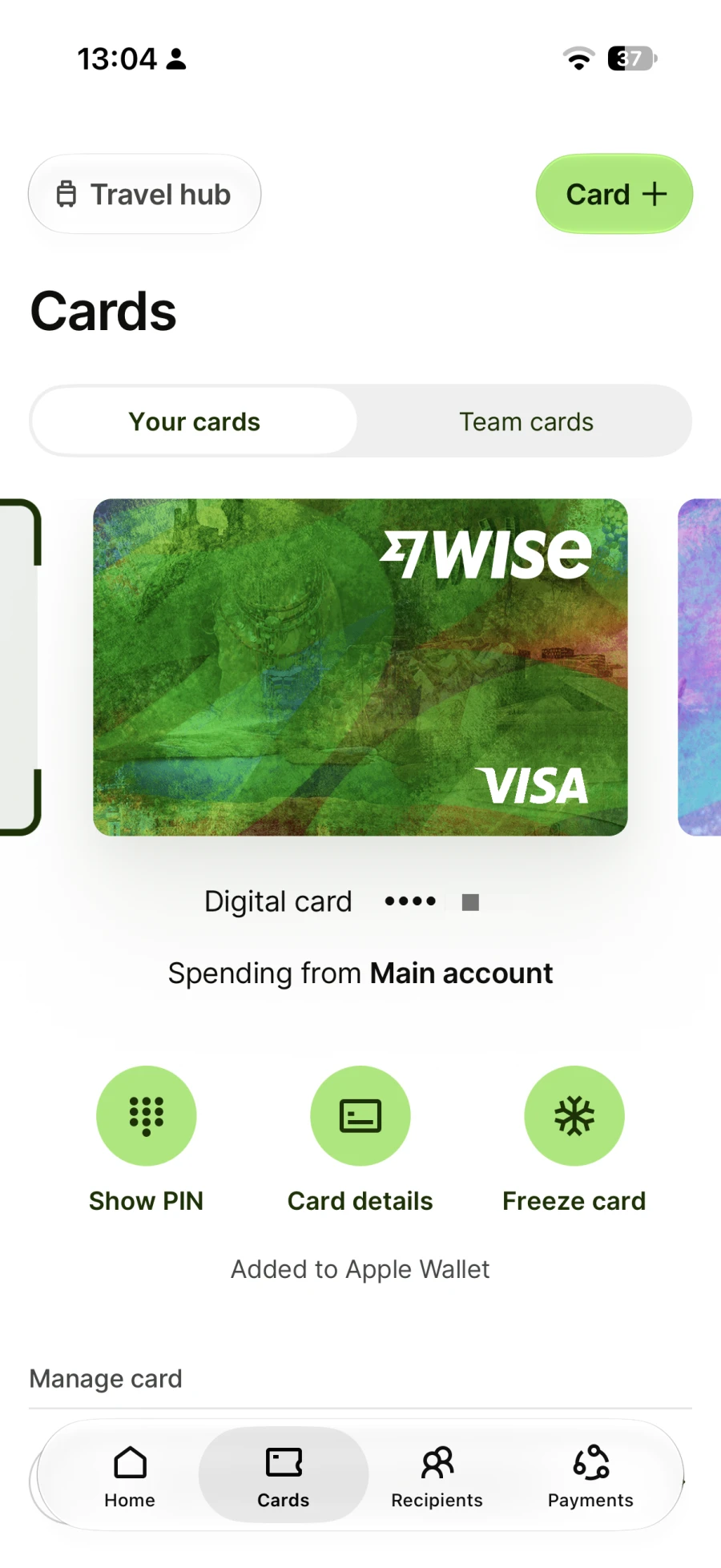
And FYI, since I wondered about it every time, I’m documenting it here: you don’t need to have the currency on your account to pay. If you pay in EUR with only CHF on your account, Wise converts on its own at the time of payment. Whether you exchange yourself in the app beforehand, or you let the card do it, Wise only charges you the exchange fees (with the exchange rate at that moment though, obviously).
To compare with other cards, I recommend my article on card fees abroad.
Wise money transfers, including large amounts
The thing that surprises me every time with Wise is how fast transfers are. Between Swiss bank accounts, it often takes a few tens of minutes. But it’s mostly for international transfers that it blows my mind, because it’s often done in less than 24 hours (when you compare that with other banks from the last century, it’s a game changer!)
As for amounts, here’s my rule to choose between Wise and Interactive Brokers (the other best option to exchange cash):
- Less than CHF 10'000: I use Wise. Fees stay low, it’s fast, and the money goes straight to the account of the person or the company I’m paying.
- More than CHF 10'000, to my own account: I go through Interactive Brokers. It’s cheaper for such an amount, but IBKR only sends to an account in your name, and with a settlement delay on the currency exchange transaction.
- More than CHF 10'000, to a third party: I convert at Interactive Brokers, then I send my currencies to Wise for the final transfer. And if you’re in a hurry, stay on Wise.
I detail all the numbers with concrete examples in my comparison of transfer services for large amounts.
Is Wise safe?
Wise is a secure currency conversion service, both with its app (and the various mechanisms such as strong two-factor authentication) and in its internal practices (SOC 1, SOC 2 Type 2, PCI-DSS, and ISO/IEC 27001 certifications).
But Wise isn’t a Swiss bank. Which means it doesn’t benefit from deposit protection up to CHF 100'000. And it doesn’t have this protection in the United Kingdom either. Instead, it keeps your assets entirely separate from its own, without ever dipping into them to go and issue mortgages for example (as traditional banks do).
So, for my part, I leave around CHF 2'000 on average on my Wise Business account, never much more (and nothing on my personal account). Because, as I explain below, it’s a transit account for my cash needs in foreign currencies.
Also, a reader told me she had read comments from people who had their Wise account blocked without being able to access their money for months. Personally, it has never happened to me since 2020. Neither with my personal account, nor with my Wise Business account. So if it happened to you, let me know in the comments so we have something concrete rather than hearsay.
Wise Business for a GmbH or an AG in Switzerland
Franco, a reader of the blog, once asked me this in a comment. He has a GmbH in Switzerland, his main client pays him in EUR, and he has invoices to pay in CHF.
Is Wise Business made for him?
The answer is yes, and that’s exactly how I use it myself. You give your EUR bank details to your client, you receive their payments for free, and you convert to CHF at the mid-market rate when you need to (with no markup on the exchange rate!!). Then you send your CHF to your company’s main account, with no fees either.
Compared to the personal Wise account, three things change with the Wise Business account:
- The opening fee: CHF 55, one time, to get your bank details
- The card: the first one is free, then it’s CHF 4 per additional card. In our case, Mrs. MP and I each have our own as a virtual card (and I keep the physical card in my wallet in case contactless doesn’t work)
- Accounting: in addition to the statements, you get an export to accounting software
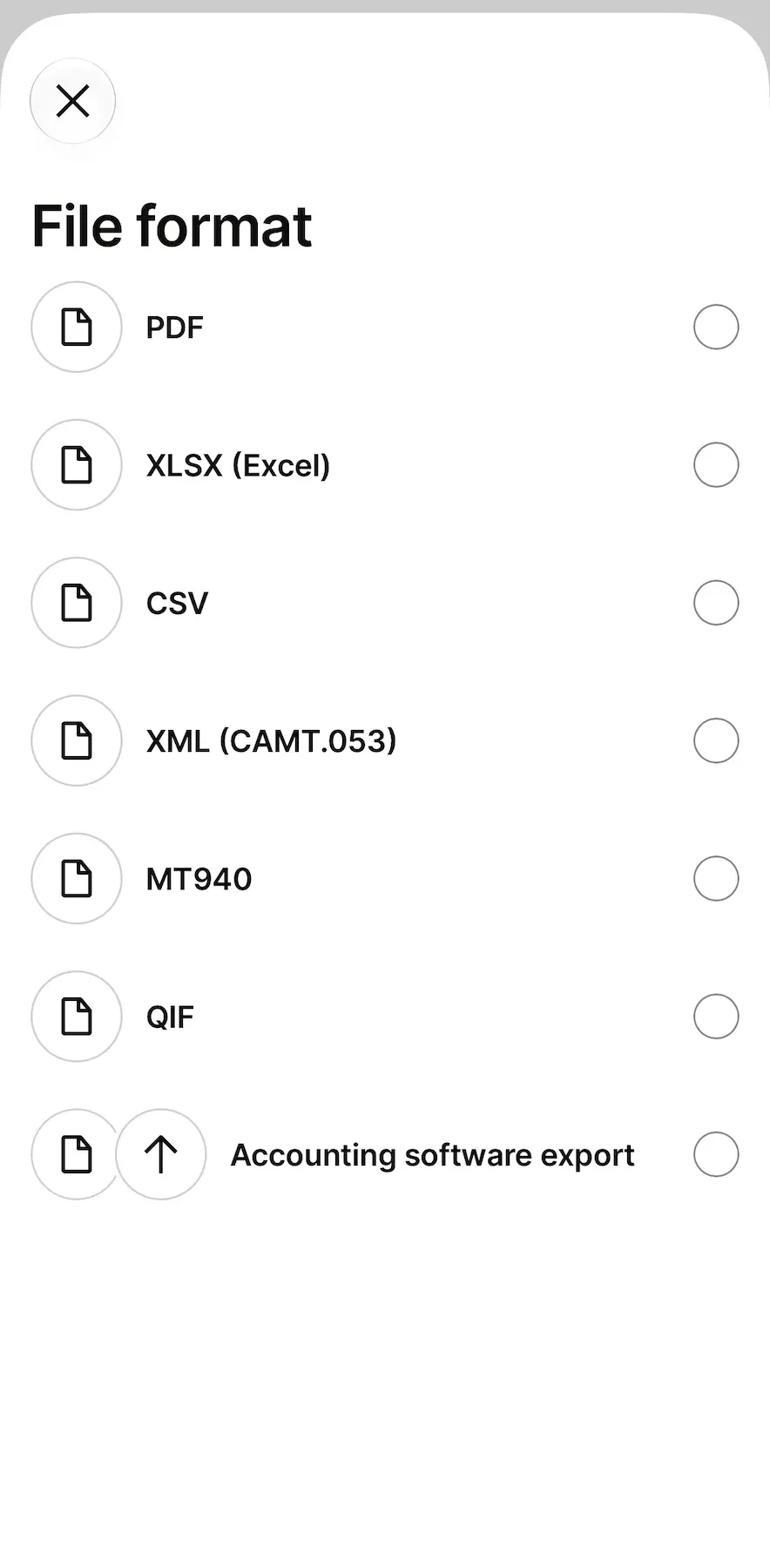
The export formats for the statements of my Wise Business account, including the export to accounting software
Everything else is identical to the personal account, whether it’s the exchange rate, the virtual cards or the app.
And if you’re still hesitating about the card, I compared Wise Business with Revolut Business and Migros Bank in my comparison of the best business credit card in Switzerland.
My transit account method with Wise Business
A quick aside about my Wise Business account: when looking at how I was using it, my accountant told me that it was in fact a transit account (entirely “transparent” from an accounting point of view), and so there was no need to bother tracking it in my bookkeeping.
Here’s how I use it:
- At the beginning of each month, I transfer a fixed amount from my company’s main account to my Wise Business account (for example CHF 2'000 to keep it simple)
- I convert this money into the various currencies I’ll need
- I store all my invoices related to Wise transactions in a Google Sheet
- Each month I put money back on Wise to always be topped up
- The payments I receive from my clients in foreign currencies don’t stay on Wise either. I transfer them to my company’s main account, and they go into my bookkeeping from the moment they arrive on that account
- And at the end of the year, I make sure I’m at CHF 0 (and the same in the other currencies) on my Wise Business account. That way, I keep this transit account principle. And all the transfers I made to Wise Business are booked as business expenses with all the supporting documents that go with them. Very handy!
As usual, it’s my method, validated with my accountant. But since it’s still accounting, I’ll let you do your own checks with your own accountant, so that everything is clean and in order.
Reviews from Wise users
The Wise app gets 4.7 out of 5 on the Swiss App Store and Play Store, a nice score! But as usual, before signing up for a new financial service, I also check the online reviews:
Ratings of the Wise app on the Swiss app stores
First of all, here are the average ratings of the Wise app on the Swiss app stores of Apple and Google (screenshots from November 2026):
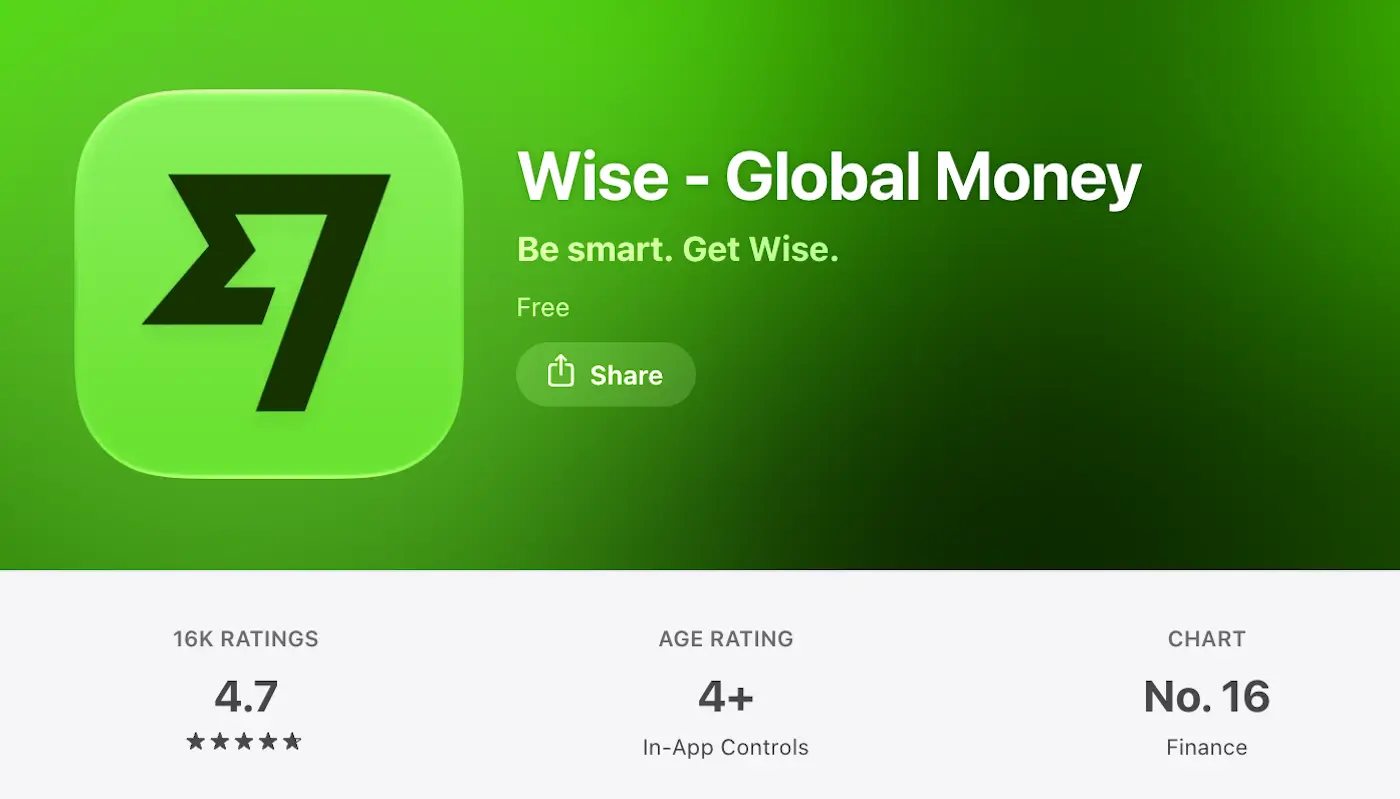
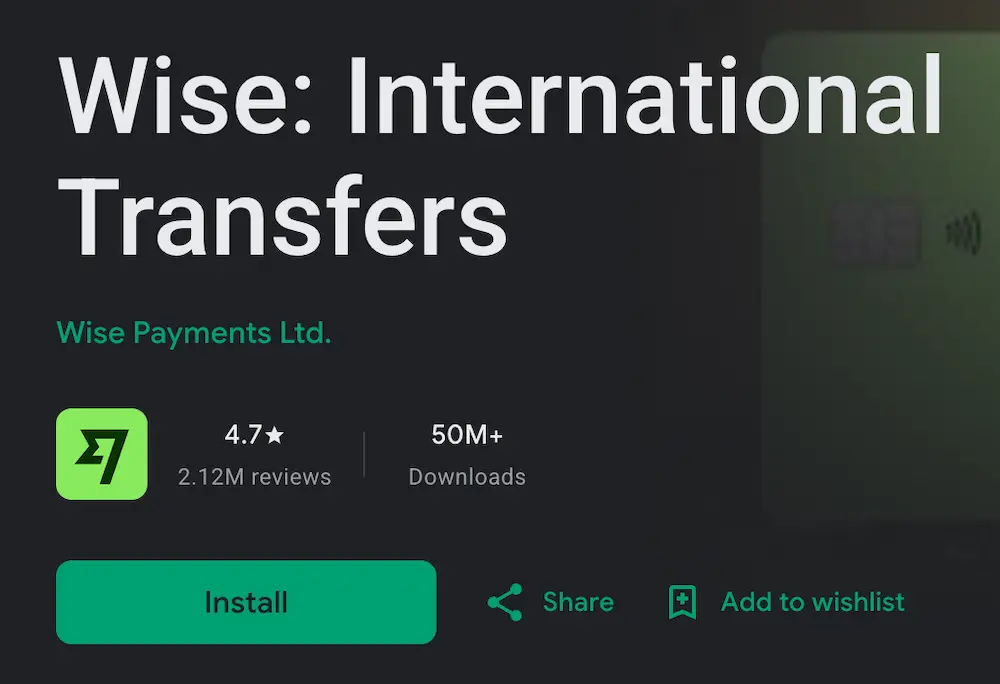
The Wise app has been downloaded more than 50 million times on Android, and it gets 4.7 out of 5 on both platforms. There are worse stats ;)
What the reviews say about Wise
And here are a few public comments from Wise users on Apple’s App Store and Google’s Play Store:
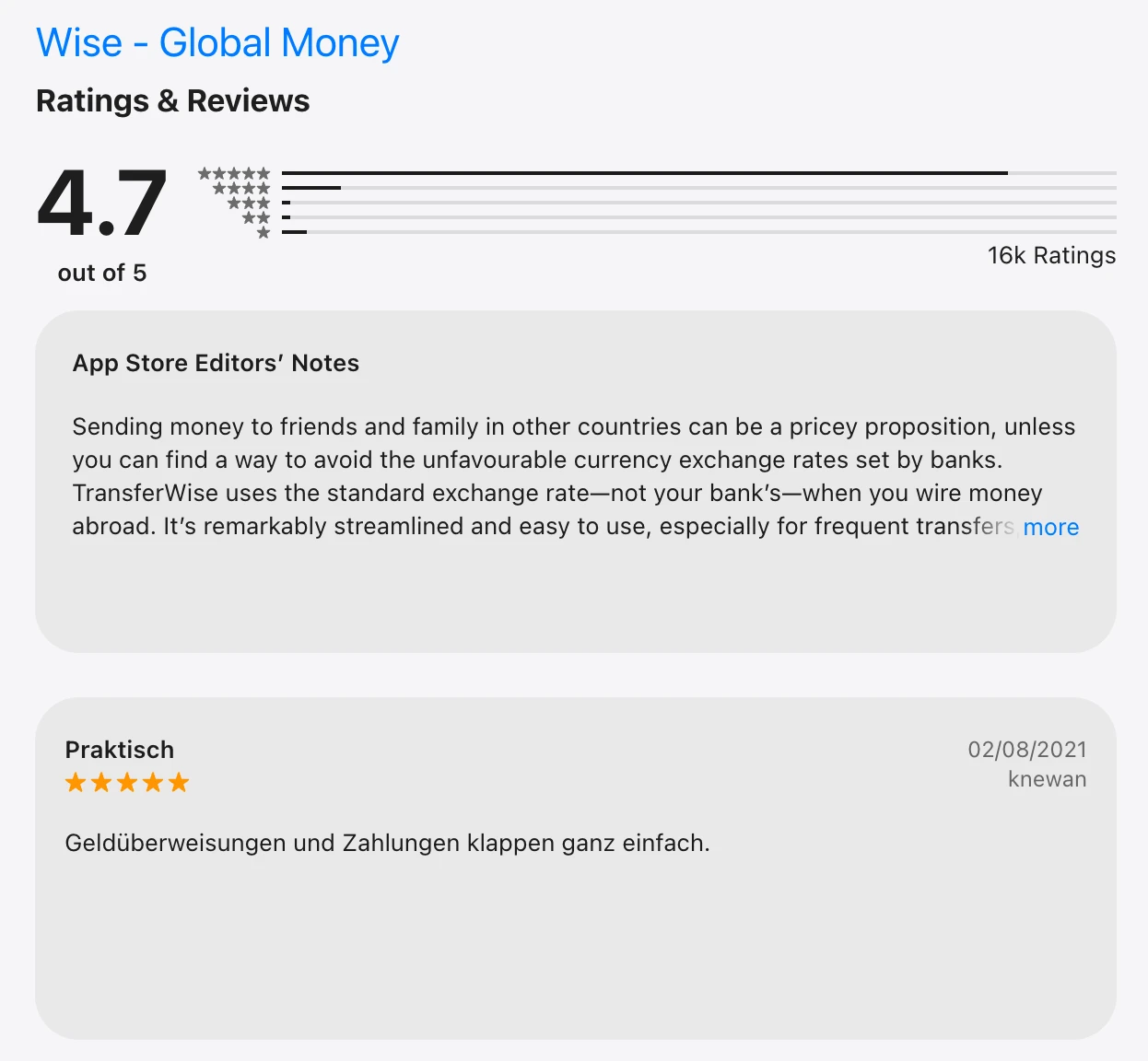
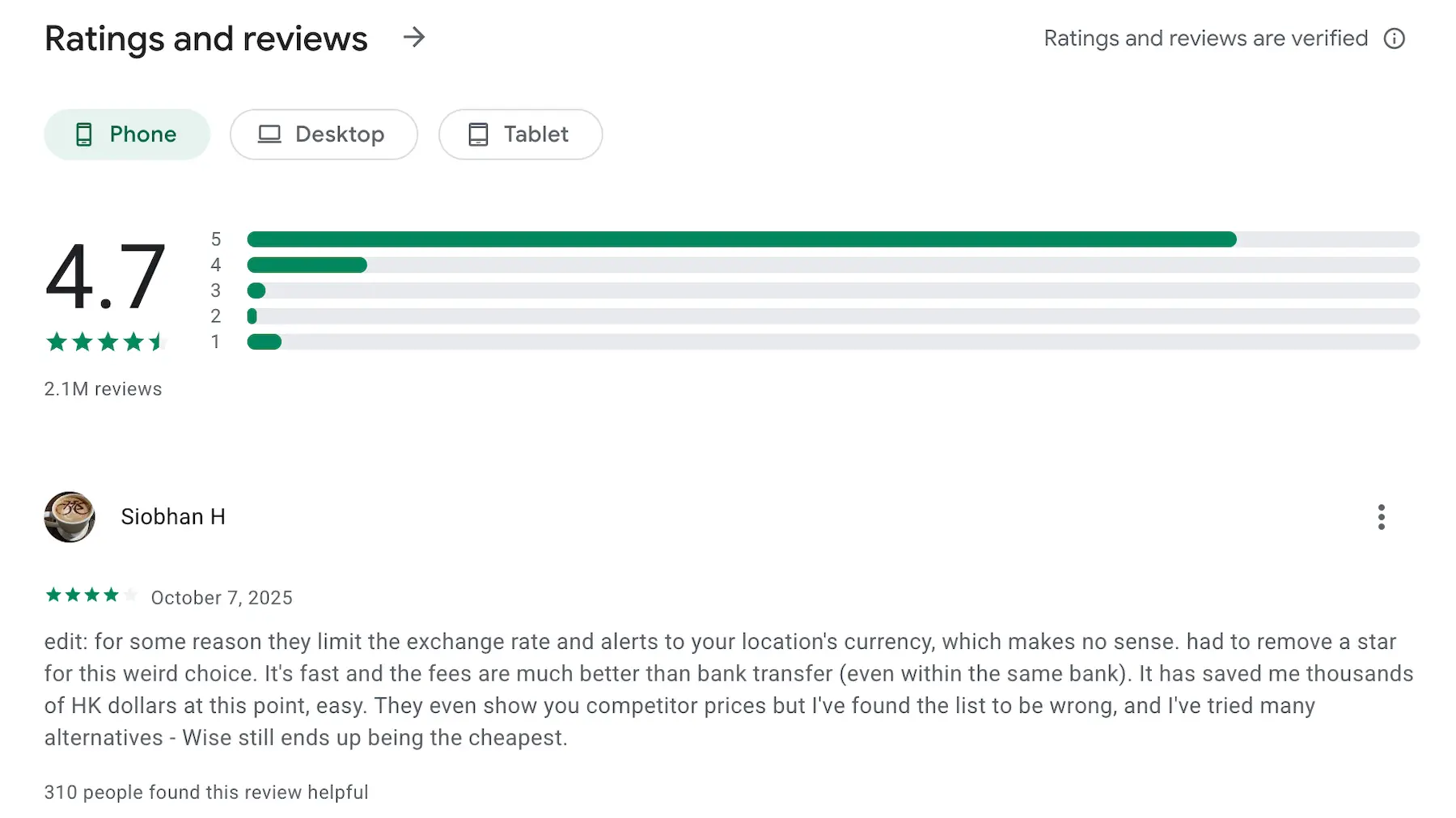
Most reviews are positive, and talk again and again about the optimal exchange rate and how simple the app is. The negative ones mostly talk about identity checks and accounts blocked during a review. On my side, as I told you earlier, I’ve never had this issue in six years, personally or for business.
You can also use these links to see the most recent ratings of the Wise app on iOS and of the Wise app on Android.
Alternatives to Wise, and how they compare
Wise has quite a lot of alternatives when it comes to currency exchange, a bit fewer when it comes to transfers abroad. Let’s see what it looks like at a glance first, then I’ll detail each alternative right after.
| Alternative | When it wins | When Wise wins |
|---|---|---|
| Revolut | Less than CHF 1'250 per month, and on weekdays | Above CHF 1'250 per month, or on the weekend |
| neon | Up to CHF 1'000 in transfers per year, without leaving your neon app | More regular use, and a multi-currency account |
| Yuh | SEPA transfers with EUR you already hold, or one or two transfers per year | Currency conversion, transfers outside SEPA, and more than 40 currencies |
| Interactive Brokers | Above CHF 10'000, to an account in your name | Below CHF 10'000, and to pay a third party |
| b-sharpe | Above CHF 500'000 (depending on the currency), or if you want a provider based in Switzerland | Up to CHF 500'000 |
| Traditional Swiss bank | Never | Always, on fees as well as on speed |
| Revolut Business | Never in my case | No monthly fees, and a smooth account opening |
Wise vs Revolut
Revolut is the alternative everyone thinks of when we talk about “currency conversion”. So I ran the test for you, with screenshots to back it up (from November 2026). I simulated the same conversion from CHF to EUR in both apps, at almost the same minute, with Revolut’s free plan (Standard).
| Amount converted | Received with Wise | Received with Revolut | Cheapest |
|---|---|---|---|
| CHF 1'000 | 1'081.40€ | 1'083.09€ | Revolut, by 1.69€ |
| CHF 10'000 | 10'814.04€ | 10'736.36€ | Wise, by 77.68€ |
| CHF 100'000 | 108'226.62€ | 107'241.76€ | Wise, by 984.86€ |
You can see that Revolut’s Standard plan lets you convert CHF 1'250 per month with no fees. Above that, Revolut takes 1% of the amount over the limit. And on the weekend, it adds another 1% in fees.
Wise only takes between 0.15% and 0.23% in this test, with no monthly limit and no weekend surcharge.
By the way, I ran the same test again on a weekend in November 2026, to see this surcharge with my own eyes:
| Amount converted | Received with Wise | Received with Revolut | Cheapest |
|---|---|---|---|
| CHF 1'000 | 1'078.94€ | 1'068.71€ | Wise, by 10.23€ |
| CHF 10'000 | 10'789.49€ | 10'592.69€ | Wise, by 196.80€ |
| CHF 100'000 | 107'980.99€ | 105'805.51€ | Wise, by 2'175.48€ |
Wise charged me exactly the same fees as on a weekday (CHF 2.30 for CHF 1'000, and CHF 22.94 for CHF 10'000). Revolut even loses on CHF 1'000, while it was winning by 1.69€ on a weekday.
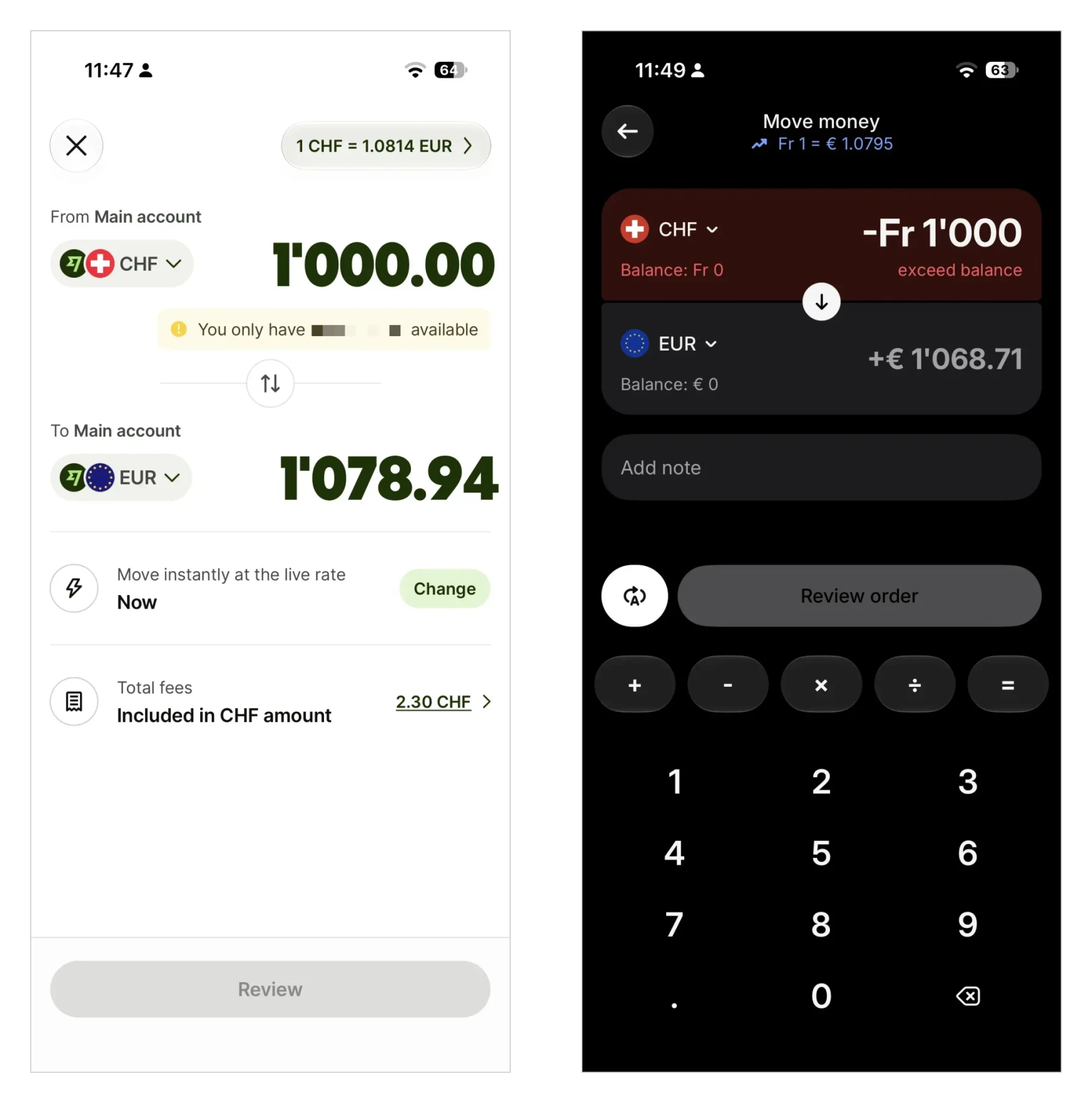
My simulation of CHF 1'000 to EUR on a weekend, with Wise on the left (same CHF 2.30 fee as on a weekday) and Revolut on the right, where I receive 10.23€ less
But what bothers me the most with Revolut is the lack of transparency. Look at the two screens for CHF 10'000 on a weekday:
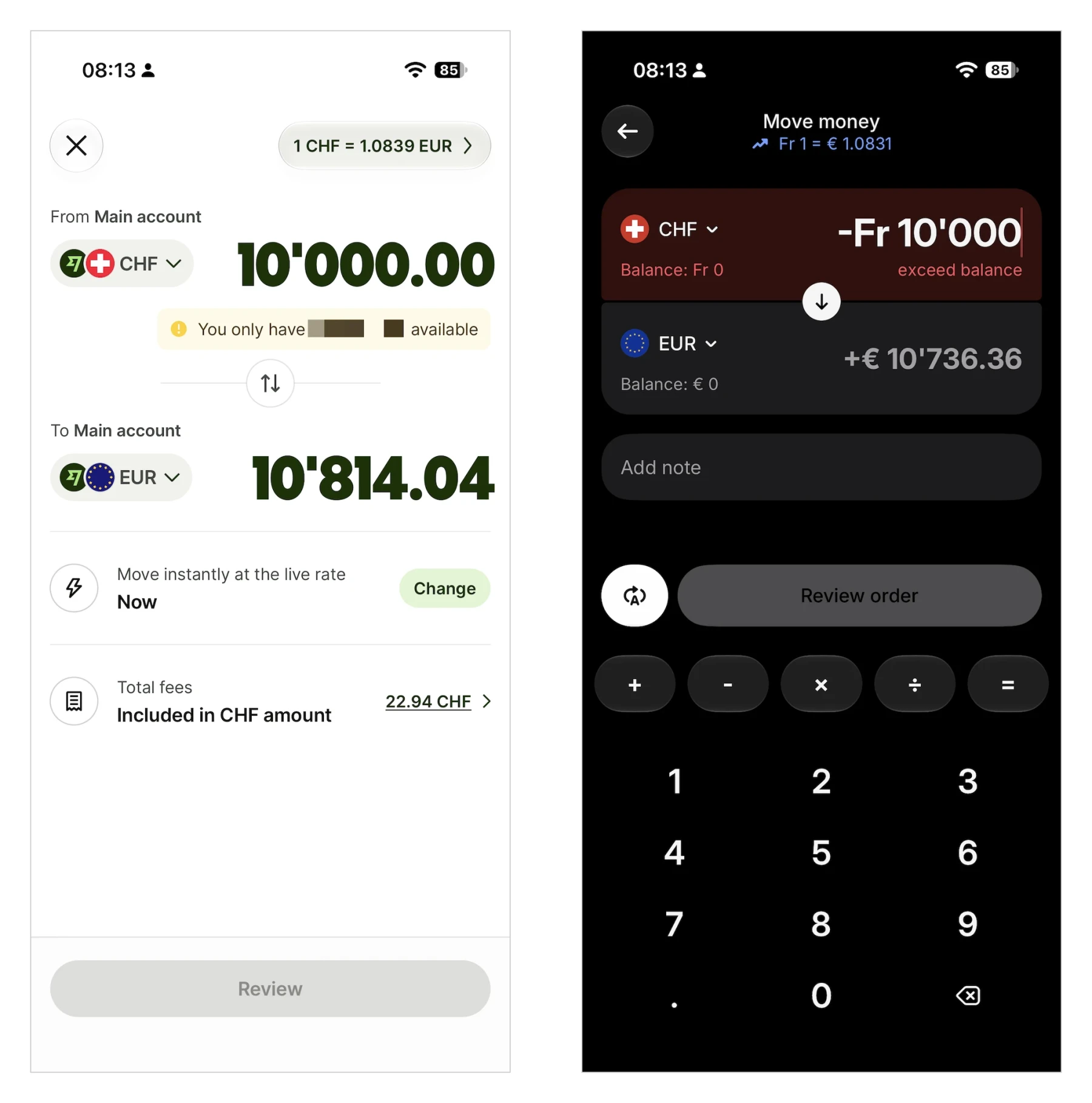
My simulation of CHF 10'000 to EUR, with Wise on the left (the rate at the top and the CHF 22.94 fee at the bottom) and Revolut on the right, where I see the rate and the amount received, but no fee line
With Wise, everything is on the same screen. With Revolut, the rate shown at the top should give me 10'831€, while the screen shows 10'736.36€. The missing 94.64€, or about CHF 87.50, is the 1% fee. And I had to calculate it myself.
To be fair to Revolut: since my Revolut account is empty, that may be the reason why you don’t see the fees.
But it’s kind of their general philosophy when it comes to fees. On their website too, it took me more than five minutes to find this CHF 1'250 limit in the help pages, while Wise shows its pricing in one click.
And by the way, watch out for the “Converter” inside the Revolut app, because it’s only there to give you an idea of the rate, with no fees included. For CHF 10'000, it showed me 10'843.68€, which is 107€ more than what I would actually have received. It’s not wrong as such, I just find it adds confusion to the user experience…
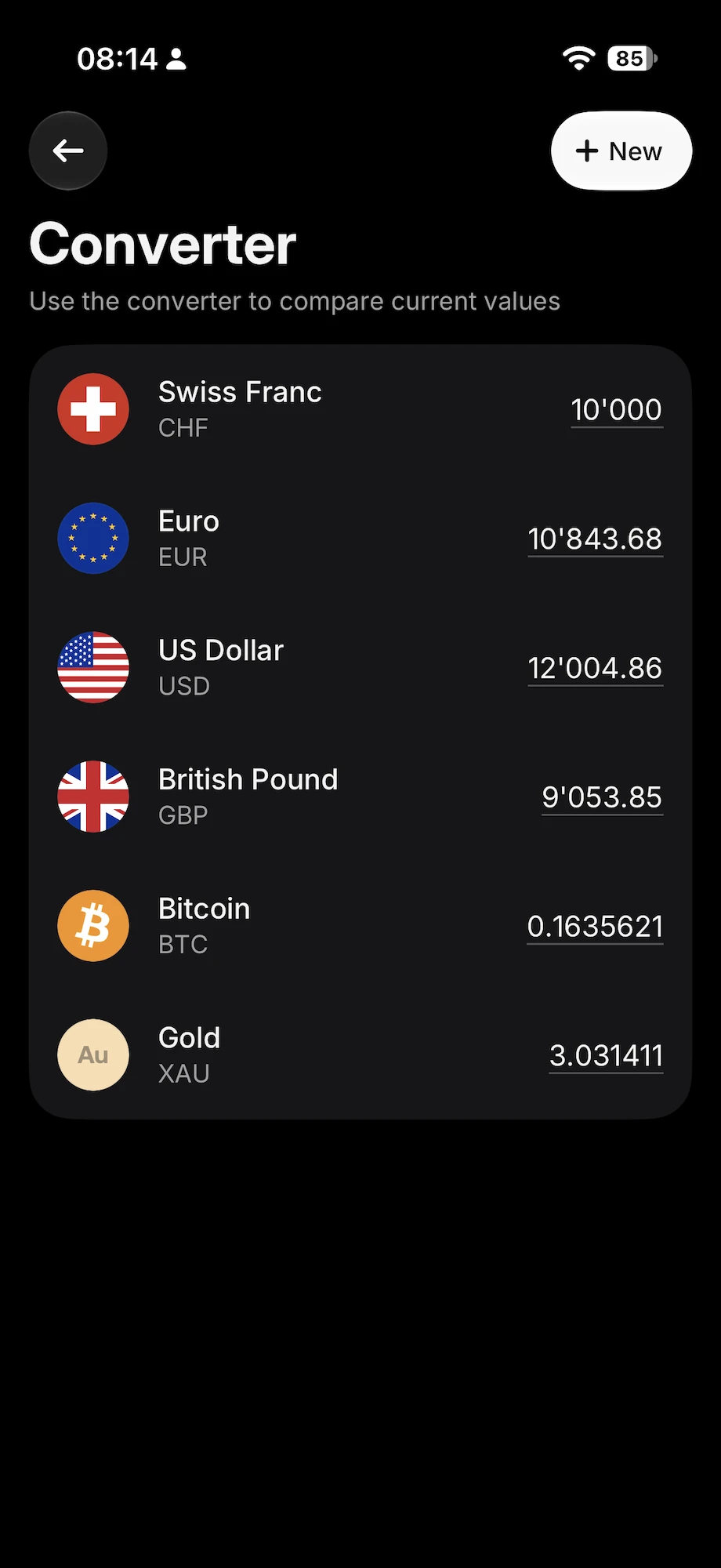
The Converter in the Revolut app, which shows me 10'843.68€ for CHF 10'000 without taking the fees into account
My verdict is simple: if you convert less than CHF 1'250 per month, and on weekdays, Revolut costs you a tiny bit less. And as soon as you go over this limit, or you convert on the weekend, Wise wins (with all the transparency they’re known for).
Wise vs neon
neon isn’t as good as Wise for transfers abroad in foreign currencies, for the simple reason that they use the Wise service built into the neon app. And they charge you convenience fees.
Having been a neon customer, I admit I miss this feature, because it saved you the step of having to transfer your money to Wise, and then to your final recipient. As neon puts it very well, it’s about convenience. And the few fees it costs (between 0.8% and 1.7% of the amount in total, Wise fees included, depending on the amount and the currency) made me use it a few times, since I needed it once or twice a year.
But if you don’t use neon as your main bank, you don’t have access to this currency transfer feature, obviously.
So my recommendation if you’re a neon user is that the Wise integration is worth it if you only make transfers up to CHF 1'000 per year, which will cost you between CHF 8 and CHF 17, versus CHF 3.50 if you go directly through Wise. For heavier use, I’d personally choose to go directly through Wise, even if it takes a bit more effort.
Oh, and also: neon doesn’t offer a multi-currency account. On this point, Wise is naturally better than neon, because it’s the core of its product.
Wise vs Yuh
Yuh offers a multi-currency account just like Wise. However, Yuh’s conversion fees (exchange rate markup of 0.95%) are higher than Wise’s (no markup on the exchange rate).
On the other hand, with Yuh, if you already hold EUR, it’s free to transfer them abroad as long as you stay in the SEPA zone (“Single Euro Payments Area”). Whereas with Wise you pay between CHF 0.50 and CHF 2 in fees.
Outside the SEPA zone, and therefore for any currency other than EUR, Wise is a better deal than Yuh (because the latter charges you a fee of CHF 4 + CHF 10 to CHF 50 in potential SWIFT fees).
Finally, Wise offers you more than 40 currencies, while Yuh sticks to the most used ones in Switzerland (13 currencies only).
My verdict is a bit like for neon: if you make one or two transfers in a foreign currency per year, it costs you a bit more to use only Yuh, but you only have one Swiss bank account to manage. However, as soon as you use this feature more regularly, I recommend using Wise to pay less in fees.
Wise vs Interactive Brokers
Interactive Brokers is THE best financial service out there in terms of fees for currency conversion. It beats everyone, including Wise.
But there are two points that qualify this ranking:
- With IBKR, a sequence such as “transfer to IBKR + settlement of the transaction + currency conversion + transfer to your account in the foreign currency” can take several days (compared to a few hours on Wise)
- You can make transfers from your IBKR account only to another account in your name (and not to a third party)
So, for a few francs more in fees at Wise, I prefer to use Wise for my currency exchange transactions below CHF 10'000. It’s faster and more convenient, especially when it’s to send money to a third party.
Above CHF 10'000, the fee gap widens in favor of IBKR. To convert CHF 10'000 to EUR, you receive about 21€ more with IBKR than with Wise. For CHF 100'000, it’s about 150€ more, and for CHF 500'000, about 500€ more. So I go to a bit more trouble by doing it this way: my CHF account > IBKR > currency exchange > send the currency to my Wise account > transfer to the third party.
You’ll find more details on Wise vs IBKR in this article: How to transfer large amounts of money abroad cheaply from Switzerland.
Wise vs b-sharpe
Wise is cheaper than b-sharpe in all my tests up to CHF 500'000 (and even above that, Wise stays ahead of b-sharpe in some currencies).
From CHF 100'000, b-sharpe starts to be competitive, with spreads that bring the conversion fees down, but it still doesn’t beat Wise. But the larger your amount gets, the more b-sharpe can be a good candidate (and move ahead of Wise above CHF 500'000).
But what really makes the difference when I talk with readers is that b-sharpe is based in Switzerland. So, if this point is very important to you, then b-sharpe wins, as they’re based in Geneva.
Wise vs your traditional Swiss bank
I kind of added this one as a joke, because Wise beats every traditional Swiss bank I know. Whether it’s on exchange fees (above all!), or on speed and convenience.
For small amounts (less than CHF 10'000 to 20'000), we’re talking about 2-3% more in fees for traditional banks compared to Wise, according to my comparison for large transfers. And about 1% more in fees for the larger amounts.
So for currency exchange, there’s no contest, it’s Wise (and never your classic Swiss bank).
Wise Business vs Revolut Business
When I was looking for my ideal multi-currency account, I first thought of Revolut Business, since I was already a customer of theirs.
And there, it really was a disappointment… At first you fill in the sign-up form, all good. Then came several requests for additional documents to verify the identity and the company. It took ages… until somewhere in the process, I never got an answer again…
That’s what made me choose Wise Business. Where opening my account went smoothly. And I’ve been very happy with their service for several years now.
And when comparing in 2026, I also saw that Revolut Business is much more expensive to start with than Wise Business. With Revolut Business in Switzerland, you have to choose between the Basic (CHF 10/month), Grow (CHF 50/month) and Scale (CHF 150/month) plans. Whereas with Wise Business, you have no monthly fees.
So if you need a multi-currency account for your company in Switzerland, my recommendation is Wise Business every time.
Side note: my bad experience with Revolut Business is starting to get old, as it dates back to before COVID, so if you’ve had new (good or bad) experiences with their service, tell me in the comments section at the end of the article.
How to open a Wise account in Switzerland in 3-5 minutes (max)
As you might expect, it only takes 3 to 5 minutes to open your Wise account.
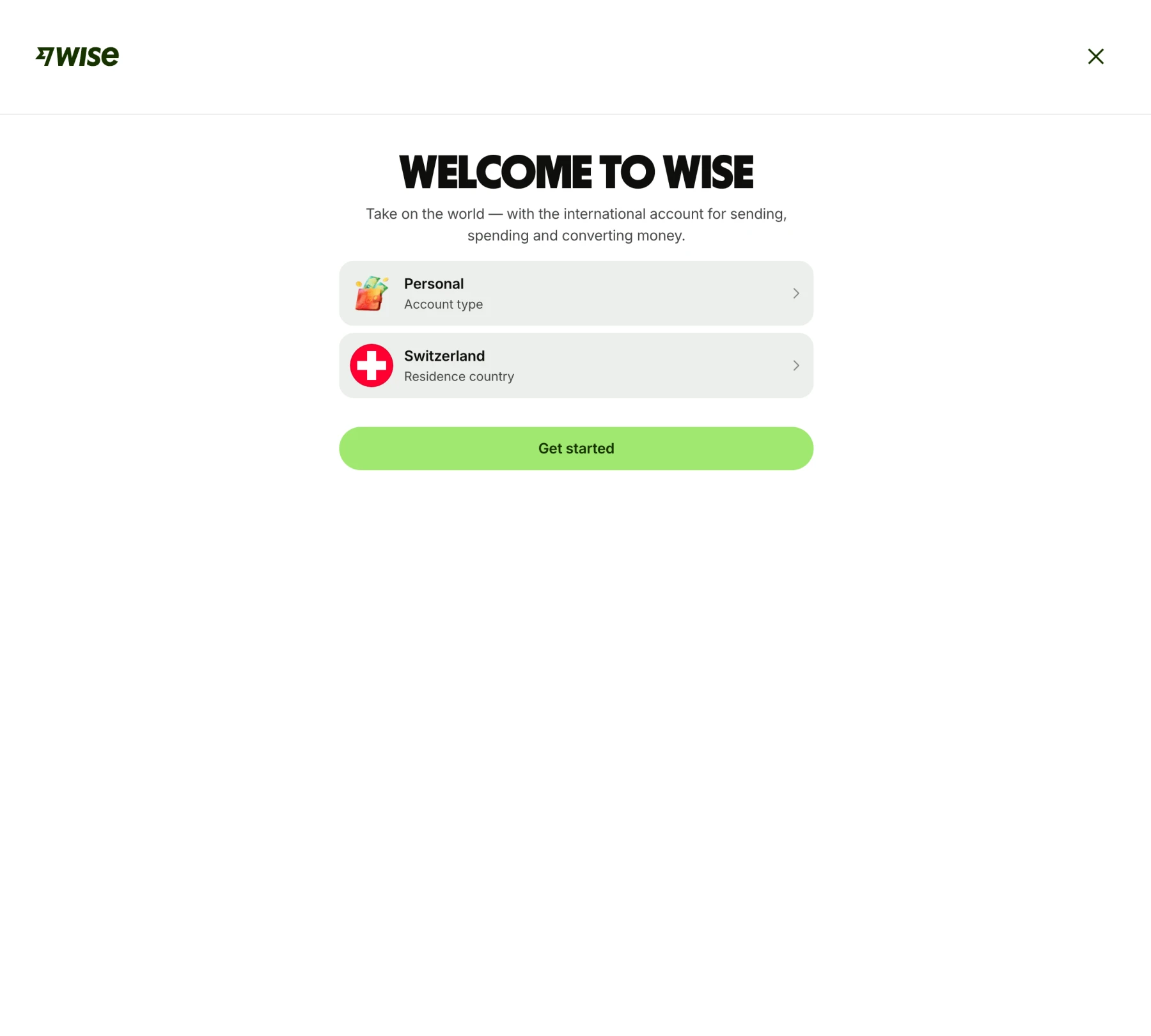
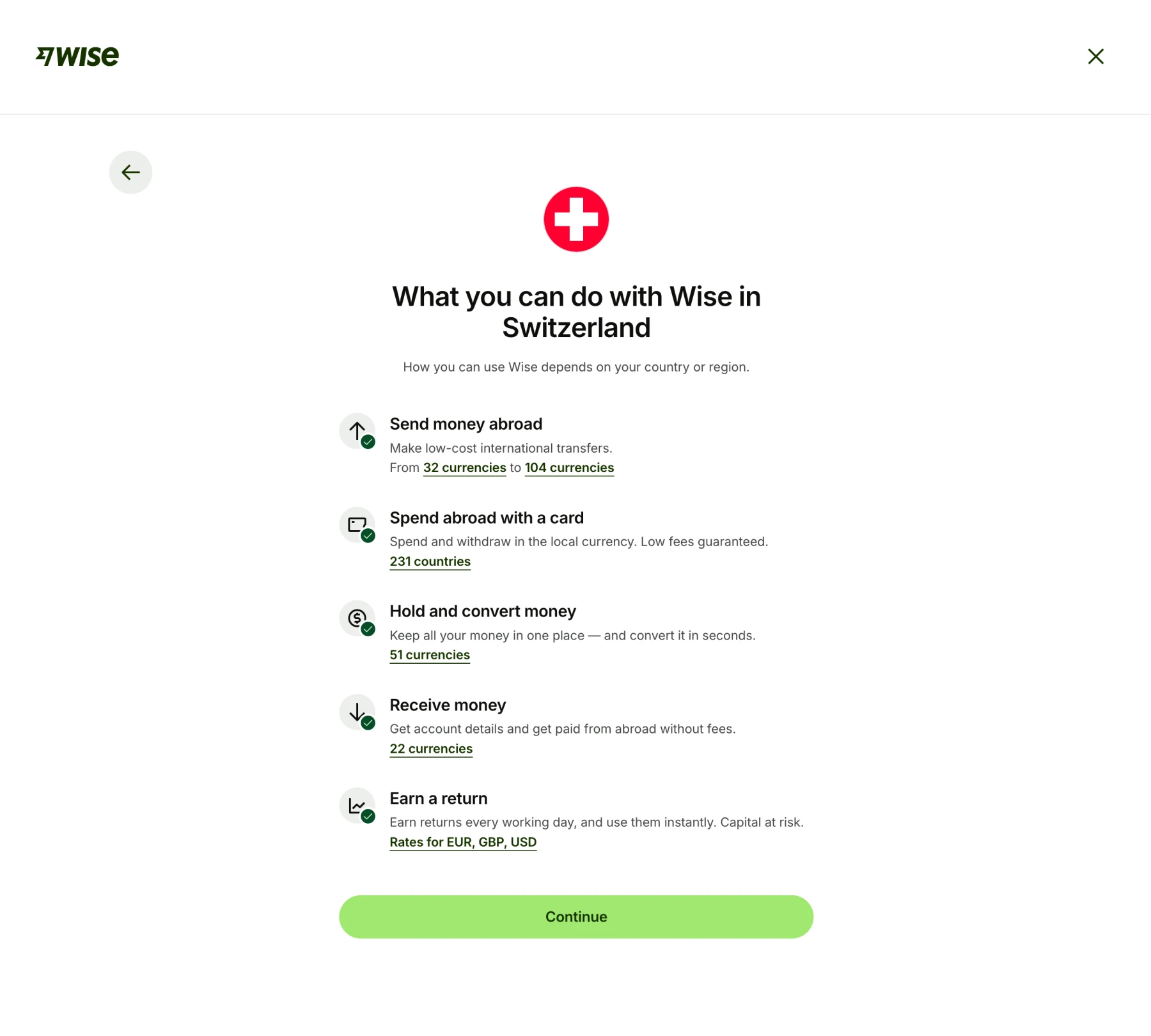
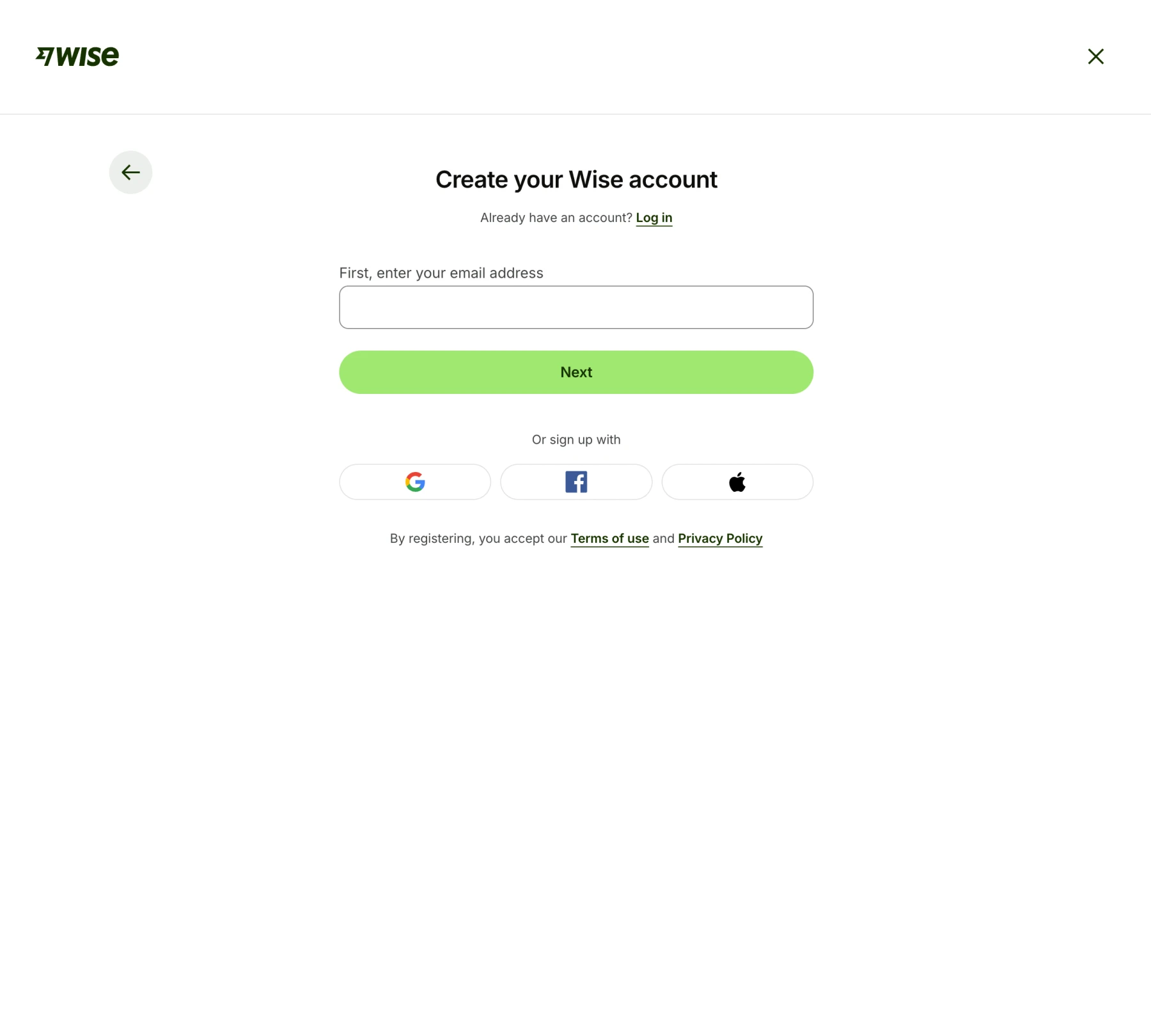
The main steps look like this:
- Go to the Wise homepage and choose between a Wise Personal account or a Wise Business account
- Enter your email address, then confirm it
- Enter your phone number, then confirm it
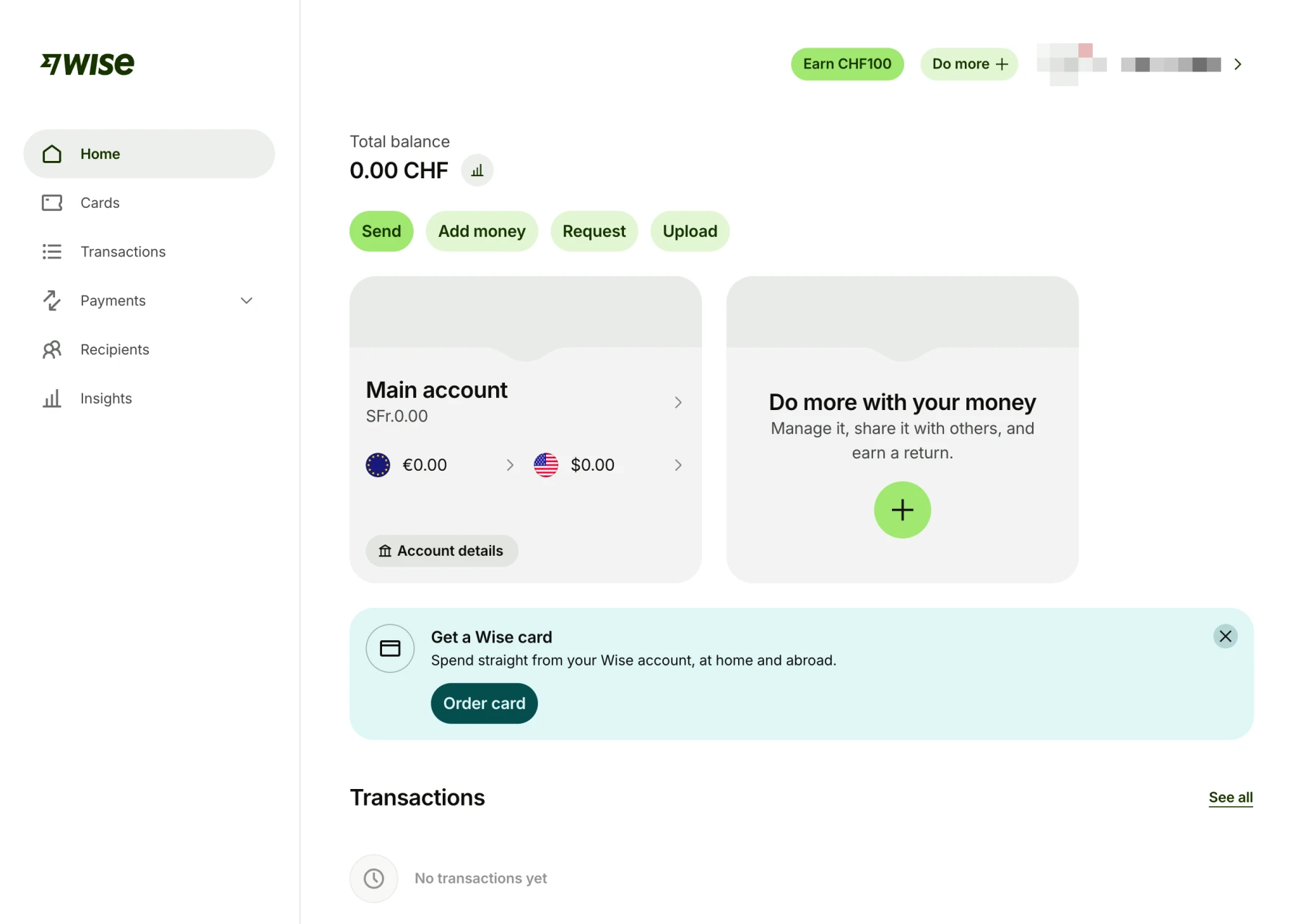
- Your Wise account is created :)
- The identity verification and first deposit part comes next, once your account has been created
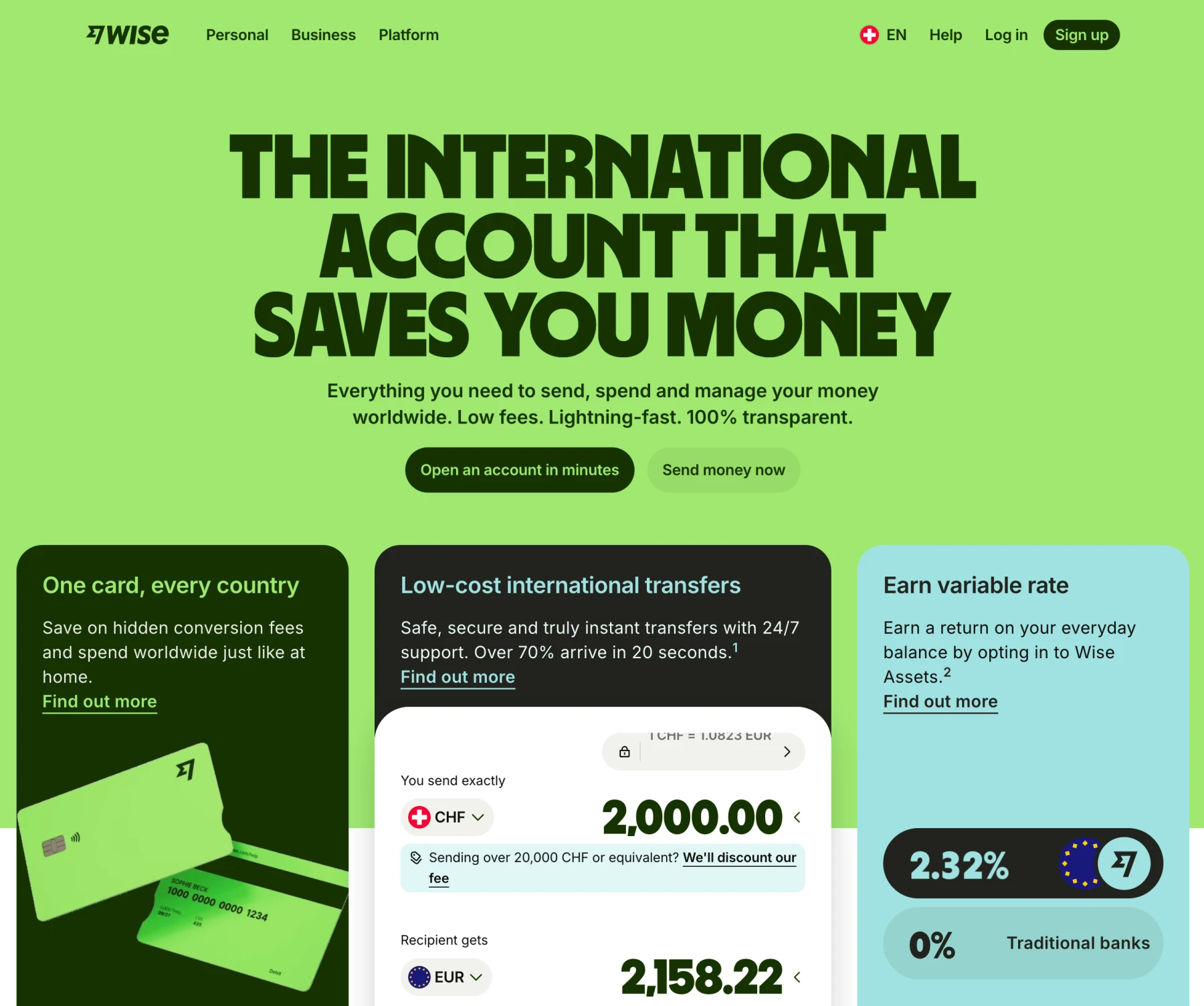
What changes for a Wise Business account
The beginning of the process to open your Wise account is the same, except that you choose “Business” instead of “Personal” on the first screen. Then, three things change.
- The information requested: in addition to yours, Wise wants your company’s, namely its UID number, its activity, its website if it has one, and the identity of the shareholders who hold 25% or more (for anti-money laundering purposes)
- The CHF 55 payment: it’s what starts the verification of your company, and Wise refunds it if the verification doesn’t go through
- The timeframe: it’s counted in days and not in minutes, because Wise verifies your company. For my GmbH, it took 11 days
And by the way, on the accounting side, there’s no direct connection with bexio. So if you use it as a standard account (and not just as a transit account like me), I recommend using the statement exports I mention above.
And just like the personal account, you won’t get a Swiss IBAN.
FAQ about Wise
Does Wise work in Switzerland?
Yes, Wise works in Switzerland. As a Swiss resident, you can open a Wise Personal or Business account, hold CHF in it, and receive your Wise card at home.
On my side, I only use Wise to convert foreign currencies, and to make transfers in foreign currencies to third parties abroad.
Is Wise a bank?
No, Wise isn’t a bank, and even less a Swiss bank. It’s an electronic money institution called Wise Payments Limited, with a license in the United Kingdom issued by the FCA (the British equivalent of FINMA).
In practice, your money at Wise isn’t covered by the Swiss deposit protection of CHF 100'000. Instead, Wise keeps your assets entirely separate from its own, as I explain above in the section about security.
That’s why I only use Wise as a multi-currency transit account, and why I never leave large amounts on it (CHF 2'000 on average).
Does Wise offer a Swiss IBAN?
No, Wise doesn’t offer a Swiss IBAN. The IBAN of your CHF account starts with “GB” and not with “CH”, while Wise gives you local bank details in 22 currencies (EUR, USD, GBP, etc.).
On my side, it has never been a problem. I top up my Wise account in CHF from my Swiss bank account, and I’ve never had an issue.
So as long as you don’t plan to have your salary paid into it or to use it for TWINT, everything works perfectly.
How do I receive money with Wise, and what does it cost?
You receive money with Wise by giving the sender your local account details, and it’s free in 22 currencies (EUR, USD, GBP, etc.). The only exception is a Swift payment, for which Wise takes a fixed fee, for example 2.39€, GBP 2.16 or USD 6.11.
Just keep in mind that your CHF account has no Swiss IBAN, since its IBAN starts with “GB”.
Can Wise block my account?
Yes, like any regulated financial institution, Wise can suspend your account during a compliance check.
Personally, it has never happened to me since 2020, neither personally nor with my Wise Business account. And Wise has never asked me for supporting documents either.
To limit the risk, keep your supporting documents at hand, stay within the law, and plan some extra time if your transfer is really important (like a real estate purchase with tens or hundreds of thousands of CHF to convert).
And if it happened to you, tell me about it in the comments.
What are the disadvantages of Wise?
The disadvantages of Wise for a Swiss resident are the following:
- Not a Swiss bank: your IBAN starts with “GB”, and there’s no TWINT
- No deposit protection: your assets are kept separate from Wise’s, but not covered up to CHF 100'000 like in a Swiss bank
- No joint account: each personal Wise account is individual
- Cash withdrawals: free up to CHF 230 per month, then 2.69% on the amount over the limit
- Large amounts: above CHF 10'000, Interactive Brokers beats Wise on the cost/convenience ratio to convert your currencies
In my real life, none of these points bothers me day to day, since I only use Wise as a multi-currency transit account.
Does Wise have a monthly limit or a weekend surcharge?
No, Wise has neither a monthly exchange limit nor a weekend surcharge. You pay the same fees on a Saturday night as on a Tuesday morning, no matter what you’ve already converted during the month.
That’s one of the big differences with Revolut, which charges you 1% above CHF 1'250 per month with its Standard plan, and another 1% on the weekend!
Can I pay with the Wise card without a balance in the currency?
Yes, you don’t need to have the currency on your Wise account to pay with your card. If you pay in EUR with only CHF on your account, Wise converts on its own at the time of payment, and only charges you its usual exchange fees.
So you pay the same price as if you had converted yourself in the app beforehand (at the exchange rate of the moment).
Personally, I usually convert beforehand, but it’s out of habit and not to do “currency market timing”, because nobody can predict exchange rate fluctuations.
Is the Wise card a good travel card?
For my personal spending, the Wise card isn’t the travel card I use, because I already have my Bank WIR card for payments at the interbank rate.
So personally, I really only use Wise when I need to convert currencies and then transfer them. If it’s just to pay for something by card, I use Bank WIR (here’s my detailed Bank WIR review).
Does Wise offer a joint account?
No, Wise doesn’t offer a joint account in Switzerland. Each personal Wise account has a single holder.
And if you’re looking for a real joint account, I compare the options in my article on the best joint account in Switzerland.
Does Wise work with TWINT?
No, Wise doesn’t work with TWINT. There’s no Wise TWINT app, and you can’t link your Wise account to TWINT.
Personally, I use TWINT via my main bank (Bank WIR), and I keep Wise on the side for everything related to foreign currencies.
From what amount is IBKR a better deal than Wise?
IBKR becomes a better deal than Wise from CHF 10'000 (that’s my personal threshold). Below that, I use Wise, because the difference in fees isn’t worth the days of waiting and the extra steps at Interactive Brokers. Above that, I go through IBKR, because the savings become really worthwhile.
Just keep in mind that IBKR can only send your money to an account in your name. So to pay a third party, I convert at IBKR, then I send my currencies to Wise for the final transfer.
I detail all of this in my article on how to transfer large amounts of money abroad from Switzerland.
Conclusion of my Wise review
I’ve now been using Wise for six years, and I’m really very happy with it. It’s transparent and fair on fees, and the quality of service is always top-notch!
Personally as well as for business with Wise Business, it’s my solution to convert and send foreign currencies up to CHF 10'000. Above that, I go through Interactive Brokers.
I’m not sure Wise should become a real Swiss bank, with a CH IBAN and TWINT. When I look at Yuh, which took this path, its exchange fees are less competitive than Wise’s, probably because of all the costs that come with being a real bank. So I’d rather Wise stick to their current, successful product strategy (for us users).
What about you, do you use Wise or another solution for your currencies? (you can reply in the comments section below)