
It’s been a while since anything changed (or made me question) my stock portfolio… But it’s good for the “analyst” side of my brain, because it had truly become routine for years with my beloved VT ETF!
Vanguard’s announcement of new Irish-domiciled ETFs in summer 2026 directly impacted my stock portfolio as a Swiss investor.
As usual, I’ll skip the technical jargon and keep this as clear as possible. But let me know in the comments if you have questions, because “there’s no such thing as a stupid question”, as they say.
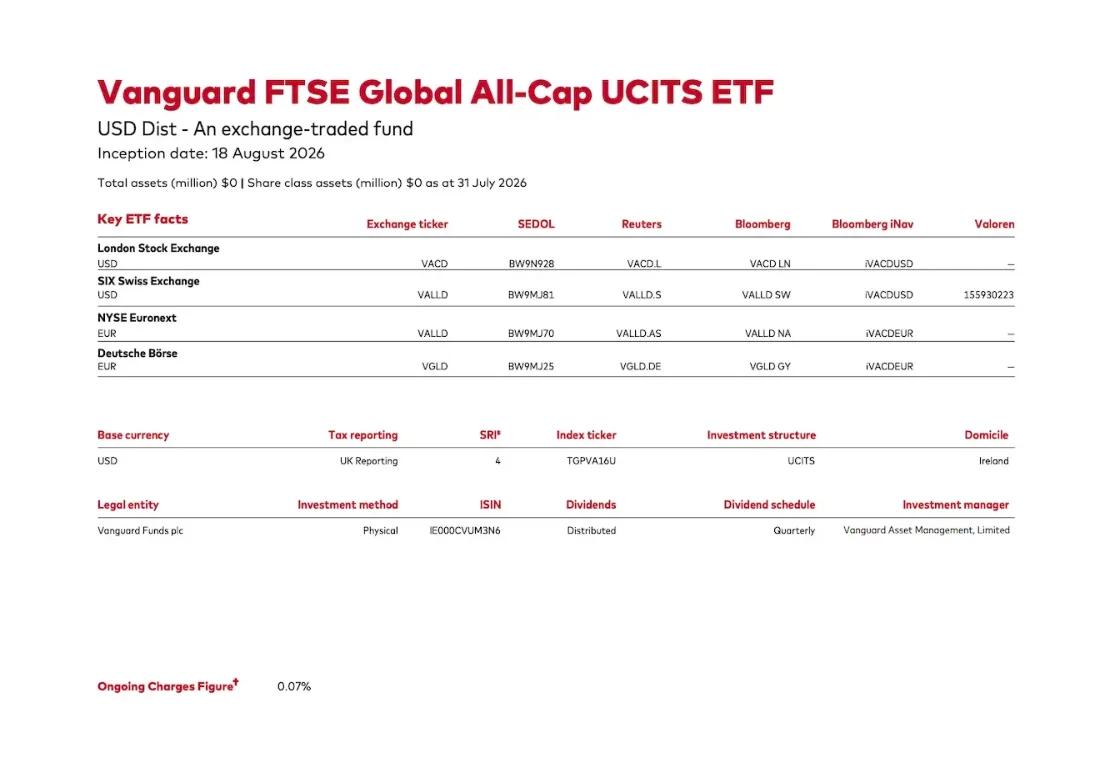
Vanguard’s new VALLD and VALL ETFs enter the picture
Vanguard launched six new ETFs on European soil (and therefore directly accessible to us as investors in Switzerland):
| ETF | What does it cover? | Distribution | ISIN |
|---|---|---|---|
| Vanguard FTSE Global All-Cap UCITS ETF USD Dist (VALLD) | The whole world (large, mid, and small caps) | Distributing | IE000CVUM3N6 |
| Vanguard FTSE Global All-Cap UCITS ETF USD Acc (VALL) | The whole world (large, mid, and small caps) | Accumulating | IE000VAHT5T0 |
| Vanguard FTSE Global Small-Cap UCITS ETF USD Dist (VGSD) | Small caps worldwide | Distributing | IE000F8RXD33 |
| Vanguard FTSE Global Small-Cap UCITS ETF USD Acc (VSML) | Small caps worldwide | Accumulating | IE0007TPRF31 |
| Vanguard FTSE All-World ex-U.S. UCITS ETF USD Dist (VXUD) | The whole world excluding the US | Distributing | IE000G1H7OC0 |
| Vanguard FTSE All-World ex-U.S. UCITS ETF USD Acc (VXUS) | The whole world excluding the US | Accumulating | IE0009A5ADV9 |
As you can see, each ETF comes in two versions: accumulating (meaning dividends are automatically reinvested into the ETF), and distributing (meaning you receive the dividends in cash, and decide what to do with them).
The two ETFs that matter to us as Mustachians are VALLD and VALL. They’re the only two that cover the entire global stock market, small caps included.
We’ll ignore the other four, since they only track small caps (VGSD and VSML) or the world excluding the US (VXUD and VXUS). Neither index is diversified enough for what we’re looking for as Mustachian investors.
Personally, VALLD is the one I favor, and I’ll explain exactly why throughout this article.
And if you’ve been following me for a while (or went through my program to learn how to invest in the stock market in Switzerland, actually understanding what you’re doing!), you’re probably wondering why Vanguard released VALLD and VALL, when they already offer the famous VT ETF, which also covers the whole world (small caps included).
Difference between the VT, VALLD, and VALL ETFs
VT, VALLD, and VALL all track the exact same index: the “FTSE Global All Cap” index, which contains roughly 10,000 companies (large, mid, and small caps).
That said, VT has one small difference compared to its VALLD and VALL siblings. VT’s TER (Total Expense Ratio) is 0.06%, while VALL and VALLD both charge 0.07%.
And the other, bigger difference (for us as Swiss investors) between VT and these two newer ETFs lies in their domicile:
| ETF | Domicile |
|---|---|
| Vanguard FTSE Global All-Cap UCITS ETF (VALLD/VALL) | Ireland |
| Vanguard Total World Stock ETF (VT) | United States |
And domicile determines who’s actually allowed to invest using these vehicles.
VT vs. VALLD / VALL: which broker do you need to access them?
Within the European Union, VT isn’t available for purchase through European brokers. But Switzerland isn’t part of the EU. That gives us access to it, as long as the broker we use actually bothers to make that distinction: “the EU doesn’t include Switzerland”.

As a reminder, as a Switzerland-based investor, I recommend using one of these three brokers (in order of preference, see the full comparison in Best broker in Switzerland (2026 comparison)):
Interactive Brokers is a US broker, and lets its Swiss clients buy and sell VT. Same goes for Swiss broker Saxo Bank.
DEGIRO, on the other hand, won’t let you buy VT…
So here’s the situation in a nutshell:
- If you invest with Interactive Brokers or Saxo Bank: go with VT, since it charges 0.01% less
- If you invest with DEGIRO: go with VALLD (rather than VWRL, which is less diversified and more expensive, more on that below)
So Vanguard released these new, Europe-accessible ETFs based in Ireland specifically to fill that gap left by VT being off-limits to European investors.
But, because there’s always a “but”… there’s also the tax question to cover for us little Swiss investors…
VT vs. VALLD / VALL: which one wins on taxes (for a Swiss resident)?
As we saw above, VT still wins on fees.
Except VT is US-domiciled, while VALLD (and VALL) are based in Ireland.
And that directly affects the withholding tax on the dividends such an ETF pays you.
The common mistake is assuming you pay less withholding tax on Ireland-based ETFs compared to US-based ones, and that Irish ETFs are therefore the most tax-efficient choice for a Swiss investor.
That’s true, in theory.
But the issue is that the US makes up a huge chunk of our world ETF. And if you invest in those companies through an Irish ETF, you lose the ability to reclaim the US withholding tax.
So as long as the US makes up more than 50-60% of our world index (in other words, as long as the US remains the world’s top economic power), US-based ETFs will keep winning on taxes for a Swiss investor.
You’ll find more details and examples in these two articles:
All that to say: VT still wins on this front compared to VALLD (and VALL).
Easy (or not… but hey, things are starting to get clearer).
But we’re not done yet… because let’s be honest, this blog would be a lot less fun without transatlantic estate tax law!
VT vs. VALLD / VALL: how does estate tax work?
VT is based in the United States.
So if you pass away, US law will apply to any US-based securities in your estate, including our beloved VT.
I actually looked into all of this back when I started investing, and I thought it meant that above USD 60,000 invested in VT, you’d get hit with a 40% US estate tax. That turned out to be wrong. I checked with a lawyer, and you can actually go much higher than that. Full details in this article: US-Switzerland estate tax treaty, the VT ETF explained.
What is true, though, based on estate settlement stories I’ve read from VT holders, is that it can take months, sometimes 1 to 3 years, to unfreeze US-based assets so the surviving spouse can access what’s rightfully theirs.
And that’s exactly where VALLD (or VALL) becomes more appealing for us as Swiss investors, compared to the US-based VT. Ireland doesn’t levy any estate tax if you live outside Ireland, so there’s no administrative headache.
VT vs. VALLD / VALL: what should you actually pick?
Taking everything above into account (fees, domicile, taxes, and estate planning), here’s the mental model I use to pick my world ETF as a Swiss resident:
You’re not married or in a relationship:
- And your heirs won’t need their inheritance for 1 to 3 years: go 100% VT
- Otherwise, use the mental model below
Mental model when a survivor needs the deceased’s wealth:
- You’re still in the accumulation phase, both partners are working, and if one passes away, the other can live off their job while the estate gets settled (1 to 3 years): go 100% VT
- You’re already FI (living off your wealth): be conservative and assume estate settlement with the IRS (the US tax authority) takes 3 years, then do this:
- Keep one year (or two, if that helps you sleep better) of annual spending in cash in a standard Swiss bank account, so you have quick access to liquid funds
- Move the equivalent of 2 years of annual spending into VALLD at Saxo Bank
- Keep the rest of your wealth invested in VT through Interactive Brokers
- And of course: if your partner doesn’t need cash because they have income from work, they can stay 100% VT
- Special case: if your partner is completely uncomfortable with the idea of handling part of the estate in English, dealing with US entities like the IRS or Interactive Brokers (IBKR), it’s worth considering putting 100% of your assets in VALLD with Swiss broker Saxo
What are we doing in the MP family?
During this final stretch of building wealth toward our financial independence goal in Switzerland, we’re sticking with our favorite US broker, Interactive Brokers, for now, with 100% of our assets in VT.
As soon as we’re FI, we’ll switch to keeping 1 year of annual spending in cash, and 2 years of annual spending in VALLD at Swiss broker Saxo.
That way, if either me or Mrs. MP were to pass away suddenly, the surviving spouse wouldn’t have to go find a job to cover expenses while the IRS bureaucracy takes 1 to 3 years to settle the estate.
Assuming we spend CHF 100,000 a year, we’d want CHF 100,000 in cash, and CHF 200,000 in VALLD at Saxo.
But all this comes at a cost, since it’s not the optimal setup (that would be staying 100% VT). This safety net for accessing our assets once financially independent will cost us extra each year:
- TER difference between VT and VALLD: CHF 20/year (0.01% of CHF 200,000)
- Non-recoverable US withholding tax on VALLD dividends: CHF 258/year
- (this comes from the 15% withholding on the US portion of dividends, versus 0% loss with VT, since it’s recoverable through the DA-1 form, provided your DA-1 cap isn’t reduced, or even at zero: Partial DA-1 refund? The 2 reasons (threshold and cap))
- Total: CHF 278/year
There are worse insurance premiums to pay for guaranteed access to part of your funds, so you can keep living your financial independence in Switzerland with peace of mind.
The distributing version (VALLD) is even smaller (a few million dollars under management), so this liquidity risk is even more pronounced. The bid-ask spread (the gap between the buy and sell price) is likely a bit wider than on an established ETF like VT. In plain terms, that means when you buy, you pay a tiny bit more than the ETF's "fair" price, and when you sell, you get a tiny bit less than that same price. It's a hidden cost on top of the usual brokerage fees, and it stays minor as long as you're not buying/selling too often.
But my belief is that Vanguard is playing the long game with these two ETFs (like it does with all its other products), and that they'll become the go-to choice for European investors in the years ahead. That's a bet, not a certainty, so it's up to you to decide if you're comfortable with that.
VWRL or VALLD (for a DEGIRO investor)?
If you use DEGIRO, this question is bound to come up:
So what do I do, stick with my VWRL ETF, or switch to VALLD?
The answer: VALLD is the better choice over VWRL, since it’s far more diversified (roughly 10,000 companies for VALLD versus 3,800 for VWRL) and cheaper (0.07% TER for VALLD, versus 0.14% for VWRL).
So if you prefer DEGIRO since it’s a European broker rather than an American one, I’d recommend VALLD as your world ETF over VWRL (less diversified and more expensive, as we saw above).
Bottom line: VT, VWRL, VALLD, or VALL?
Here’s a table summarizing all the key attributes of these four ETFs, along with my recommendation for each:
| Criteria | VT | VALLD (Dist) | VALL (Acc) | VWRL |
|---|---|---|---|---|
| Domicile | United States | Ireland | Ireland | Ireland |
| Index tracked | FTSE Global All Cap | FTSE Global All Cap | FTSE Global All Cap | FTSE All-World |
| Number of companies | ~10,000 | ~10,000 | ~10,000 | ~3,800 |
| Small caps included | Yes | Yes | Yes | No |
| TER | 0.06% | 0.07% | 0.07% | 0.14% |
| Distribution | Distributing | Distributing | Accumulating | Distributing |
| Available on DEGIRO | No | Yes | Yes | Yes |
| US withholding tax on US dividends | 15%, recoverable (DA-1) | 15%, lost | 15%, lost | 15%, lost |
| US estate tax applicable | Yes | No | No | No |
| MP recommendation | During the accumulation phase, via IBKR or Saxo | Once FI, my choice for 2x our annual spending | Fine tax-wise (already listed on ICTax), but no direct dividends once FI | Not recommended (less diversified and more expensive), replaced by VALLD/VALL |
FAQ: VT, VWRL, or VALLD ETF
What does UCITS mean?
It stands for “Undertakings for the Collective Investment in Transferable Securities”: a set of rules created by the European Union to regulate the management, sale, and operations of mutual funds and ETFs.
So when you see “UCITS” on an ETF’s fact sheet, it means it’s domiciled in Europe, and that you can access it as a Swiss investor.
Is estate tax based on your broker’s domicile, or the fund’s/ETF’s?
Estate tax depends on the ETF’s domicile, not the broker’s. The broker’s domicile has no impact, except maybe that if it’s a foreign broker, you’ll need to handle the estate process in its language (like English with Interactive Brokers).
VALL, VGLA, VALU, VALLD, VGLD, or VACD?
These tickers represent two distinct ETFs (i.e., with two different ISINs), each listed under 3 different tickers depending on the exchange:
- VALL (ISIN IE000VAHT5T0) trades under the tickers VALL, VGLA, or VALU;
- VALLD (ISIN IE000CVUM3N6) trades under the tickers VALLD, VGLD, or VACD.
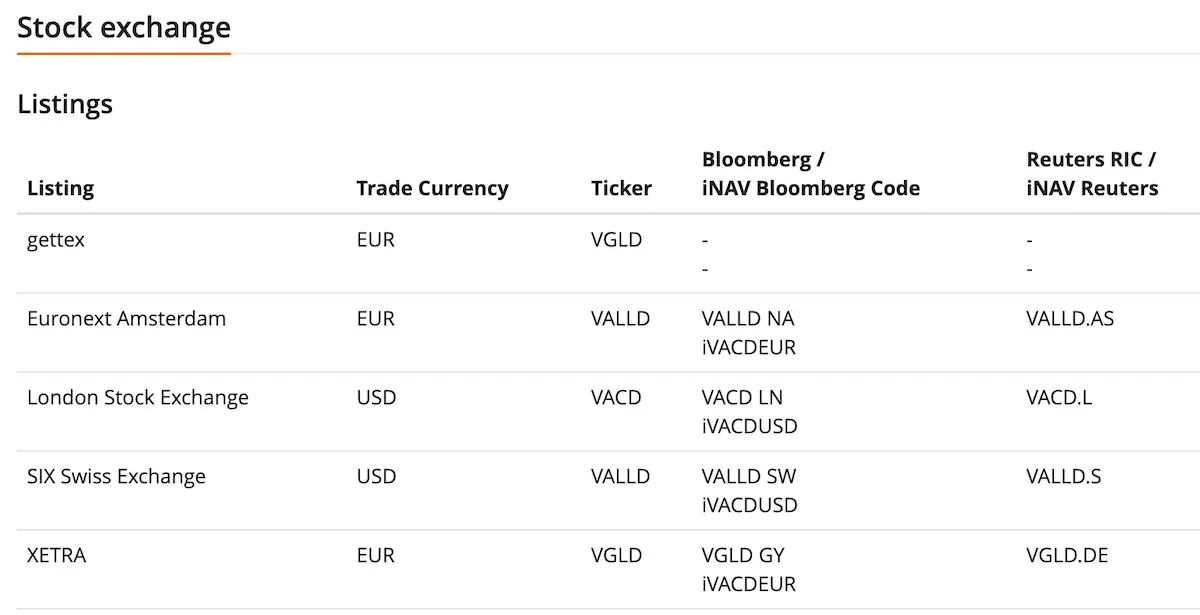
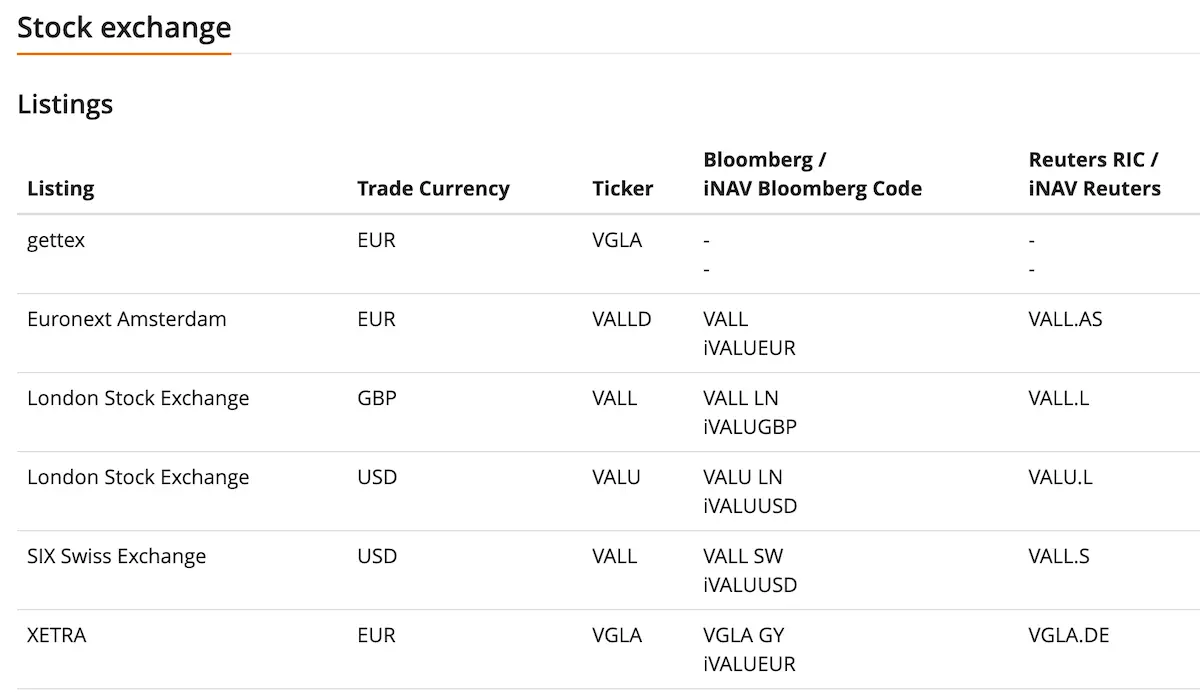
No matter which ticker you pick for a given ETF, you end up with the exact same instrument.
Personally, I use VALLD (traded in USD on SIX Swiss Exchange), since my VT dividends are already in USD, so this avoids an unnecessary currency conversion. I’ll explain the real reasoning behind this choice right below.
Quick note: be careful if you’re buying VALLD on the Amsterdam exchange, since justETF’s site shows the same ticker for two different ETFs… I think it’s a display bug on their end, since it’s technically impossible for two different ETFs to share the same ticker on the same exchange.
VALL (accumulating) or VALLD (distributing): which one should you pick?
Tax-wise, they’re a wash when it comes to the US withholding tax: the 15% loss on US dividends is identical for VALL and VALLD, no matter which one you pick.
On the ICTax front (the official site of the Swiss Federal Tax Administration), both ETFs are fine: VALL is listed, and VALLD doesn’t need to be anyway, since you simply declare the dividends you actually receive.
The real reason behind my choice is different: I’ll only hold VALLD once I’m FI, not before (see my mental model above). And at that point, I’ll need cash to live on. Ideally, I’d rather rely on cash dividends first, without having to manually sell shares.
An accumulating ETF, on the other hand, would force me to sell shares every time I need cash, with the risk of bad timing if the market happens to be down that day. A distributing ETF solves that on its own, as explained in my guide on Swiss dividend tax 2026 for ETFs and stocks.
How do I build my Swiss stock portfolio to become FIRE?
This is a question I get often, whether by email or in the comments of articles like this one.
Answering it properly would take more than a few lines. And it really matters to me that you actually understand what you’re doing, rather than blindly copying the investment strategy I describe here.
Because imagine if my blog disappeared one day, for whatever reason. You’d be stuck not knowing what to do: sell? Hold? What if a new ETF comes out?
That’s why I created my program to teach you how to invest in the Swiss stock market yourself. It’s one of the very few paid things on my blog. Think of it like the old saying: give someone a fish, or teach them to fish. The second option gets you a lifetime of independence.
That’s exactly the goal of my program.
And that’s why this whole article exists to answer just one specific investing question: VT, VALLD, VALL, or VWRL? And in case you skipped straight to the end, here’s the answer for us Mustachians: VT while you’re accumulating your wealth, and VALLD once you’re FI (but only for an amount equal to 2 years of annual spending) ;)