

Whether the “FIRE in Switzerland” milestone is becoming real for you, or you just want to prepare for it, one question comes up a lot for me (I’ve asked myself the same thing):
What happens to each of the 3 pillars once you become financially independent?
As a reminder, if you skipped econ class in high school, or you’re an expat, I’ve written an article detailing the role of each pillar in the Swiss pension system.
So let’s start at the beginning, with the 1st pillar.
What happens to it when you retire at 40 (or any other age before the official retirement age of 65)?
1st pillar (OASI) once you’re FIRE
As a reminder, you have to start contributing to the 1st pillar (whether you have a job or not) from January 1st following your 20th birthday in Switzerland. And if you start working younger, you have to start contributing to OASI at 17.
That money you pay into a shared pot gets paid back to you as an OASI pension once you reach Switzerland’s official retirement age (between CHF 1'260/month minimum and CHF 2'520/month maximum).
Except when you reach a very early retirement at 40, by definition, you haven’t turned 65 yet.
So:
What happens between your FI date and turning 65?
Bad news (for your finances): you’re still required to pay OASI contributions until you turn 65.
Except once you’re FI, you’re considered a person without gainful employment (if you truly have none), so: your contributions are no longer based on a salary, but on your net worth.
Depending on which bracket you fall into, OASI will charge you a fixed amount based on a tiered scale, from CHF 530/year (net worth below CHF 350'000) to CHF 26'500/year (net worth above CHF 8'950'000).
Result: your OASI bill can climb fast, since you’re living off a large net worth once you’ve reached financial freedom. So we’re talking several thousand CHF per year here.
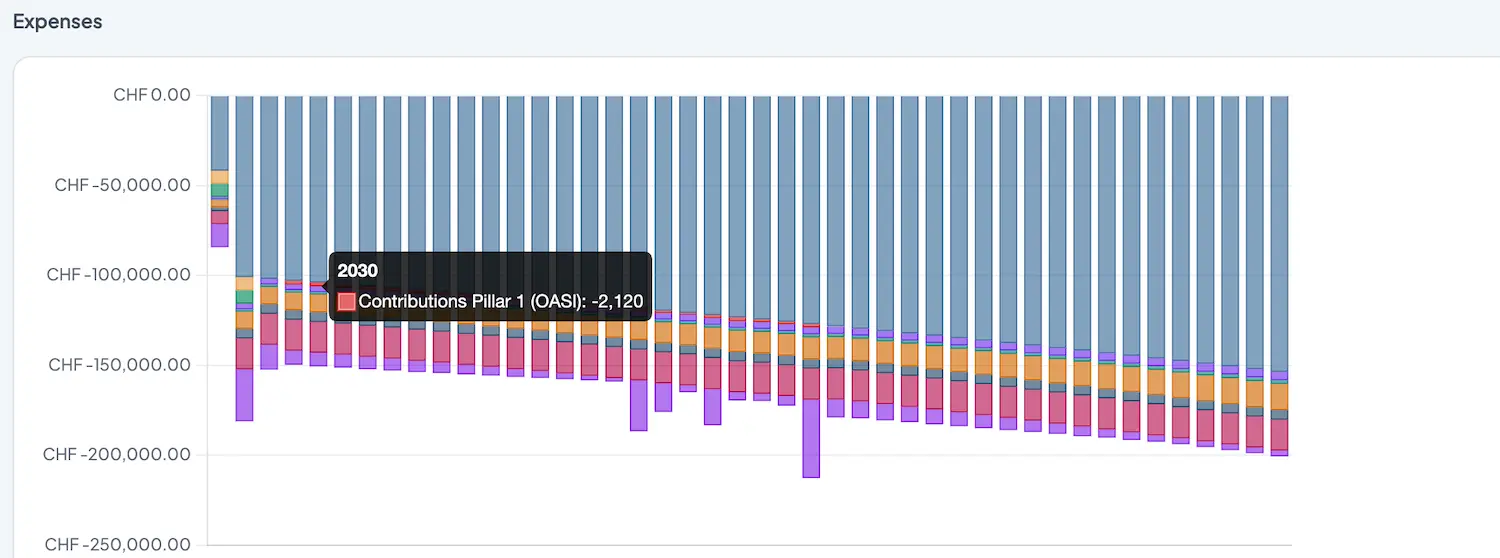
But the (legal!) tax optimization trick is to have a small income from work (a side job), even a modest one, because it lets you be considered active.
And in that case, your OASI contributions are calculated on that income, not on your net worth. That lets you pay minimal contributions, around a few hundred francs a year instead of several thousand.
As of 2026, the ideal tax optimization is to earn:
- At least CHF 2'500/year, so you count as “active” and pay your OASI contributions on your income instead of your net worth
- And at most CHF 10'100, so you only pay the minimum OASI contribution of CHF 530/year
So the smart move once you’re FI is to buy your OASI contributions “at a discount” with a side job.
But there are still some rules you need to follow for the OASI compensation office to consider your activity as genuinely self-employed (and not just a paper scheme to check a box). Here’s what it actually looks at:
- you work in your own name and for your own account
- you take on real economic risk (no guaranteed pay, you can lose money on it)
- you have several clients (ideally at least 3), not a single one calling the shots
- you’re not in a subordinate relationship (nobody dictates your hours, instructions, or presence, no disguised employment)
- your OASI contributions paid on that income (employee + employer share) need to reach at least half of what you’d pay as a non-active person, otherwise OASI still bills you as someone without gainful employment, no matter how much time it takes (art. 28bis OASI regulation)
Also important to know: the OASI compensation office isn’t bound by what the tax authorities say, and can reclassify your side job even if you declare it as self-employed on your tax return. So make sure it’s a real small business, not disguised (and therefore illegal) tax optimization…
You can take this further than a simple side gig in your own name, through a company. That gets a bit more complex, so I wrote a dedicated article about it: OASI contributions after FIRE: how much should I pay?
OASI contributions: a concrete example once you’re FI
Let’s say you’re FI in Switzerland, with CHF 2 million in net worth invested in the stock market.
Here are the two scenarios side by side, showing what you’d pay in OASI contributions depending on whether you’re purely living off your investments, or you have a small paid activity just for fun and without constraints:
| Situation | OASI calculation basis | Approx. annual OASI contribution |
|---|---|---|
| No income (non-active person) | Net worth CHF 2'000'000 => taxable basis ~ CHF 80'000–100'000 | ~ CHF 3'800–4'800/year |
| With a side job of CHF 2'500–10'100/year taking 50% of your time | Work income CHF 2'500–10'100 => considered active | CHF 530/year (minimum OASI contributions) |
The MP family’s real case: OASI
Once we’re FI, we’re going to pay ourselves a salary from one of our corporations to optimize our OASI contributions as much as possible.
It’s a bit more complex to set up than a “simple” small job with a standard salary, but since we already have the infrastructure in place, we’re going to make the most of it.
OASI contributions: once you go from FI to “real” retiree
For this one, once you reach Switzerland’s official retirement age, it becomes very simple:
- You stop paying your contributions
- And you start receiving your OASI pension
And that’s it :)
Next, let’s move on to the 2nd pillar…
2nd pillar once you’re FIRE
When you’re FIRE before the official retirement age, you’re going to leave your employer at some point.
At that point, your 2nd pillar (aka your pension assets) has to be transferred.
But since you no longer have a pension fund tied to a job, your capital goes into what’s called a vested benefits account (or several, to split across two vested benefits accounts for a tax advantage, all perfectly legal).
That said, once you’re FI (even if you’re active as self-employed for your OASI), contributing to the 2nd pillar stays optional. It’s only mandatory for salaried employees.
And since the money in your 2nd pillar is locked until at least age 60 (5 years before the reference age) AND it’s not the best investment in terms of returns, I’d rather recommend you put your savings in the stock market than contribute to it.
The good news, though, is that your vested benefits capital can easily be invested in ETFs these days. I go into detail in this article: Best vested benefits account (2026 comparison).
That said, if you’re financially independent and not yet 60, you still have a few ways to withdraw these funds:
- Buying your primary home (called EPL in official jargon, for “home ownership promotion”). It’s the most common case, and plenty of people use it mid-career to buy. It’s possible both with your vested benefits account and while still salaried.
- Becoming self-employed: if you want to start your own business and need starting capital. A good trick if you want to withdraw your vested benefits all at once before you turn 60. You can no longer be a salaried employee in this case.
- Leaving Switzerland for good: important to know though, if you move to an EU/EFTA country, you can only withdraw the extra-mandatory portion (the minimum mandatory part stays locked in a vested benefits account). And if you move outside the EU/EFTA, you can withdraw everything.
- Disability: if you receive a full disability pension, you can also request early payout of your vested benefits.
The MP family’s real case: 2nd pillar
I see our 2nd pillar pension assets as the conservative part of our investment strategy, so we’re not going to touch it during our FI phase.
And we’ll withdraw it in stages over several years, to optimize our taxes (more on that in an upcoming article). That’s at least how we’ve planned our FIRE finances.
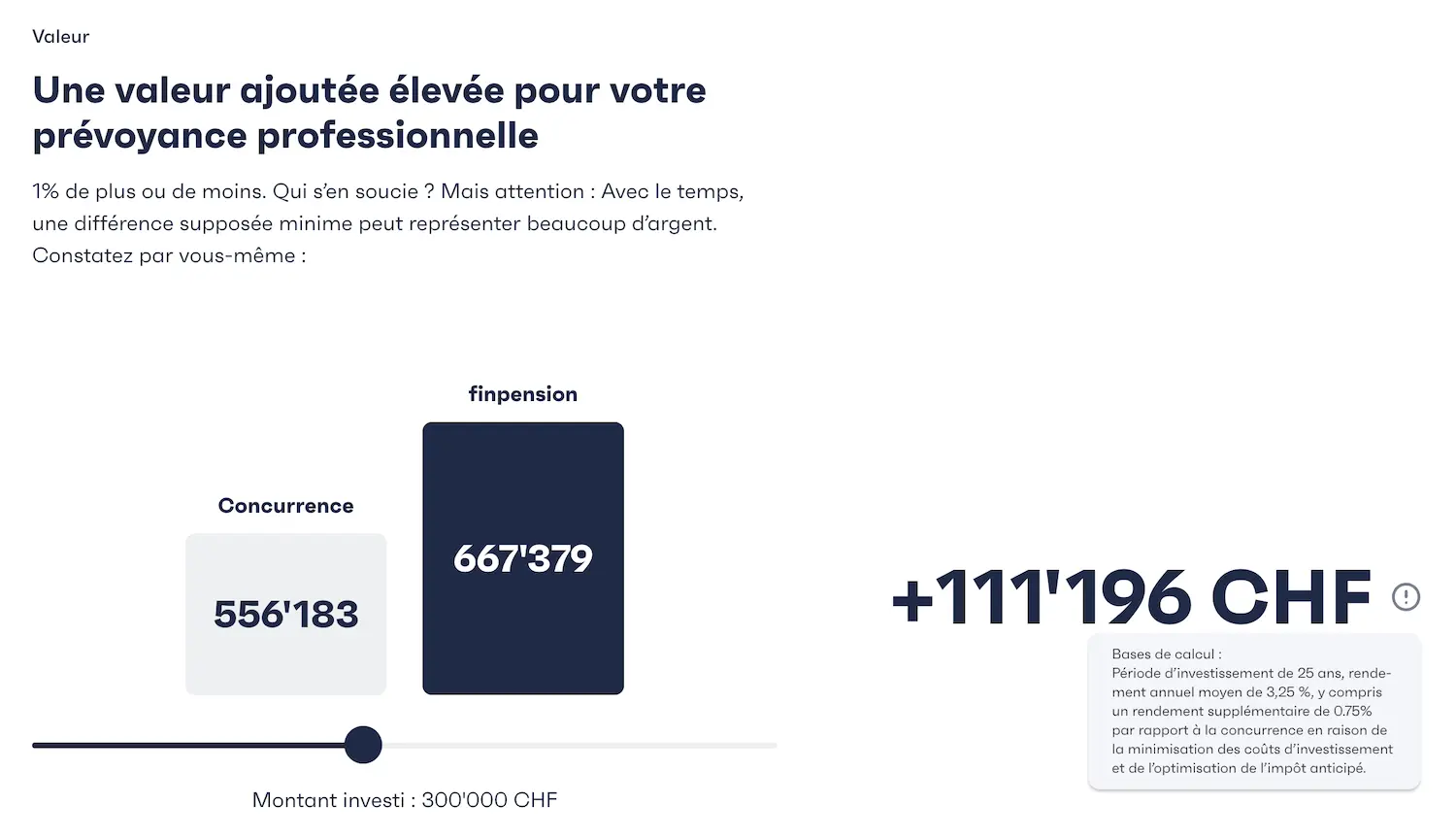
The day I'm FI, finpension will be my choice for a vested benefits account (split across two foundations for maximum tax optimization)
2nd pillar / vested benefits: once you go from FI to “real” retiree
From age 60, i.e. 5 years before the reference retirement age in Switzerland (and at the latest at 65, or 70 if you’re still working), you can withdraw your vested benefits. They get paid out as a lump sum, never as a pension, unless you went through an insurer and its shady products (they can offer a pension, but I’d steer you away from them, as mentioned above).
As for us, we’ll withdraw our capital one vested benefits account after the other (hence the split across two foundations), and invest it in the stock market ourselves, to keep our fees as low as possible.
And finally, let’s move on to the next and last pillar: the famous pillar 3a.
3rd pillar (aka pillar 3a) once you’re FIRE: how does it work?
It’s nice because the further you climb up the pillar order, the simpler it gets.
Once you’re in (very) early retirement, before the reference age in Switzerland, you’re no longer allowed to contribute to the 3rd pillar, since this individual pension plan is reserved for active people with income subject to OASI (whether salaried or self-employed).
And once you’re FIRE, the capital invested in your 3rd pillar stays in your pillar 3a account, invested in whichever financial products you chose to generate a return (I recommend this dedicated article: Best third pillar Switzerland (2026 comparison)).
That said, as you’ve understood, if you’re self-employed to optimize your OASI contributions, then yes, you can keep contributing to a pillar 3a.
The MP family’s real case: pillar 3a
Since we’ll likely keep some activity through our corporation (the more complex setup I document in the other OASI article linked above), we’ll always be able to afford a pillar 3a to optimize our taxes.
But that’s a bonus, and we won’t keep the side activity just for that perk, because our freedom matters way more!
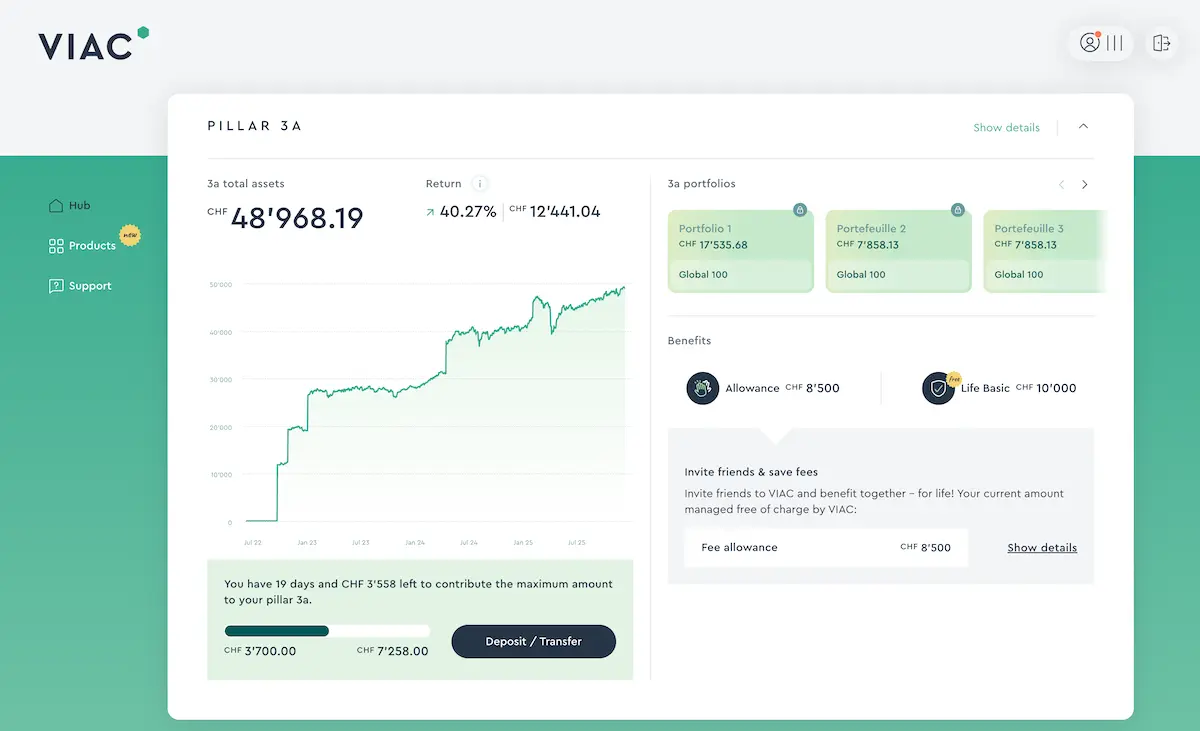
On the 3a foundation side, in addition to finpension (already mentioned for vested benefits), VIAC is also my pick. I recommend both, tied as of today.
Pillar 3a: once you go from FI to “real” retiree
From age 60 (5 years before the reference age), you’re entitled to access the capital saved and invested in your 3rd pillar. You can then do whatever you want with it.
As for us, we’ll withdraw our 3a accounts one by one, staggered over several years to optimize our taxes. And it’ll go straight into our Interactive Brokers brokerage account where we’ll keep growing our savings in the stock market.
And well… that’s about it!
I’ll admit this made things a lot less complicated once I broke down these 3 pillars piece by piece for when I’ll be FI.

Spiez, on the shore of Lake Thun: way more interesting than these Swiss pillar stories, but might as well have a clear mind to enjoy it once the topic is sorted out
Conclusion
To recap the MP family’s situation once we become FI, here’s what we’ll do with each of our pillars the moment we pull the plug on salaried work for good:
| Pillar | What we'll do once FIRE |
|---|---|
| 1st pillar | Keep contributing, since we plan to have personal projects (through our corporation, but it could also be as self-employed) |
| 2nd pillar | Let our capital grow in our vested benefits account (100% invested in stocks, with a 39% overexposure to the Swiss market via finpension's Global 100, which is fine with me since it's the conservative part of our portfolio) |
| 3rd pillar | Keep contributing, putting everything in Global 100 for tax savings |
And you, do you have a different strategy for your 3 pillars once you reach financial freedom?
FAQ: Swiss pillars and FIRE
At what age do I have to start contributing to OASI in Switzerland?
From January 1st following your 20th birthday if you have no gainful employment, or from age 17 if you’re already working. It then runs until the official retirement age (65).
How do I avoid paying OASI on my net worth once I’m FIRE?
By keeping a small side job, earning between CHF 2'500 and 10'100/year, that takes up at least half your time. Your contributions are then calculated on that income, not your net worth.
Is the vested benefits account (2nd pillar) paid out as a pension or a lump sum?
As a lump sum only, never as a pension, unless you go through an insurer and its subpar products (which I’d steer you away from).
At what age can I withdraw my vested benefits and my pillar 3a?
From age 60, i.e. 5 years before the reference retirement age (65). Before that, it’s only possible in the cases provided by law: buying your primary home, becoming self-employed, leaving Switzerland for good, or disability.
Can I still contribute to pillar 3a once I’m FIRE?
Only if you have income subject to OASI, whether as a salaried employee or self-employed. Without that, you can’t contribute to a 3a.