
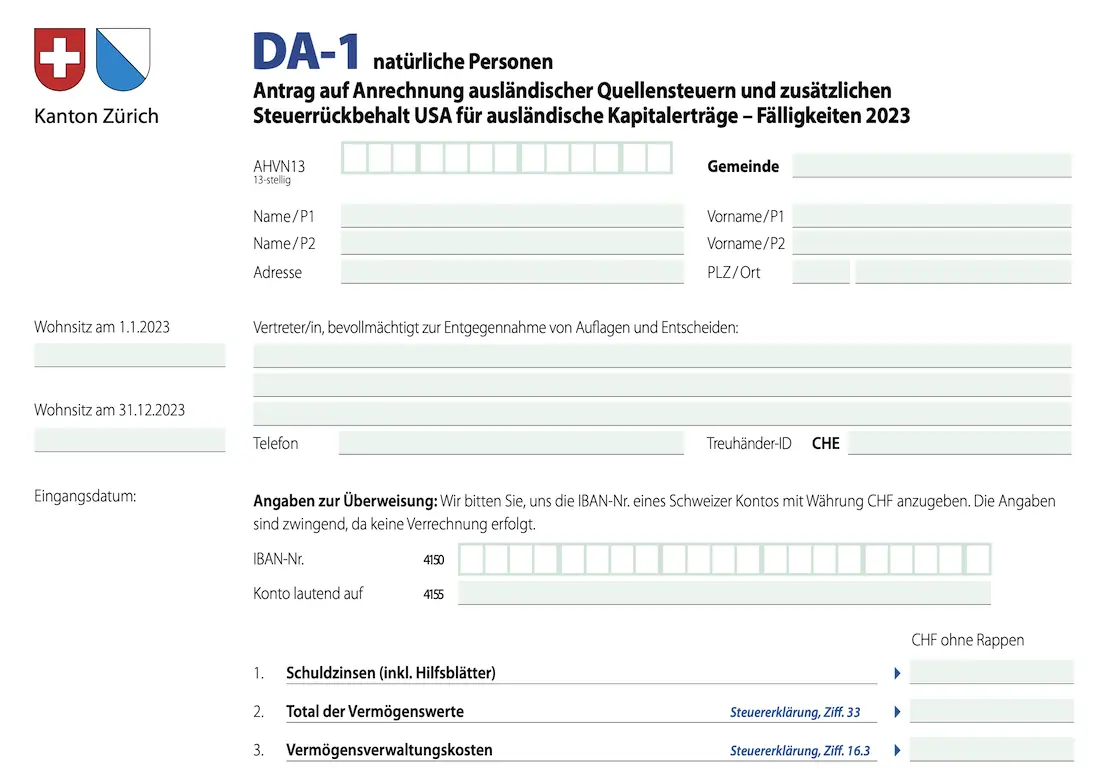
Cedric, a reader, left this comment under my tutorial VaudTax tax return:
Quick follow up as I received my decision today. It went smoothly thanks to your help! They just decided to cut around half my DA-1 reimbursement due to:
“Décision de rejet partiel ou total de votre demande (article 52, al. 3 LIA). Après contrôle de votre demande, nous vous informons que le droit au remboursement est réduit aux montants indiqués plus haut pour les motifs suivants:
Le montant maximum de l’imputation d’impôts étrangers retenus à la source ne peut excéder la somme des impôts suisses frappant les rendements en cause après déduction des intérêts passifs y afférents et des frais liés à leur acquisition (art. 8 à 11 de l’Ordonnance du Conseil fédéral du 22 août 1967 en la matière).”
Needless to say I don’t really understand all that but it doesn’t really matter…
In plain English: the decision partially or fully rejects the claim, because the maximum amount for crediting foreign taxes withheld at source can’t exceed the total Swiss tax on that income, once the related liability interest and acquisition costs are deducted (art. 8 to 11 of the Federal Ordinance of 22 August 1967 on the matter).
Except I got that letter too.
And “doesn’t really matter” is easier said than done: out of the CHF 867 I’d claimed through my DA-1 form, the Vaud tax office only gave me CHF 44.45 back. I filed a complaint, they stood their ground. And the worst part: they were right.
Here’s why it’s “normal”, and what you can do about it.
A partial DA-1 refund happens for one of two reasons: either your foreign taxes don’t exceed CHF 100, or the legal cap applies, and that cap shrinks with your liabilities (mortgage, loans).
The DA-1 form in a nutshell
When you hold foreign ETFs or shares, you get hit with withholding tax abroad (typically 15% on US dividends, see the theory of Swiss and foreign withholding tax). The DA-1 form lets you claim that withholding tax back through your Swiss tax return, to avoid double taxation.
What I hadn’t understood for years: that refund goes through two filters before it lands in your account…
First filter of the DA-1: the CHF 100 threshold
Art. 7 of the Ordinance on the Crediting of Foreign Taxes Withheld at Source is clear:
The crediting of foreign taxes withheld at source is only granted if the non-recoverable withholding taxes from the contracting states, levied on income from those states, exceed the equivalent of 100 francs in total.
(German original, equally authoritative under Swiss federal law: art. 7 of SR 672.201: “Die Anrechnung ausländischer Quellensteuern wird nur gewährt, wenn die nicht rückforderbaren Quellensteuern der Vertragsstaaten von den aus diesen Vertragsstaaten stammenden Erträgen insgesamt den Gegenwert von 100 Franken übersteigen.”)
Below that, you get nothing. Nada.
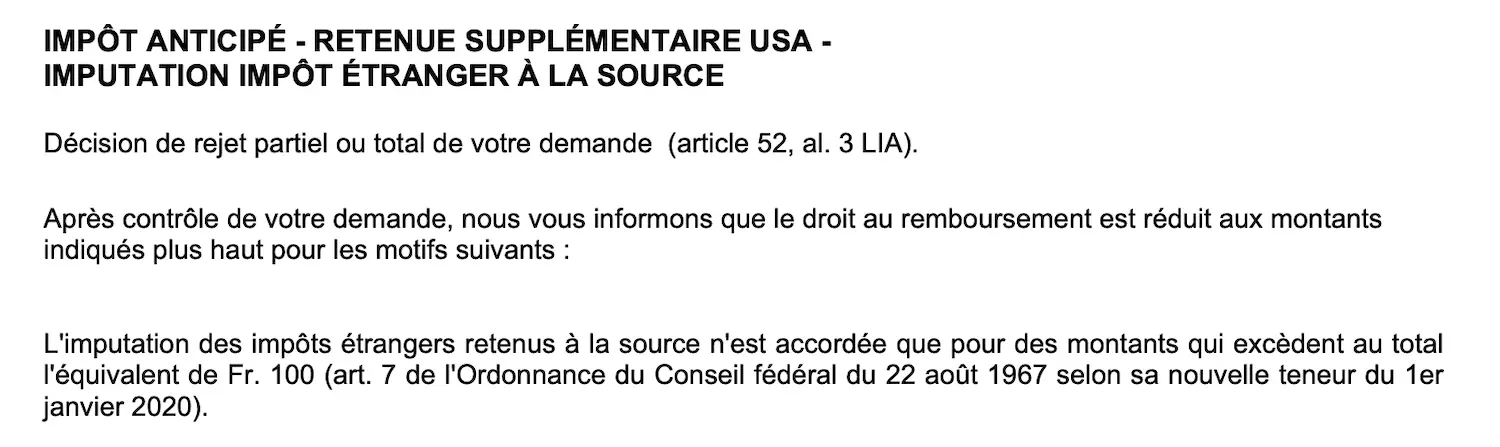
In my case, CHF 867 > CHF 100, so I wasn’t blocked by this filter.
Second filter of the DA-1: the cap (maximum amount)
Then there’s the “maximum amount” (art. 8 para. 2 of the Ordinance): Switzerland never refunds you more than the Swiss tax you’d have paid on those same dividends.
The tax office’s reasoning is actually pretty logical: in Switzerland, tax hits your net income, not your gross income.
So before calculating Swiss tax on your foreign dividends, it deducts costs from them. Art. 11 of the Ordinance says, verbatim:
Pour le calcul du montant maximum, les revenus sont diminués des intérêts passifs, des autres dépenses et des déductions fiscales. […] Les intérêts passifs sont répartis proportionnellement aux actifs.
(German original: art. 11 of SR 672.201: “Für die Berechnung des Maximalbetrags werden die Erträge um die Schuldzinsen, die anderen Aufwendungen und die steuerwirksamen Abzüge gekürzt. […] Die Schuldzinsen werden proportional zu den Aktiven verteilt.”)
In plain English: to calculate the maximum amount, income is reduced by liability interest, other expenses, and tax deductions, and that liability interest is allocated proportionally across your assets.
Concretely, the AFC’s DA-M notice deducts the following from your gross foreign dividends:
- Your liability interest, allocated using the ratio: taxable value of your foreign securities / your total assets. And here’s the catch: the text makes no distinction whatsoever. All your liability interest counts, mortgage interest included, even if your mortgage has nothing to do with your ETFs…
- Your wealth management fees, allocated using the ratio: return on foreign securities / total return on your securities. By default, the AFC allows 5% of your gross dividends, unless you prove a different amount.
All that gives you a net foreign income.
You then apply your Swiss tax rate (federal + cantonal + communal) to that net income.
And that defines your DA-1 refund cap.

The Vaud cantonal tax office's response: liability interest (mortgage interest included) reduces the DA-1 refund amount...
Sounds a bit complicated?
Same here on my first read, don’t worry! But we’re lucky in Switzerland to have a tax administration that’s pretty solid, and it gives us a genuinely useful example.
The AFC’s official example for the DA-1 refund cap
The AFC’s DA-M notice (Merkblatt DA-M), “Notice on the crediting of foreign taxes withheld at source”, describes a taxpayer K, who I’ll call Karl, in the following situation:
- Taxable value of his Dutch shares: CHF 79'300
- Gross Dutch dividend: CHF 2'410
- Total assets (presumably including his house): CHF 860'000
- Liability interest paid during the year (typically a mortgage): CHF 15'000
- Wealth management fees: CHF 1'600
- Total return on his securities (dividends and interest across his whole portfolio): CHF 15'500
- Combined Swiss tax rates: 5% federal + 5% cantonal + 8% communal = 18%
- Non-recoverable NL withholding: 15% of the dividend = CHF 2'410 × 15% = CHF 361.50
Calculating the cap:
- Share of liability interest = 15'000 × (79'300 / 860'000) = CHF 1'383.15
- Share of management fees = 1'600 × (2'410 / 15'500) = CHF 248.75
- Net income = 2'410 - 1'383.15 - 248.75 = CHF 778.10
- Cap = 18% × 778.10 = CHF 140.10
Karl claimed CHF 361.50, but only gets CHF 140.10 back in the end… That’s more than 60% of the withholding tax gone, for good.
The MP family’s case: CHF 867 claimed, CHF 44.45 refunded
For a past tax period, I claimed CHF 867 in crediting through my DA-1 form: the foreign tax withheld on my gross dividends.
Here’s the response I got from the cantonal tax office, after my complaint:
Dans votre cas concrètement, les intérêts passifs et les frais d’administration de la fortune mobilière, proportionnellement à la fortune totale déclarée, sont déduits des revenus de titres. Le revenu net de la fortune mobilière soumis à l’IIES, après déduction des frais liés à la fortune, devient négatif.
In plain English: in my specific case, liability interest and securities administration costs, in proportion to my declared total wealth, are deducted from my securities income. The net movable-wealth income subject to the crediting, after deducting wealth-related costs, becomes negative.
Negative… Wait, what?
Reading that sentence a few times, and the Ordinance on Fedlex (my passion… or not…), I understood that my mortgage interest AND my P2P loan interest were both factored into the cap calculation, even though neither one has anything to do with my ETFs…
But well, I’m not about to change the law (not today anyway).

My face reading that my net income was negative, and my DA-1 refund reduced to almost nothing as a result...
So my cap should have been CHF 0 (since the underlying calculation was negative). Instead, they brought it down to CHF 44.45. I still can’t explain that exact figure (I don’t have the detailed calculation from the cantonal tax office).
But CHF 44.45 or CHF 0, instead of CHF 867, still stings, because we’re talking about 95% lost, entirely legally.
Why a partial DA-1 refund is “normal”
The DA-1 form isn’t the foreign country giving you your money back. It’s Switzerland giving you a discount on its own tax, to avoid the same dividends being taxed twice.
My CHF 867 are gone abroad for good. The only question is how much Switzerland is willing to give up from its own pocket.
And its answer is:
At most, whatever I collect as tax on those specific dividends. Not a franc more, otherwise I’d be paying your foreign tax for you.
So the question becomes: how much does it actually collect on those dividends?
A simple example:
- You receive CHF 1'000 in foreign dividends, 150 withheld abroad.
- The same year, you pay CHF 1'000 in interest on your debt, which you deduct from your income.
- Result on your tax return: +1'000 - 1'000 = 0. Those dividends didn’t add a single franc to your taxable income. Switzerland therefore collected zero tax on them.
- You claim 150 through the DA-1. Switzerland replies: “I didn’t collect anything on those dividends, so I have nothing to give back.”
In their eyes, you’d be refunded a tax you never paid.
It’s frustrating, but consistent.
Here’s the part that stings, and where your frustration is legitimate (mine too!): you’re entitled to ask why your mortgage interest would be “linked” to your ETF dividends, when your mortgage paid for your house, not your ETFs.
The tax office’s reasoning is that the money at your disposal can be used however you decide to allocate it in your own budget. Without a mortgage, you’d have had to sell ETFs to pay for the house. So your mortgage debt indirectly finances everything you own, your ETFs included.
And going back to my example (5% of foreign taxes recovered) compared to Cedric’s (roughly 50% of foreign taxes refunded), what makes the difference is the size of the mortgage AND my P2P loans relative to the rest of my net worth.
Bottom line: the more debt you carry, the bigger the share of liability interest allocated to your ETFs, and the more your cap shrinks, potentially all the way to CHF 0.
Liability interest and ETF choice: VT isn’t necessarily the best pick anymore
In theory, a US ETF like VT is unbeatable tax-wise, precisely because the DA-1 gives you back the 15% withheld.
But if your DA-1 cap is at zero, that advantage disappears, and VALLD takes the lead: with VT, you lose 15% on all of your dividends. With VALLD, you only lose that 15% on its US equity share, roughly 60% of the fund. On CHF 1'000 of dividends, that’s CHF 150 lost versus CHF 90. The choice between VT, VWRL and VALLD is back on the table, and VALLD becomes the simpler option.
My rule: if your DA-1 cap drops to zero or close to it, VALLD wins for your future purchases. As long as your DA-1 still gives you back a meaningful share of the withholding, VT keeps the edge.
One nuance though: if you’re like most of my readers, you don’t have 5-6% P2P loans financing real estate, and your mortgage is sized to your actual needs (not a 17-room American “mansion”). In that case, you’ll still get a decent amount back through the DA-1 form, especially as your wealth keeps growing.
Still, it’s good to know, and it’s worth running the numbers for your own situation, because it can affect which ETF you pick between VT and VALLD.
It’s also worth remembering (thanks Simon!) that from 1 January 2029, the imputed rental value disappears, and with it the mortgage interest deduction on your primary residence. Which should mechanically push your DA-1 cap back up. So that’s something to weigh before changing everything for three tax years. But knowing our dear country, I’ll wait to see the adapted Ordinance (and the timeline actually kept) before counting on it (source: Federal Council press release of 1 April 2026, in German).
What you can do about a partial DA-1 refund
The calculation is mechanical, but you’ve still got a few levers, all sourced from the Ordinance:
1. Check the figures in the decision, and redo the cap calculation
When I say “figures”, I mean specifically the amount of your liability interest, the value of your foreign securities, your total assets, etc.
That’s the basics, because the tax office (or you, on your own return!) can also make mistakes sometimes.
Next, redo your DA-1 cap calculation with the box below.
- Your gross foreign dividends (the ones on your DA-1 form)
- Your total liability interest (mortgage, loans, everything)
- The taxable value of your foreign securities
- Your total gross wealth (before deducting your debts)
- Your wealth management fees (or 5% of your dividends if you took the flat rate)
Apply your tax rate (federal + cantonal + communal) to that net income, and there's your cap. If the net income is close to zero or negative, your DA-1 won't refund much of anything, and now you know before you even get the decision.
2. Don’t claim the DA-1 crediting, declare on a net basis instead (art. 2 para. 3)
I’m not fully sure about this one, I’m only going to test it on my next tax return, but instead of claiming your DA-1, you can do this:
Someone who doesn’t claim the crediting of foreign taxes withheld at source can request that the taxes levied by the contracting state be deducted from the gross amount of income, when assessing Swiss income tax.
In other words, you deduct the foreign tax withheld from your taxable income instead of claiming it back. If your cap is close to zero, this can net you more than the DA-1 would.
I’ll let you know how the tax office takes it. It’s written in black and white in the Ordinance, but I want to see how the cantonal tax office applies it in practice before recommending it blindly.
In my case above, if art. 2 para. 3 had worked, it would have let me recover roughly CHF 190 in “overpaid” tax (CHF 867 × a marginal rate of 22%, for example), versus the CHF 44.45 from the DA-1.
3. Use the time limit to your advantage (art. 14)
The right to crediting expires three years after the end of the tax period. If you forgot to file a DA-1 form over the past three years (because you were just starting to invest and didn’t know about it), there’s still time to claim what’s owed to you.
FAQ: DA-1 refund
Below the CHF 100 threshold, is the VALLD ETF better than VT?
Yes, but the gap is small: CHF 40 a year at most. Below the threshold, the DA-1 gives you nothing back. So with VT, you lose the 15% withheld on all of your dividends. With VALLD, you only lose it on its US equity share, roughly 60% of the fund.
The worst-case math, right below the threshold: CHF 100 lost with VT, versus CHF 60 with VALLD. That’s a CHF 40 gap per year, and closer to CHF 35 once you factor in VT’s slightly lower TER (0.06% vs. 0.07%).
And it only holds while your portfolio is still small. With a dividend yield of about 1.5%, you cross the CHF 100 threshold at around CHF 45'000 invested in VT. Beyond that, the DA-1 gives you the 15% back and VT takes the lead again, as long as your cap isn’t reduced by your debt (see the second filter above).
My rule: if it’ll take you several years to reach that CHF 45'000, VALLD is the right pick for now. If you’re getting there fast, stick with VT so you don’t have to switch ETFs in a year or two. The full comparison is here: VT, VWRL or VALLD: which world ETF for a Swiss investor?
Conclusion: DA-1 form refund
The DA-1 form is a discount Switzerland gives you on its own tax, not a check from the foreign country. And that discount goes through two filters: the CHF 100 threshold, then the cap, which shrinks as your debt grows.
For most of my readers, with a reasonable mortgage and a growing net worth, the DA-1 still refunds a decent amount. So no need to panic, and no reason to sell your VT ETF tomorrow morning ;)
That said, if you’re in my situation (a mortgage plus P2P loans generating a fair amount of liability interest), redo Karl’s example with your own numbers. It’ll tell you whether VT is still your best pick, or whether VALLD deserves a spot in your portfolio.
And when your tax decision arrives: compare the line “crediting of foreign taxes” to what you’d claimed on your DA-1 form. If there’s a gap, you now know where it comes from, and what you can try.
On my end, I’m testing the “declare on a net basis” option on my next tax return, and I’ll update this chapter with the tax office’s response (if you want to make sure you don’t miss it, sign up for the newsletter to hear about it as soon as I do).