

If you use Interactive Brokers (IBKR), you’ve probably already lived through this:
- You deposit money into your account, pretty proud of yourself
- You pick your ETF, and double-check for a few minutes that all the details are correct
- You move your mouse to “Buy”, take a deep breath, and click
- And then you get a small heart attack when you see the error message: “Your order is not accepted. There is insufficient overall settled cash in your account.”… What!?
Haha, that reminds me so much of my first steps as a stock market investor…
And indeed: as long as a transaction isn’t “settled” (whether it’s cash, ETFs, stocks, or even bonds), you can’t really claim to be the final owner of the cash or the security.
Quick answer: that “insufficient settled cash” message means your money isn’t settled yet. Even if your balance shows enough, cash from a deposit, a currency conversion, or a sale only becomes usable after its settlement cycle (T+1 or T+2). Wait for it to settle (or use a margin account) and the error goes away. The rest of this article explains why, and how to check it.
What is settlement of a transaction (in finance)?
Settlement is the moment a financial transaction becomes final: the moment the goods and the money actually change hands.
To picture it, imagine you’re going to Migros.
You do your shopping like usual. Then you get to the checkout, and they ask you:
How are you paying? Cash or card?
You go with card, because it’s more convenient.
You insert your card, enter your PIN, and the payment terminal takes a little while with all sorts of cryptic codes only a few mortals understand, until it tells you: “Transaction approved”.
You take your card back, you grab your groceries in exchange, and there you go. The settlement is done because you are now the owner of your groceries. And Migros, for its part, owns the cash you handed over.
In finance, we say the transaction is settled.
Settlement cycles on Interactive Brokers (T+0, T+1, T+2)
A transaction isn’t settled the same day on Interactive Brokers (nor on any other broker, by the way). Depending on what you buy or convert, count 1 or 2 business days.
These tell you when your cash (or security) is really "settled", meaning usable.
T+0 = the day you make the transaction
T+1 = one business day later
T+2 = two business days later
Here are the cycles that matter to you as a Mustachian investor:
| Operation | Settlement cycle |
|---|---|
| Currency conversion (FOREX) | T+2 |
| US stocks and ETFs (e.g. VT on ARCA) | T+1 |
| UCITS ETFs (European ETFs) | T+2 |
| Bonds | T+1 or T+2 depending on the type |
And if you look closely at the first two rows, you’ll notice a mismatch that causes trouble: your CHF to USD conversion settles at T+2, but your US ETF settles at T+1. So your purchase moves faster than your currency exchange…
That’s exactly the mismatch that pushes IBKR to convert a currency automatically on your behalf (the “AutoFX” feature), to avoid a negative balance. IBKR support confirms it (as discussed on my forum):
When a client buys assets trading in currencies other than the cash account’s currency, IBKR engages in a “spot” conversion (FXSETTLE) on the client’s behalf to smooth the negative cash balance.
This feature was rolled out because stock settlement moved from T+2 to T+1, while currency exchange stays at T+2. It’s handy, but it can cost you double-conversion fees if you don’t wait for your cash to settle before buying your US ETF. I explain that mechanism in detail (and its exact cost) in the dedicated article: Currency conversion notification on IBKR: what to do?
Your displayed balance is not your settled cash
Another point worth detailing is the cash you see in your IBKR mobile app interface.
To keep things simple and not scare the newcomer (like I was in 2014), brokers simplify their user interface when it comes to your balance.
For example, when you deposit CHF 1'000, Interactive Brokers will show it to you at some point, but that money isn’t usable yet because it isn’t “settled”.
Because behind the scenes, it’s slower than on your phone screen: there’s a clearing house and a custodian that have to validate the exchange (I’ll spare you the mind-numbing details).
As IBKR puts it nicely: an account can show positive cash, but that doesn’t mean the cash is settled.
Hence the distinction to keep in mind:
- Displayed cash: what you see in your balance, including recent conversions and sales
- Settled cash: the part actually available to place a new order or even a withdrawal
As long as an operation isn’t settled, IBKR treats it as “in transit”.
And if you want to know where you stand with your cash, the easiest way is to check your activity statement (I’ll show you that below).
Settlement blocks your withdrawals too, not just your buys
We often talk about settlement on the buying side, but don’t forget the selling side, because you can only withdraw settled cash!
Here’s a concrete example: say you sell your VT ETF today, and you want to wire the cash to your Swiss bank account right after. Well, the cash from your sale won’t be withdrawable until settlement has happened (T+1 for a US stock or ETF, T+2 for a UCITS ETF).
And it’s the same story if you sell and immediately try to buy something else: on a cash account the sale proceeds aren’t settled yet, so you’ll hit the “insufficient settled cash” error until T+1/T+2 passes.
Same for a conversion: the CHF you just got back by selling USD aren’t really “withdrawable” until they settle (T+2).
So if you have a deadline (a real estate purchase or an important bill to pay), make sure to plan a few business days ahead.
And when I say business days, don’t think only about Switzerland…
Central bank holidays push back your settlement
Something that might surprise you: nothing settles on the holidays of the central bank of the currency involved.
It happened to me on a July 4th…
I had converted about CHF 10'000 into USD to buy my VT ETF, and I couldn’t understand why my cash still wasn’t settled after 1-2 days. I had forgotten that the US Federal Reserve was closed for Independence Day (the US national holiday). So the settlement of my USD was pushed back by that much.
The takeaway: to compute your T+2, count only business days, and keep an eye on the holidays of the currency you’re after.
Watch out for “free-riding” on a cash account
While digging into this topic, I came across an extra rule worth knowing. As someone who likes snowboarding, the “freeride” angle made me chuckle :-D
It’s a “trap” many people ignore, and it’s specific to the “Cash” account.
On a cash account, you’re supposed to buy with settled funds. If you buy a security with cash that isn’t settled yet, then sell it before the original settlement has gone through, you can trigger what’s called a “good faith violation” (or “free-riding”, which is a way cooler name for a violation).

Once is fine. But if you repeat it, the broker can temporarily restrict your account to settled funds only for a while.
That said, this is more of a fun fact to drop at your next dinner party than anything else, because you’re a buy-and-hold investor (you don’t buy to resell two days later like day traders).
And if you have an IBKR margin account, then you can’t free-ride, because that type of account lets you go temporarily negative (and you just pay some interest if the negative balance lasts).
How to check your settled cash on IBKR
IBKR shows you in black and white how much cash is settled on your brokerage account.
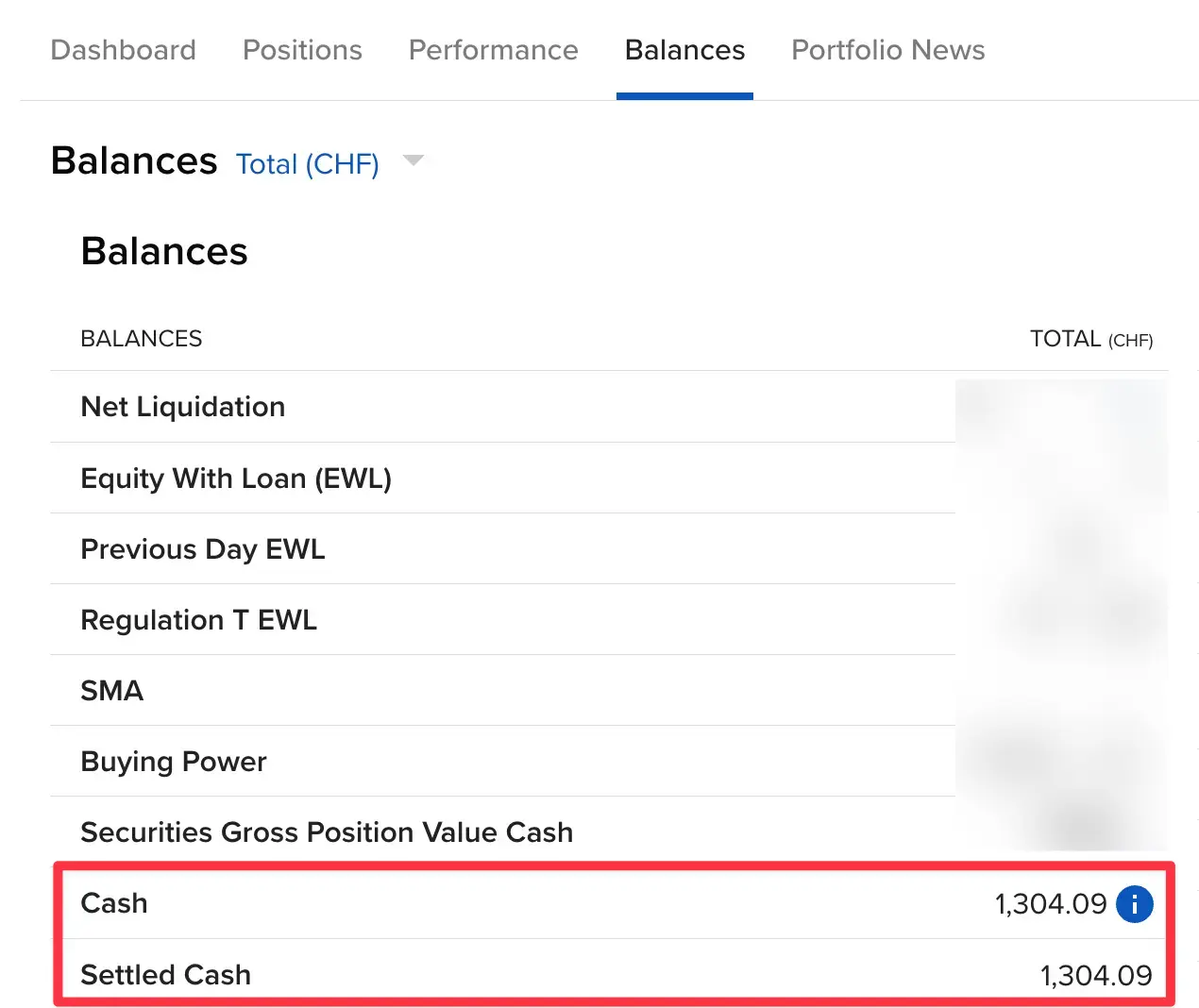
You can see it under Portfolio > Balances, but the info isn’t always live:
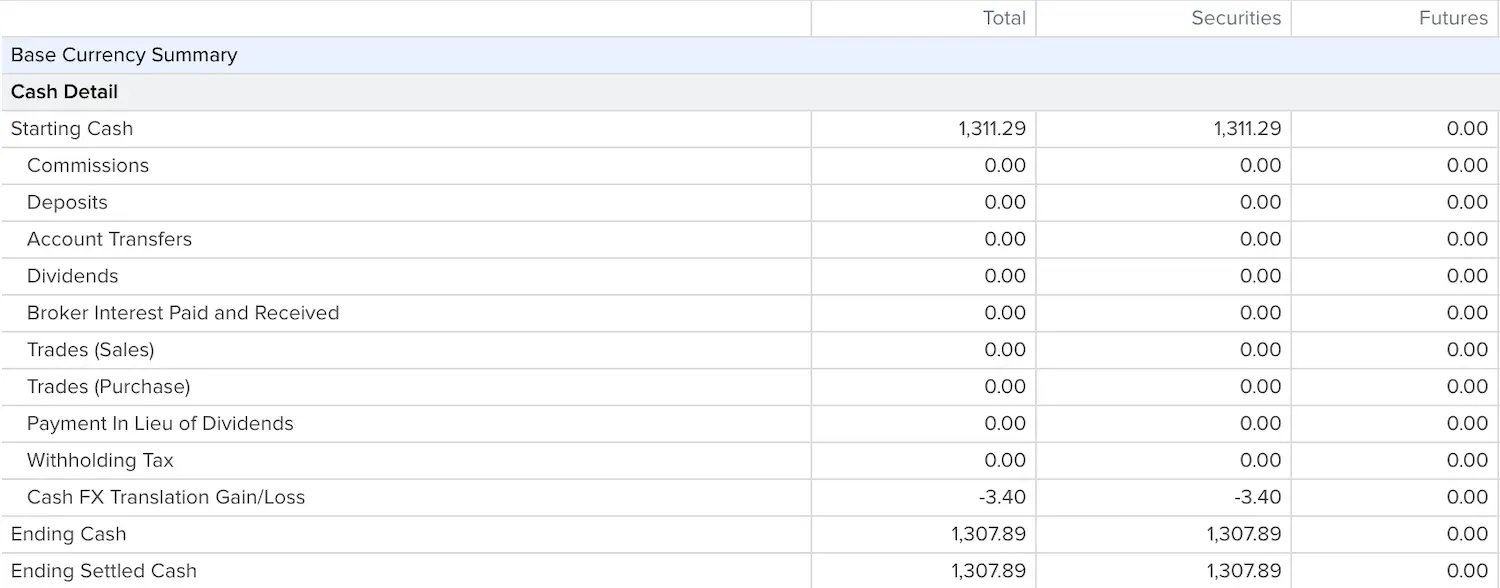
The most reliable way to see where you stand in the past (so the day after a transaction at the earliest) is to go to the Interactive Brokers Client Portal > Performance & Reports > Statements, and generate an activity statement. Then look for the Cash Report > Ending Settled Cash line:
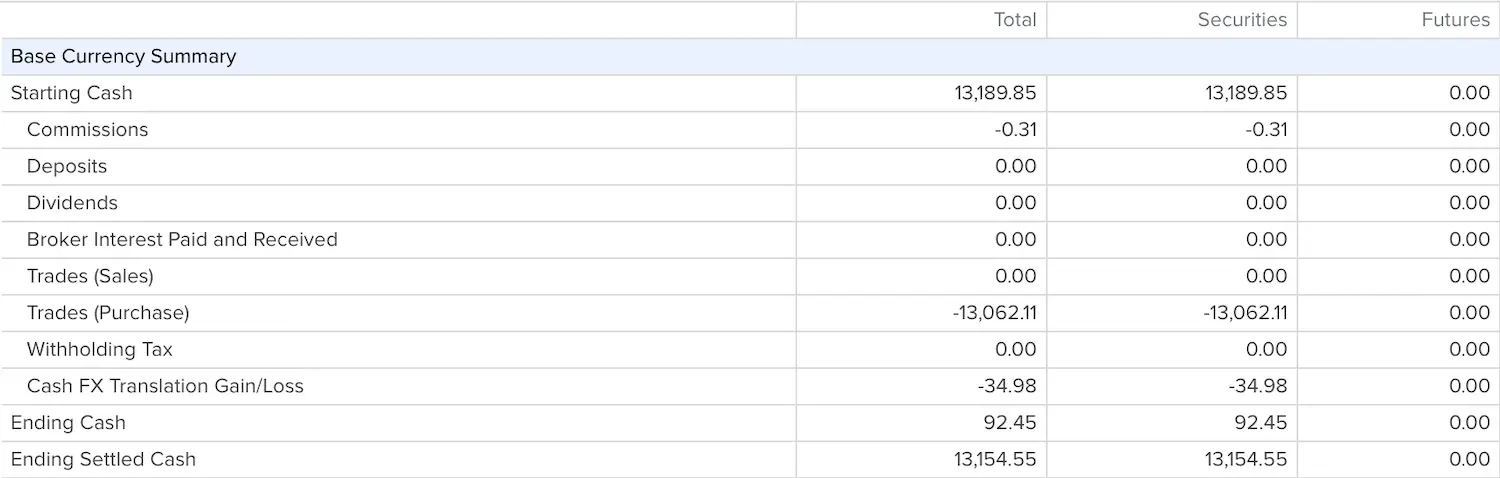
In this other example, I bought an ETF but still hold the cash because the transaction isn't settled yet (tomorrow, though, the 'Ending Cash' and 'Ending Settled Cash' lines will be identical)
That’s the only number to look at before buying in a currency you just converted, or before requesting a withdrawal. As long as you have enough settled cash in the right currency, everything goes through without surprises.
How to fix the “insufficient settled cash” error
You’ve got three options, from most frugal to most convenient:
- Wait for your cash to settle (the cleanest fix). After a deposit, a conversion or a sale, wait for the T+1/T+2 cycle, check your settled cash, then place your order.
- Use a margin account. On a margin account the order goes through anyway (with a temporary negative balance), so this error simply doesn’t happen. You only pay margin interest if the negative balance lasts.
- Plan ahead. Convert your CHF to USD a couple of business days before you actually want to buy, so the cash is already settled when you need it.
And if you’d rather let IBKR convert for you automatically instead of getting the error, that’s a related behavior I cover in the currency conversion notification article.
A bit of settlement history (just for fun)
If you rewind the clock, you realize we’ve come full circle in terms of how efficiently goods move between two parties.
Back in the day, like several millennia ago, it was pretty simple: you want my goat? OK, then hand me your wheat (literally, in grains, no money back then). And boom, the transaction was settled instantly.
Then, around 600 BC, we start finding traces of accounts, with debts recorded on clay tablets. Temples and palaces played the role of a “deposit house” to store these tablets. Say you wanted to buy my goat, well basically you could go to the palace and ask them to record a debt as a debit for me, and an extra credit for you. But it took a good few days or even a week to do (ever tried carving all that into clay with a sharpened reed?!).
In the Middle Ages, settlement also took time because merchants wanted to avoid wandering around with lots of gold. So they created “bills of exchange”. I buy your goat in exchange for a bill of exchange, which you can cash in at a big fair where everyone’s debts are netted, and only the net balance gets settled. Deal? Same back then, settlement took one to two weeks.
And if we move to more recent years, say 1900 to 1960, it’s the same: when you wanted to buy a stock, the title of ownership was a physical paper certificate. So if I sold you a Nestlé share, you had a courier literally hand-delivering your certificate.
I can picture the mess, with you stopping by your broker in Lausanne to buy a Nestlé share. Your broker knows someone in Zurich wants to sell. He executes the trade. And right away, a courier in a Mercedes would set off the next day to deliver your Nestlé certificate. Hoping he doesn’t mix it up and hand you someone else’s certificate on his route… but anyway, I’m getting sidetracked!

It took until the 1960s for stock exchanges to drown in paper, to the point of even closing on Wednesdays to catch up on the backlog of certificate transfers (Wall Street’s famous “Paperwork Crisis”). After that, everything got dematerialized, and we only transfer entries now (you bought this, I sold it to you).
The settlement cycle then gradually went from 5 business days down to 1 business day recently (see the explanations above).
Since the dawn of time, the goal has been the same: reduce the time it takes to move a good, and also the risk between the moment of agreement and the moment the transaction is completed (risk of theft or error).
But in 2026, even though we’ve cut this settlement cycle down, things still don’t happen instantly the way the user interfaces might lead us to believe…
FAQ: insufficient settled cash on IBKR
What is settled cash on IBKR?
It’s the part of your balance actually available to place a new buy order, a currency conversion, or a withdrawal. Cash from a conversion or a sale only settles after the settlement cycle (T+1 or T+2).
Why is my balance positive but “unsettled”?
Because IBKR displays your conversion or sale right away, but settlement only lands at T+1 or T+2. In between, the cash is visible but not usable yet.
How long until a CHF-USD conversion settles?
T+2, so two business days, excluding central bank holidays (think July 4th on the US side, for example).
Why do I get “insufficient settled cash” right after selling?
Because the proceeds from your sale settle at T+1 (US stocks and ETFs) or T+2 (UCITS ETFs). Until then they show in your balance but aren’t settled, so buying again with them on a cash account triggers the error. Wait for settlement, or use a margin account.
Can I withdraw cash that hasn’t settled yet?
No. You can only withdraw settled cash. After a sale or a conversion, wait for settlement (T+1 or T+2) before wiring the money.
What is a “good faith” / free-riding violation on a cash account?
It’s when you buy a security with funds that haven’t settled yet and sell it before the original settlement. Repeated, it can lead IBKR to restrict your account to settled funds only for a while.
Conclusion (as a buy-and-hold Mustachian investor)
Cash settlement is simply the delay between “I clicked” and “the money actually changed hands”. Your displayed balance and your settled cash are two different things, and that difference explains most of IBKR’s weird-looking behavior.
Remember three things:
- A currency exchange settles at T+2, a US stock at T+1: this mismatch is the source of automatic conversions
- Settlement also affects your withdrawals
- Before buying or withdrawing, always check your “settled cash” in the Client Portal
And if IBKR converted a currency twice even though you had “enough” cash, that’s the classic symptom of settlement not having gone through yet. The details of that double conversion and how to avoid it are here: Currency conversion notification on IBKR: what to do?
Finally, if you invest to hold your ETFs long term, this settled-cash story shouldn’t affect you much, except when you wire your CHF to Interactive Brokers, then convert them into USD. There, make sure to wait 2 business days before buying your favorite ETF.
PS: if you’re just getting started with IBKR, I’ve created a complete IBKR guide that explains (almost) everything about Interactive Brokers: opening an account, fees, conversions, buying ETFs, etc.
And you, have you ever been caught off guard by cash that was “displayed but not settled” on IBKR?