
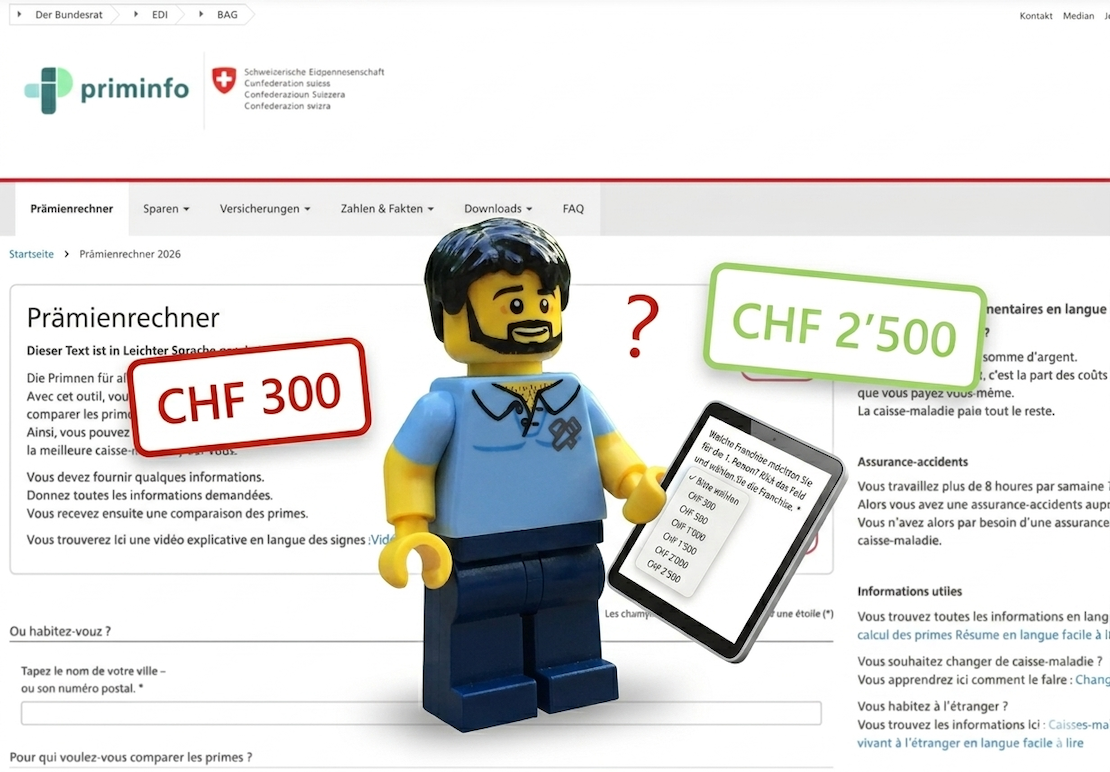
You pay your health insurance premium every month. But have you actually optimized your deductible? Most people pick something “in the middle” thinking it’s a fair compromise. Spoiler alert: it’s the worst option.
The real question is: CHF 300 or CHF 2'500? And nothing in between.
I’ll prove it to you with concrete math, based on our own experience. Because when Mrs. MP had a suspected illness that could require heavy treatment, we had to seriously run the numbers. And the answer is simpler than you’d think.
TL;DR: go for CHF 300 if your yearly medical expenses exceed ~CHF 1'900. Go for CHF 2'500 otherwise. Intermediate deductibles (500, 1'000, 1'500, 2'000) are never mathematically optimal.
The simple rule: CHF 300 or CHF 2'500
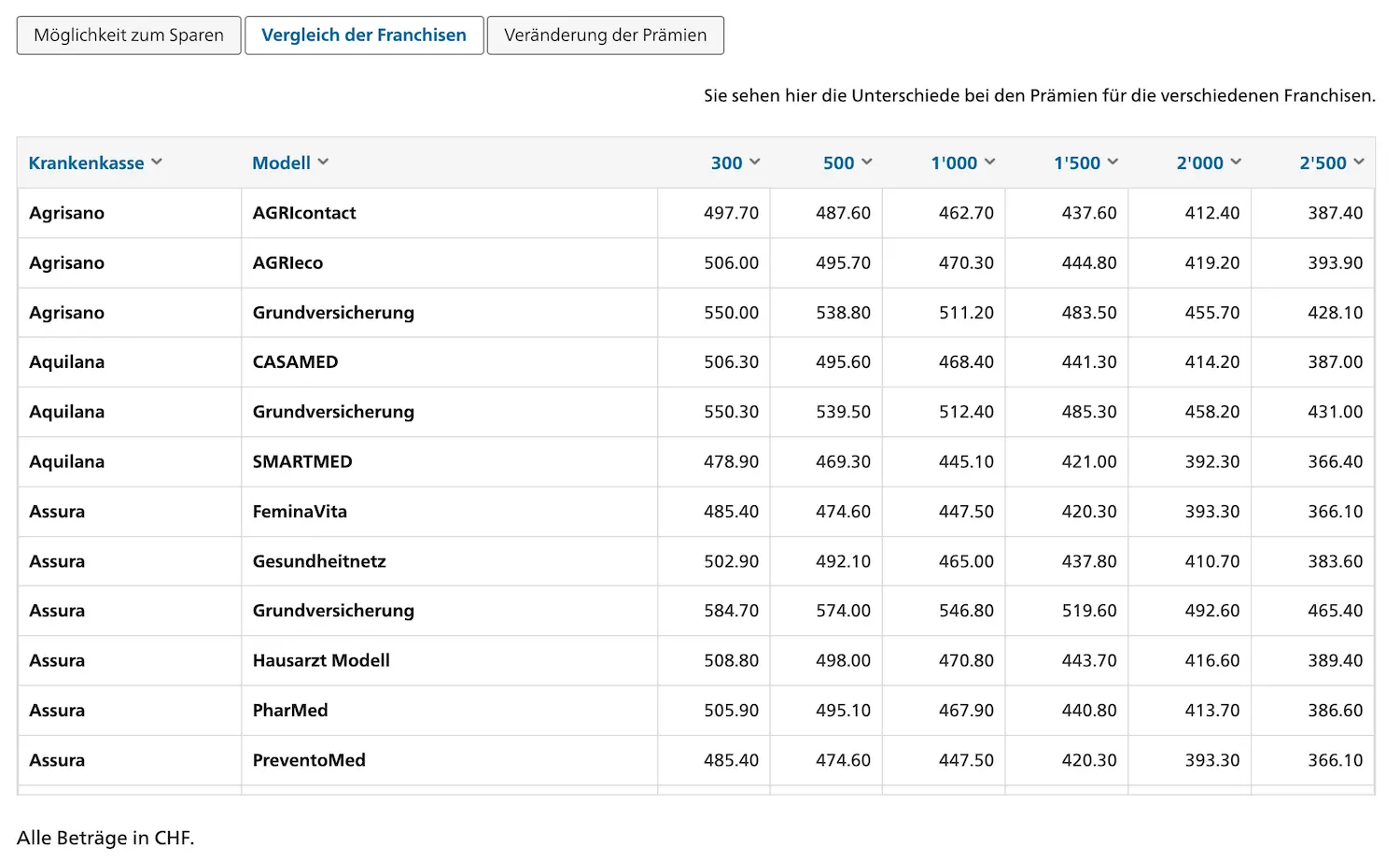
Swiss health insurance companies offer six deductible levels for the basic insurance (KVG/LAMal):
| Deductible | Monthly premium (cheapest found for 2026) |
|---|---|
| CHF 300 | CHF 494.55/month |
| CHF 500 | CHF 483.85/month |
| CHF 1'000 | CHF 456.65/month |
| CHF 1'500 | CHF 429.45/month |
| CHF 2'000 | CHF 402.45/month |
| CHF 2'500 | CHF 375.25/month |
The principle is simple:
- The higher your deductible, the lower your monthly premium
- The lower your deductible, the more you pay in premiums, but you’re covered from the very first CHF of medical expenses
And the logic behind the rule is purely mathematical:
If your yearly medical expenses exceed ~CHF 1'900, go for CHF 300. Otherwise, go for CHF 2'500.
Intermediate deductibles (CHF 500, 1'000, 1'500, 2'000) are never optimal. They cost too much in premiums compared to the deductible savings they offer. I’ll show you with real numbers below.
Our story: from CHF 2'500 to CHF 300 for Mrs. MP
Healthy = maximum deductible
For years, the choice was obvious for us. Mrs. MP and I were both in good health, no regular medication, just an annual check-up at most. We each had a CHF 2'500 deductible at Assura, with the family doctor plan.
Result: we paid the lowest possible premium, and we never hit our deductible. Our health insurance never reimbursed us anything, and that was perfect. We saved on premiums every month.
That’s the classic Mustachian strategy when you’re healthy.
The trigger: suspected serious illness
Then mid-2026, Mrs. MP had symptoms that led to a suspicion of an illness that could require heavy treatment. The doctor prescribed diagnostic exams to confirm (or rule out).
Diagnostic costs:
- First exam: CHF 230
- Second exam (more in-depth): CHF 420
- Total diagnostic: CHF 650
And if the diagnosis is confirmed, the recurring yearly costs would be:
- Recurring treatment: CHF 5'800/year
- Initial complementary exam (one-shot): CHF 2'000
- Total first year if confirmed: CHF 7'800
- Total following years: ~CHF 5'800/year
At that moment, the question came up: do we keep the CHF 2'500 deductible, or switch to CHF 300?
(And rest assured: Mrs. MP is doing fine. We’ve got it under control, nothing serious. But it forced us to run the math, and I figured it was worth sharing.)
The math: deductible CHF 300 vs CHF 2'500
Before diving into the numbers, a quick reminder on how KVG/LAMal reimbursement works:
- You pay your deductible (the yearly amount you cover yourself)
- You pay a 10% co-payment on the rest of the costs, up to a maximum of CHF 700/year
- Insurance covers the rest
So your maximum yearly out-of-pocket cost (excluding premiums) = deductible + CHF 700 co-payment.
Scenario 1: healthy (≤ CHF 500/year)
That’s my case, Mr. MP. A quick check-up, with two or three prescriptions at the pharmacy. Let’s say CHF 250 of medical expenses per year, as a representative example for this bracket.
| Deductible CHF 300 | Deductible CHF 2'500 | |
|---|---|---|
| Yearly premium | CHF 494.55 × 12 = CHF 5'934.60 | CHF 375.25 × 12 = CHF 4'503.00 |
| Deductible paid | CHF 250 | CHF 250 |
| Co-payment (10%) | CHF 0 | CHF 0 |
| Total yearly cost | CHF 6'184.60 | CHF 4'753.00 |
| Difference | CHF 1'431.60 less |
When you’re healthy, the CHF 2'500 deductible saves you CHF 1'431.60 per year. That’s not peanuts.
And as a Mustachian, you invest these savings in the stock market. Invested at 7% per year in ETFs, that gives you roughly CHF 19'780 in total savings after 10 years (accumulated saved premiums + compound interest).
Scenario 2: diagnostic costs (CHF 650/year)
Mrs. MP’s case in 2026, with CHF 650 in diagnostic exams.
| Deductible CHF 300 | Deductible CHF 2'500 | |
|---|---|---|
| Yearly premium | CHF 494.55 × 12 = CHF 5'934.60 | CHF 375.25 × 12 = CHF 4'503.00 |
| Deductible paid | CHF 300 | CHF 650 |
| Co-payment (10%) | CHF 35 | CHF 0 |
| Total yearly cost | CHF 6'269.60 | CHF 5'153.00 |
| Difference | CHF 1'116.60 less |
With CHF 650 in expenses, the CHF 2'500 deductible still wins, but the gap is already shrinking.
Scenario 3: confirmed serious illness (~CHF 7'800 first year)
The scenario we’re anticipating if Mrs. MP’s diagnosis is confirmed.
Important note: treatments for a confirmed serious illness are covered by the basic KVG/LAMal insurance, so you don’t need supplementary insurance for that.
| Deductible CHF 300 | Deductible CHF 2'500 | |
|---|---|---|
| Yearly premium | CHF 494.55 × 12 = CHF 5'934.60 | CHF 375.25 × 12 = CHF 4'503.00 |
| Deductible paid | CHF 300 | CHF 2'500 |
| Co-payment (10%) | CHF 700 (cap reached) | CHF 530 |
| Total yearly cost | CHF 6'934.60 | CHF 7'533.00 |
| Difference | CHF 598.40 less |
With high expenses, the CHF 300 deductible saves CHF 598.40 per year. The math was a no-brainer for us.
Why intermediate deductibles never win
Here’s the full table with all six deductibles, for the “serious illness” scenario (CHF 7'800 in expenses):
| Deductible | Premium/year | Deductible paid | Co-payment | Total/year | vs. CHF 300 deductible |
|---|---|---|---|---|---|
| CHF 300 | CHF 5'934.60 | CHF 300 | CHF 700 | CHF 6'934.60 | — |
| CHF 500 | CHF 5'806.20 | CHF 500 | CHF 700 | CHF 7'006.20 | +CHF 71.60 |
| CHF 1'000 | CHF 5'479.80 | CHF 1'000 | CHF 680 | CHF 7'159.80 | +CHF 225.20 |
| CHF 1'500 | CHF 5'153.40 | CHF 1'500 | CHF 630 | CHF 7'283.40 | +CHF 348.80 |
| CHF 2'000 | CHF 4'829.40 | CHF 2'000 | CHF 580 | CHF 7'409.40 | +CHF 474.80 |
| CHF 2'500 | CHF 4'503.00 | CHF 2'500 | CHF 530 | CHF 7'533.00 | +CHF 598.40 |
To visualize this at a glance, here’s the total yearly cost (premium + deductible + co-payment) as a function of your medical expenses, for the six deductible levels:
On the chart, the lower envelope (the lowest curve at each point) is made up of only two colors: green (CHF 2'500) to the left of the threshold, red (CHF 300) to the right. The four intermediate deductibles always sit above. They are never optimal.
See the pattern? Intermediate deductibles are never the best choice for any profile: too expensive in premiums for a high consumer of care, too expensive in deductible for a low consumer. There’s no “sweet spot” in the middle. It’s always one of the two extremes that wins.
The tipping point sits around ~CHF 1'900 of yearly medical expenses. If you’re below, pick a CHF 2'500 deductible. If you’re above, pick a CHF 300 deductible.
When and how to change your health insurance deductible?
Can you change your health insurance deductible mid-year?
No. You can’t change your deductible during the year. The change takes effect on January 1st of the following year. To lower your deductible, your request must reach your insurer before November 30th (more precisely, the last business day of November), same as for changing insurer. To raise it, you have until the end of December (art. 94 KVV/OAMal). And to be safe with postal delays, I recommend sending your request two weeks before the date.
That was the first thing we checked when Mrs. MP got her first results. Bad news: if you know you’re going to have significant expenses, you need to plan ahead and change your deductible for the following year.
Do you need a medical assessment to lower your deductible?
No. The basic health insurance (KVG/LAMal) is a mandatory social insurance. Your insurer has no right to refuse a deductible change, nor to ask for medical justification. It’s your right, period.
That’s actually a fundamental difference with supplementary insurance (VVG/LCA), which can require a health questionnaire.
Strategy: bundling medical expenses into one year?
When Mrs. MP got her suspected diagnosis, we asked ourselves: do we run the exams now (in 2026), or wait until January 2027 to bundle everything into one year with the CHF 300 deductible?
Our reasoning:
- The diagnostic costs (CHF 650) stay below the CHF 2'500 deductible = the insurance doesn’t reimburse anything anyway in 2026
- If we wait for 2027 with a CHF 300 deductible, these CHF 650 would be almost fully covered (CHF 300 deductible + CHF 35 co-payment = CHF 335 out of pocket instead of CHF 650)
- But: we didn’t want to wait more than 6 months for a medical diagnosis just to save ~CHF 315
So we did the diagnosis in 2026 (health first), and we switched the deductible to CHF 300 for 2027. Mustachian pragmatism also means knowing when health comes before financial optimization.
Conclusion: the rule to remember
The rule in one sentence: CHF 300 if your yearly medical expenses exceed ~CHF 1'900, CHF 2'500 otherwise. Never anything in between.
And the right Mustachian reflex is to redo the math every year, at the same time you compare health insurers. Because a change in situation (family, illness, risky sport, etc.) can flip the equation overnight.
The dates to remember: November 30th (last business day of the month) to lower your deductible, end of December to raise it. And to avoid nasty surprises with the post, send your request two weeks early. The change takes effect on January 1st.
One last important point that many people miss: the cheapest insurer changes depending on the deductible level you pick. Each health insurer has its own pricing model by tier, some are aggressive on high deductibles (to attract healthy young people), others on low ones. So if you switch from CHF 2'500 to CHF 300, don’t stay with the same insurer out of inertia. Re-run the comparison: how to cancel and switch compulsory health insurance.
The MP family facing the health insurance deductible choice (CHF 300 or CHF 2'500): now we're clear!
FAQ: Swiss health insurance deductible
How do you calculate which health insurance deductible to choose?
Estimate your yearly medical expenses (consultations, medications, recurring treatments). If you exceed ~CHF 1'900 per year, the CHF 300 deductible is more advantageous. Below that, the CHF 2'500 deductible saves you on premiums. Intermediate deductibles (CHF 500 to CHF 2'000) are never the optimal choice.
Can you change your deductible mid-year?
No. In Switzerland, you can only change your KVG/LAMal deductible effective January 1st of the following year. To lower it, your request must reach your insurer before November 30th (last business day); to raise it, before the end of December. For postal safety, send it two weeks early.
Is the CHF 2'500 deductible always the best for someone healthy?
Yes, in the vast majority of cases. If your yearly medical expenses stay below ~CHF 1'900, the premium savings with the CHF 2'500 deductible largely exceed what you’d pay out of pocket. It’s the strategy we’ve been applying for our MP family for years.
Do you need a medical certificate to lower your deductible?
No. The basic health insurance (KVG/LAMal) is a social insurance. Your insurer has no right to refuse a deductible change or require medical justification. This is a key difference with supplementary insurance.
What’s the deadline to change your health insurance deductible?
The legal deadline depends on which way you go (art. 94 KVV/OAMal): November 30th (last business day of the month) to switch to a lower deductible, end of December to switch to a higher one. Your request must reach your health insurer before this cutoff, and the change takes effect on January 1st of the following year. In practice, I recommend sending your request two weeks early to stay safe with postal delays (or use your insurer’s online form if available). No deductible change is possible mid-year.