
Remember, back in 2025, I told you about the stress around my mortgage and financial independence: once FI, no more payslips, and a bank that could reopen my mortgage file at the worst possible moment (see the full article for all the details: Mortgage renewal once FIRE: how to deal with it?).
And then, instead of ruminating on various hypothetical scenarios, I took action and called my banker :)
Why I was scared for my mortgage once FI
When you become FI (for “Financially Independent”), you find yourself without a salary from one month to the next. And so, if your mortgage bank and your main bank are the same entity, you run the risk of it raising an alert in their internal system when they no longer see income landing on your account…
And then what happens?
That’s what I was wondering at the time.
In my head, that internal alert was followed by a call from your banker explaining that his “Compliance” department wants to, and has to, run a new affordability check, because there seems to have been a change in your situation…
N.B. there are generally two scenarios: your mortgage bank and your main bank are the same group, it sees your salary coming in (or no longer coming in), and a change can raise an alert. If they’re two different banks, your mortgage bank only sees your interest and your amortization paid on time, and the risk of an alert is much lower if your income changes.
The call to my banker, and how I asked the question
I thought quite a bit about how to bring it up with my banker. Because as nice as he is and as much as I trust him, he still has to defend his employer’s interests…
And if he hears “Mr. X will have no more income in Y years”, he’s clearly going to make a note somewhere or call his famous “Compliance” department.
So, rather than asking him a question from the FI angle (a word that means nothing to a bank…), I described my upcoming situation to him: I might go self-employed. That’s vocabulary a bank knows how to assess.
I used the following wording:
I’m calling because I’m thinking about going self-employed in a few years. And so, well, I’d like to get an idea of what that would involve, and whether I’d need to redo some administrative paperwork for my mortgage, or not?
And I let him answer, without interrupting, so that he’d really explain everything to me in as much detail as possible.

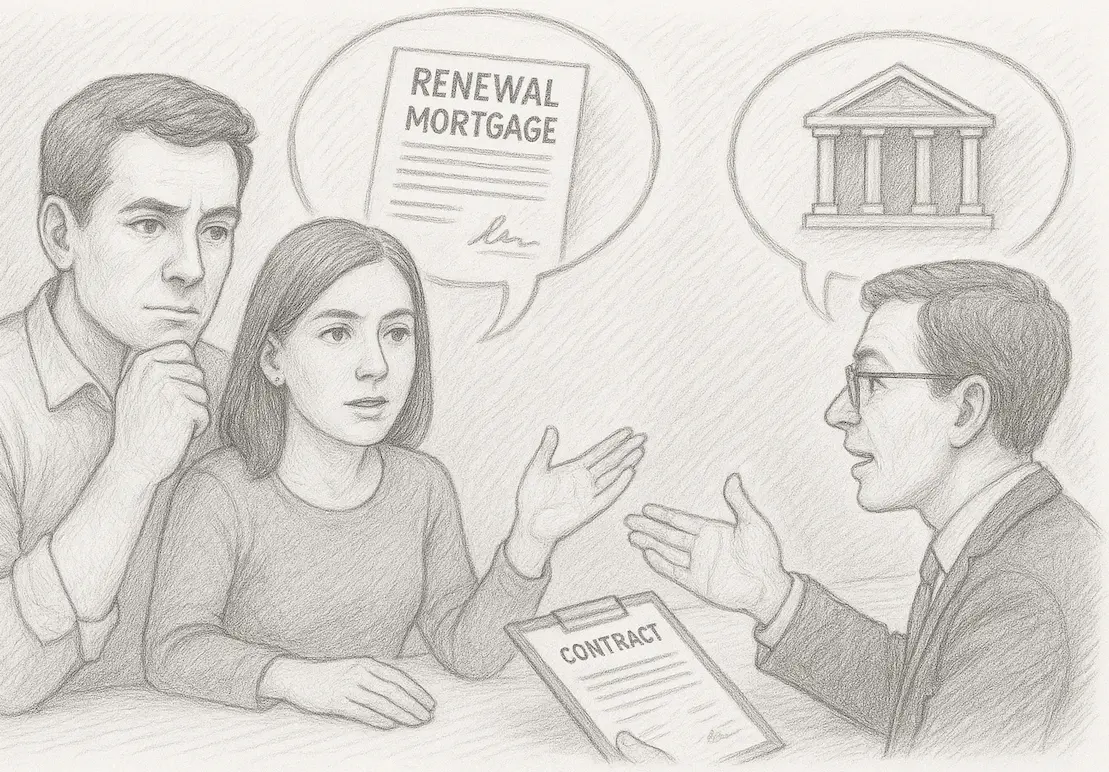
Me on the phone with my banker, explaining that I might go self-employed and what that changes for my mortgage
And the answer surprised me, but reassured me.
What my bank told me about my mortgage once FI
A periodic affordability check every 15 years
If we forget about FI or self-employment or whatever for two seconds, THE big news from this call to my banker was when he told me that their periodic affordability checks take place every 15 years.
And the bank counts those 15 years from the signing of your first mortgage with them (the one where they went through your complete file), not at each renewal of your SARON. (A little flashback to that time: we had managed to break our mortgage tied to a lousy mixed 3a.) So for us, that’ll be after 2035!
That is, unless a warning signal appears before then, in which case they re-check your affordability file for your mortgage financing.
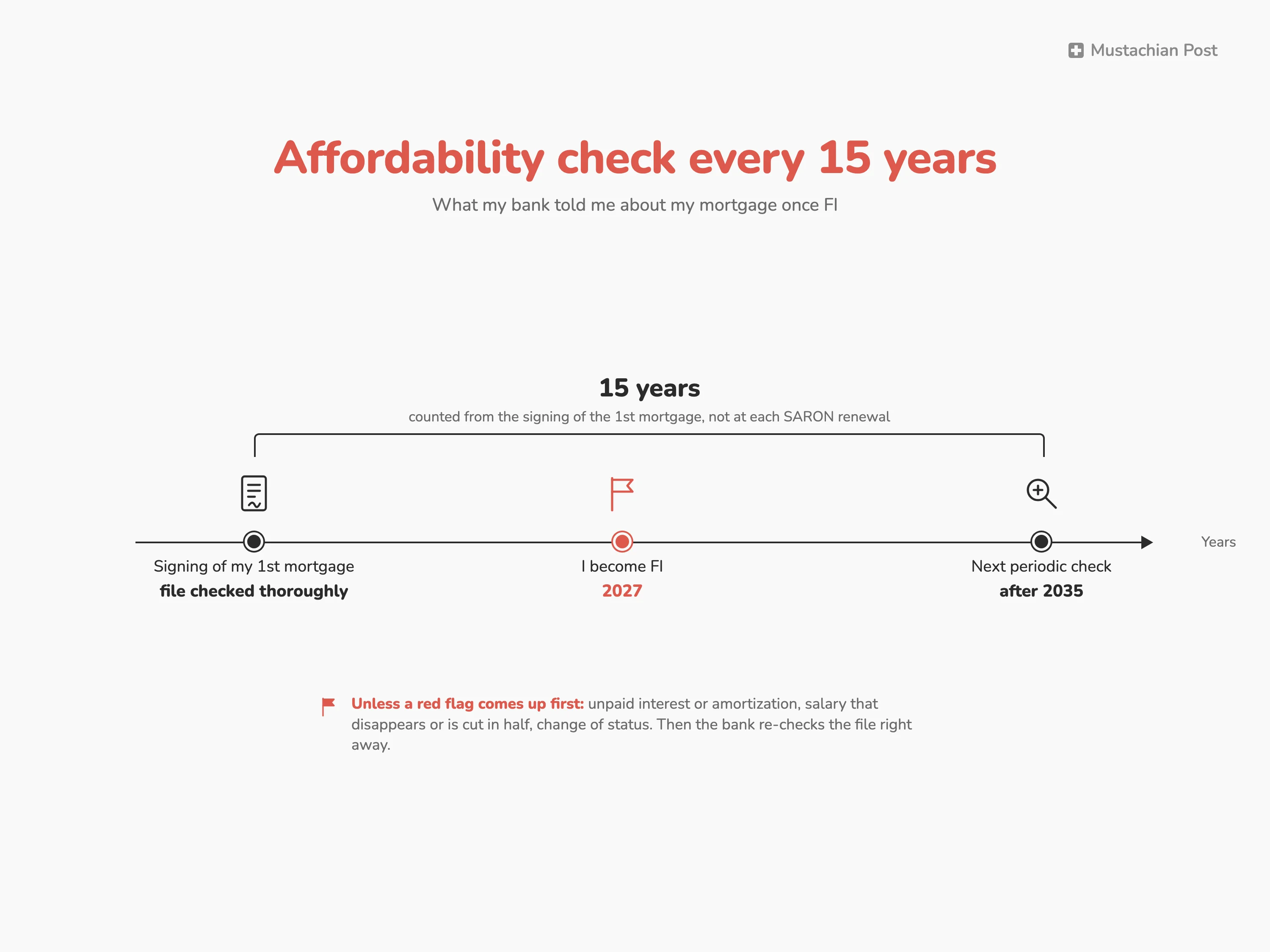
My bank will re-check my affordability 15 years after my first mortgage with them, not at each SARON renewal, so after 2035, well after I become FI in 2027
I couldn’t find any official source, but I think for other banks it must also be somewhere around a decade, otherwise it would be too much internal work (tell me if you know the period for your bank and I’ll add it here).
So, since you have a boatload of money invested when you’re FI, I wondered whether they’d take it into account in the calculation of our income in any way. Because yes, my stock market investments (see how to invest in the stock market in Switzerland) pay dividends and generate capital gains.
Above CHF 250'000, the value of your assets counts
In my bank’s case (and I think it varies depending on yours, so do check), they take into account the value of your assets invested in the stock market in your affordability calculation as soon as you exceed CHF 250'000 in assets.
And they “value” them. That means they apply a percentage X to them, and count that as additional “notional income”. I’m not sure about the exact figure, as I didn’t write it down, but from memory it was 2 or 3% (they’re conservative), compared to UBS which, according to a blog reader, values your stock portfolio at 5% for example.
And, in case I were to start taking cash out of my company as a salary, I also asked whether a self-employed salary was taken into account, and under what conditions…
A salary from your own company = self-employed income = minimum 3 years of activity
The key info is that paying yourself a salary from your company is treated as if you were self-employed.
And so, a mortgage for a self-employed person isn’t the same as for an employee, where they’ll just check your last 3 payslips…
Indeed, if you’re self-employed, to get a mortgage, the standard rule among banks, according to another banker I know, is that they’ll check that you already have 3 years of activity with cash flow, AND they’ll take the average salary paid out over those last 3 years.
And I know there are banks (Swissquote for example) that apply other criteria on top of that, such as a taxable income of CHF 100'000, when checking the affordability of a self-employed person who wants a mortgage.
And so, if your income isn’t enough of a guarantee for them, whether you’re an employee, FI or self-employed, I asked what options were left (except changing banks, which I’d like to avoid since our current mortgage is the best for our situation to date, see how to choose the best Swiss mortgage).
If the affordability check asks for more: additional collateral
If my bank’s affordability check ever asked for more, here are the three additional guarantees I’d have to provide to be able to keep my current mortgage:
- Deposit a certain amount in a savings account with them (basically lock up cash, and try to earn a little on it, as of today at the end of 2026, we’re talking 0.5% interest for this type of account with them…)
- Take out a life insurance policy somewhere so that you have a surrender value pledged in favor of the bank, which reassures them (thanks, but NO THANKS!)
- Increase your mortgage note in their favor, within the limit of the lending value the bank assigns to your property
What I liked is that there seems to be room for discussion to find solutions. Even if it means having a less-than-ideal solution for a few months (e.g. locking up cash in a savings account), while I talk to Resolve.ch and Hypotheke.ch, and if it’s much better with them, paying the early termination fees on my SARON mortgage. Because yes, terminating a SARON mortgage isn’t free, just like a fixed-rate one. In 2025, breaking it would have cost me around CHF 16'000 in penalties, as I explain in my article on the commitment period of a SARON mortgage.
And yes, I know, it would be smarter to call these two companies, Resolve.ch and Hypotheke.ch, now, rather than doing it in a rush.
Except that, first, the current solution is the best and the simplest and I have no real reason to change before then, and second, I lack the time to take these steps (that’ll be less of an excuse once FI).
What is a “standard” mortgage file for a bank?
After a good twenty minutes on the phone with my banker, here’s what I take away from it so that your case isn’t analyzed more than necessary, or doesn’t become the subject of an affordability reassessment for a mortgage in Switzerland:
- The property is owner-occupied, with the amortization rules followed (second mortgage amortized to stay under a 66% loan-to-value) and theoretical costs under 33% of income
- Employee at the start (or entrepreneur already accepted at the beginning of the banking relationship)
- No unpaid mortgage interest (so avoid any payment reminder, i.e. always pay on time), and no unpaid direct amortization either if you chose that route (I have an article on the subject if you’re interested: Direct or indirect amortization, Swiss mortgage)
- No notable and visible change in income (salary that disappears or is cut in half)
So there you go, just common sense in the end, but it was cool to be able to talk about it directly with my banker to learn their actual practices.
Oh yes, and before I forget, your type of mortgage also plays a role here.
SARON or fixed-rate mortgage: what does it change for the affordability check?
Obviously, if you have a 10-year fixed-rate mortgage, you’ll be left alone for a decade if you pay on time and your situation doesn’t change.
If it’s over 5 years, same thing, you’re left alone for 5 years.
With a 3-year SARON mortgage (the minimum, which I took recently), there’s this slight additional risk that at the end of the 3 years they say to themselves “Come on, let’s run a check this year on all the SARONs being renewed.”
That’s my fear, but it’s fairly unfounded, especially after my discussion with my banker. (A random check, on the other hand, can always happen, if only because of an ISO 9001 audit for example.)
My mortgage plan for the next decade
All that being said, and especially since I’ll be FI from 2027, here’s the plan we’re thinking of following:
- In the first years of FI, I’m thinking of paying myself a salary identical to the one before FI, from my company, in order to:
- a/ take out cash to fund our FI lifestyle (rather than selling part of the ETFs we hold privately)
- b/ sort out along the way the issue of OASI contributions once FI, which are calculated on your wealth
- c/ and that way, for our mortgage bank, nothing changes income-wise
- No Resolve.ch or Hypotheke.ch for now. And we keep one of our two 3rd pillars (invested 100% in stocks) pledged as collateral
- Plan B: if a check comes at a bad time, book an appointment with Resolve.ch / Hypotheke.ch
- But I’m betting that our wealth over a decade will keep growing even as we draw on it (with our real estate, the blog, and our other side activities), so by then, after 2035, there may no longer be any issue at all because the valuation of our net worth will reassure the “Compliance” department enough without us needing to change anything in how we are organized
Conclusion: mortgage, FI, and affordability check
Honestly, I started this call pretty stressed, then once I’d hung up with my banker, I was massively reassured.
Because, first of all, after 2035 is very far away! And that leaves us time to see what’s coming.
And then the value of our apartment may have gone up further by then. That lowers the risk for the bank, not the income it asks of you, but it makes any discussion easier.
And so, this worry, today, as I’m about to be FI in a few months, I’m really relaxed about it. Nothing needs to change for now.
(note to self: the thing that could motivate me, if I have the time, and yes I should have more of it once FI, is to run simulations with Resolve.ch + Hypotheke.ch so I can document them on the blog. That fires me up! To be continued in a few months!)
Your turn, call your banker
Try calling your banker to find out their conditions.
Along the lines of “I’m thinking about going self-employed, with a one- or two-year sabbatical in between (a family dream, after all), what would that mean for my mortgage?”
And talk to them about your real plan (going self-employed, a sabbatical) rather than “early retirement at 32”: they wouldn’t understand what you’re saying, haha! A bank assesses a status and an income, not a word like FI.
And also: yes, not everyone will have a salary from a company once FI. It bothers me a bit not to be the perfect example for this situation, but it also shows that there are as many arrangements as there are life situations. And that’s also why, on this one, I’m even more eager to learn about your situation, so I can integrate it into the article afterward.
I’d be curious to hear about your experience (affordability reassessment conditions, etc.) in the comments below.
And if you’re already FI with a mortgage, tell us too how you handled this key topic.
FAQ: mortgage and financial independence in Switzerland
Can my bank review my mortgage during the contract?
Yes, your bank can review your mortgage during the contract, because the contract fixes your rate and a commitment period, but not an end to affordability checks. It recalculates your affordability when an event occurs (income drop, missed payment, change of status) and during its periodic check, every 15 years from the signing of your first mortgage, in my bank’s case.
Do you need a salary to keep a mortgage in Switzerland?
You don’t necessarily need a salary to keep a mortgage in Switzerland, but you do need an income your bank accepts: rents, dividends, or a notional income calculated on your invested wealth above a threshold (CHF 250'000 at my bank).
Self-employed, how many years of accounts for a mortgage?
As a self-employed person, you generally need three full fiscal years of accounts, which the bank averages instead of looking at your last three payslips (if you’re employed by someone else). A salary paid by your own company counts as self-employed income, and some banks add a floor (CHF 100'000 of taxable income at Swissquote).
What happens if I no longer meet the criteria?
Your bank first tries to restore its safety margin with you, notably through additional collateral (locked savings account, life insurance, higher mortgage note), or through an extraordinary amortization or additional income. Demanding repayment is the last resort, hence the value of having your plan B (Resolve.ch, Hypotheke.ch) before you need it.




Last updated: November 5, 2026