I’ve been meaning to write a follow-up to my article on how to choose the best broker for a company in Switzerland (2026 comparison) for a long time.
In one of its FAQs, I wrote that capital gains aren’t tax-free for a company the way they are for a private person. And I wondered whether it was really a good idea to leave all my profits in my LLC (Sàrl/GmbH), and to invest them through that legal entity.
Time flew by, and I’ll admit I put that question aside for a while, because it looked complicated…
If you too have a company alongside your job, with profits you don’t need to live on, this article will interest you ;)
Spoiler alert, yes, it’s smart to invest via your company if you’re a Mustachian who wants to become FI (Financially Independent), on three conditions:
- Take the money out slowly. The Swiss private tax rate goes up as your income crosses thresholds (the famous “tax progression”). So one big dividend from your company in a single year would push you through several thresholds, and raise your taxes a lot
- Pay yourself a proper salary alongside your dividends, otherwise the OASI (AHV/AVS) can come and claim contributions from you after the fact…
- Stop piling up cash in your company the day you’re FI. Without your employee salary, your tax rate is low, so that’s the right time to take your profits out, not to keep them
The financial gain is real, but it can melt fast if you miss one of these three conditions.
So we’ll go through three typical scenarios for someone on the path to FI, inspired by my own case (and if yours isn’t in there, tell me in the comments, and I might write more articles). I’ve also prepared several examples with numbers that lead to a verdict on which investment strategy to pick (including mine), as well as the three traps to avoid.
Invest via your company or take the money out privately?
I’m taking a case close to mine, where the starting point is that I own a small business alongside my job, which I run within a dedicated entity (an LLC, but it’s the same with a corporation, i.e. an SA/AG).
This company makes profits that I don’t need to live on, because I’m in the wealth accumulation phase of my FI journey (vs. the wealth consumption phase).
The question I then faced was to choose between:
- Option A: pay myself a small salary and the rest of the profits as dividends, and invest them privately (I explain below why I don’t take everything out as dividends)
- Option B: keep the profit in the company, invest it in the stock market with a legal entity account, and take the money out later
In both cases, we use the same diversified VT ETF to invest our money in the financial markets (and not let inflation eat it away).
And we also use the same online broker, the best one (hello Interactive Brokers!), because, just like for a private person, it’s also the best trading platform for a legal entity (see my comparisons of the best broker for a private person in Switzerland and the best broker for a company in Switzerland).
In the end, it’s mostly taxes that will drive the choice between option A and option B. And also time, which works in our favor thanks to compound interest.
Because in Switzerland, private individuals aren’t taxed on realized capital gains. In other words, if you invest CHF 100 and walk away with CHF 150 two years later, well, those CHF 50 are tax-free. For a legal entity (= a company), though, those same CHF 50 get added to your company’s profit, which is then taxed. But as long as you don’t sell anything, that gain isn’t taxed (your company does pay tax every year on the dividends the ETF pays it, though).
And until now, for lack of time (or laziness, whichever you prefer haha!), I had settled for a rough theory that it was more advantageous to invest via your company if you don’t need that cash to live on right away.
Why one big dividend costs more than several small ones
My theory was the tax staircase: the higher your private income for the year, the higher the rate you’re taxed at.
That means if you go with option A, which consists of taking all the profit out of your company every year (via a small salary, and above all a big dividend), well, it increases your private income tax considerably.
Especially since in our case here, you’re not FI at that point, so you’re rather trying to raise your salary as much as possible to reach financial independence as fast as possible. So that salary already occupies the “bottom steps” of your private tax staircase. And as a result, the “small salary + big dividend” land on the “top steps”.
On the other hand, once you’re FI, the bottom steps become free since you no longer earn a salary. So logically, you pay less tax.
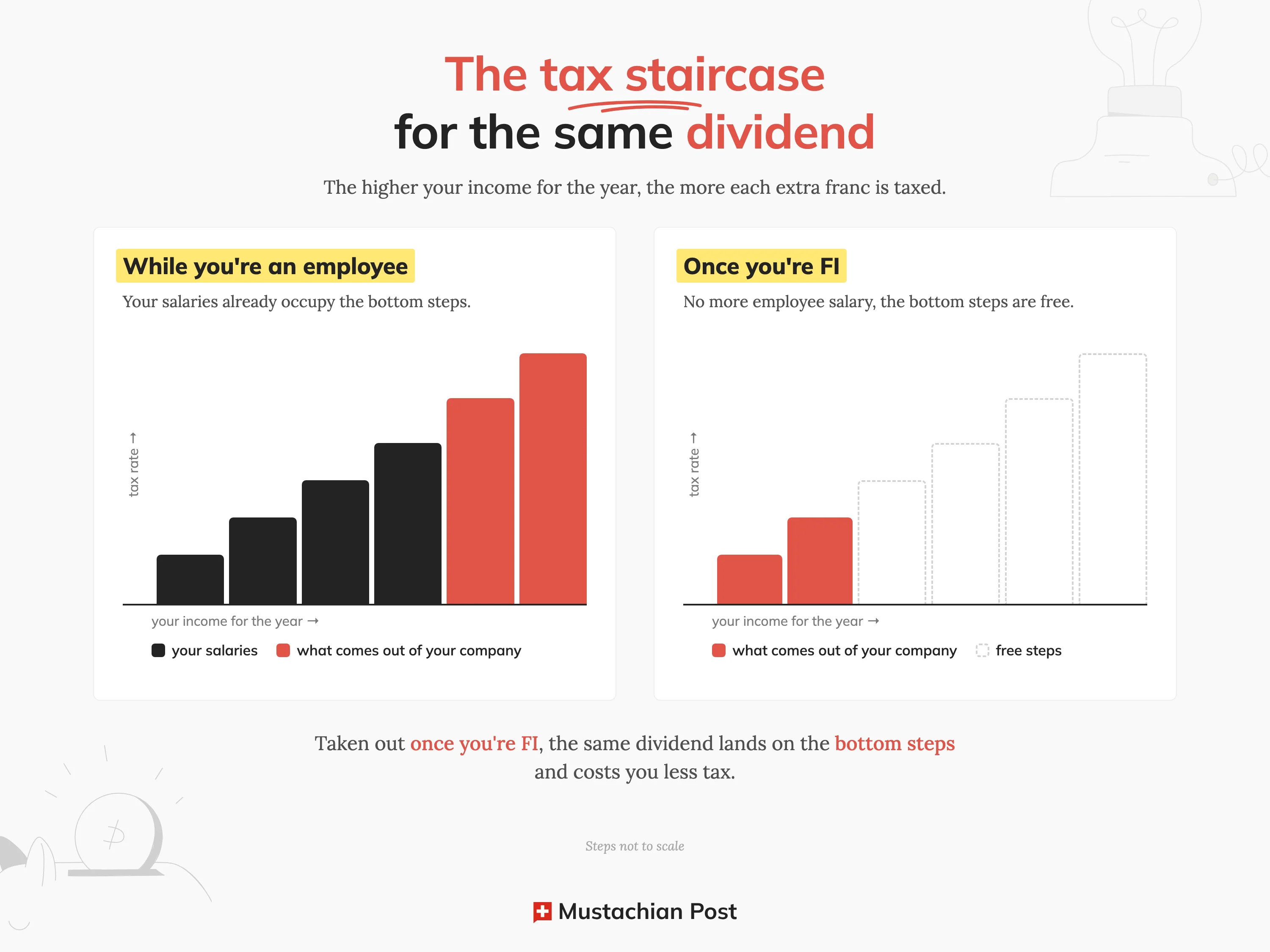
My diagram of the Swiss tax staircase, where a dividend from my company is taxed higher up when I'm an employee than once I'm FI
If you own at least 10% of your company (which is my case), only 70% of a dividend from your own company is added to your taxable income. That's the share counted by federal tax, and also by the canton of Vaud. Other cantons count between 50% (Zurich, Bern, Zug) and 80% (Basel-Stadt) for their own tax. But you still have to factor in that your company's profit was taxed at company level at a flat rate (14% in the canton of Vaud, for example). So the 30% discount softens that double taxation.
All that to say that the effect of tax progression (= every extra franc in the same year is taxed at a higher marginal rate) made me lean toward leaving all the profits in my company, and investing them from there.
But as you know, I like theory, but I like concrete examples with numbers a hundred times more!
Scenario 1: keep the profit in your company, then take it out as dividends
The starting assumptions
Here are my assumptions, inspired by my case, but with round numbers:
- On the path to FI
- A couple
- Based in Lausanne
- With two dependent children
- Taxable income of CHF 160'000 (our salaries)
- The company makes CHF 100'000 of net profit per year for 6 years
- Option A: the company pays a gross salary of CHF 25'000 per year (for managing the business and the admin), and once social security contributions and its tax are paid, about CHF 76'000 is left to take out as a dividend
- Option B: the company keeps and invests the CHF 100'000
Once FI: we own CHF 1 million privately. We no longer have any income from work. We spend CHF 100'000 per year. And we empty our company over 10 years.
So we’re talking about a 16-year scenario (6 years of accumulation, then 10 years of withdrawals).
Note that this is for option B. In option A, since we took all the profit out every year, the company is empty at the end of year 6, so we close it (liquidation) and all our money is already held privately.
That’s my scenario 1. It’s the simplest one to calculate, but it hides a trap, and you’ll see which one further down.
And as a reminder, we assume all our investments are made in the VT ETF, which returns 7% per year (5% growth and 2% dividends). I also counted the 15% US withholding tax on these dividends, which you can only reclaim up to the Swiss tax paid on them (that’s why, in the tables, option A’s wealth once FI and the company’s portfolio grow by 6.7% per year and not 7%).
The result after 16 years
After 16 years, option B ends up with about CHF 205'000 more than option A.
Side by side, here’s what it looks like:
| After 16 years | Option A (salary and dividend every year) | Option B (via the company) |
|---|---|---|
| Final private wealth | CHF 1'458'000 | CHF 1'663'000 |
| Total taxes paid (private + company) | CHF 174'000 | CHF 186'000 |
| Social security contributions on the salary | CHF 29'000 | CHF 0 |
| OASI as a person not in gainful employment (years 7 to 16) | CHF 28'000 | CHF 32'000 |
| Difference | +CHF 205'000 |
And this is where it gets counterintuitive: you pay more taxes with option B, but you still end up richer overall…
It comes down to three steps:
- Option A pays right away. Every year, out of CHF 100'000 of profit, about CHF 29'000 goes to tax and social security contributions. Only CHF 71'000 gets invested privately in the stock market.
- Option B invests everything. The full CHF 100'000 works in the stock market from the first year. At the FI date, that gives CHF 710'000 in the company versus CHF 497'000 privately in option A, i.e. CHF 213'000 more that keeps earning returns.
- Option B pays later, on a bigger amount, but bit by bit. The tax comes at the exit, on the capital and on everything it earned in the meantime. So the tax bill in CHF is higher, but so is what’s left afterward.
What pushes option B’s total taxes higher is the CHF 60'000 paid by the company on its dividends and capital gains, a tax option A doesn’t have since private capital gains are exempt.
Summed up in one picture, here’s what you get:
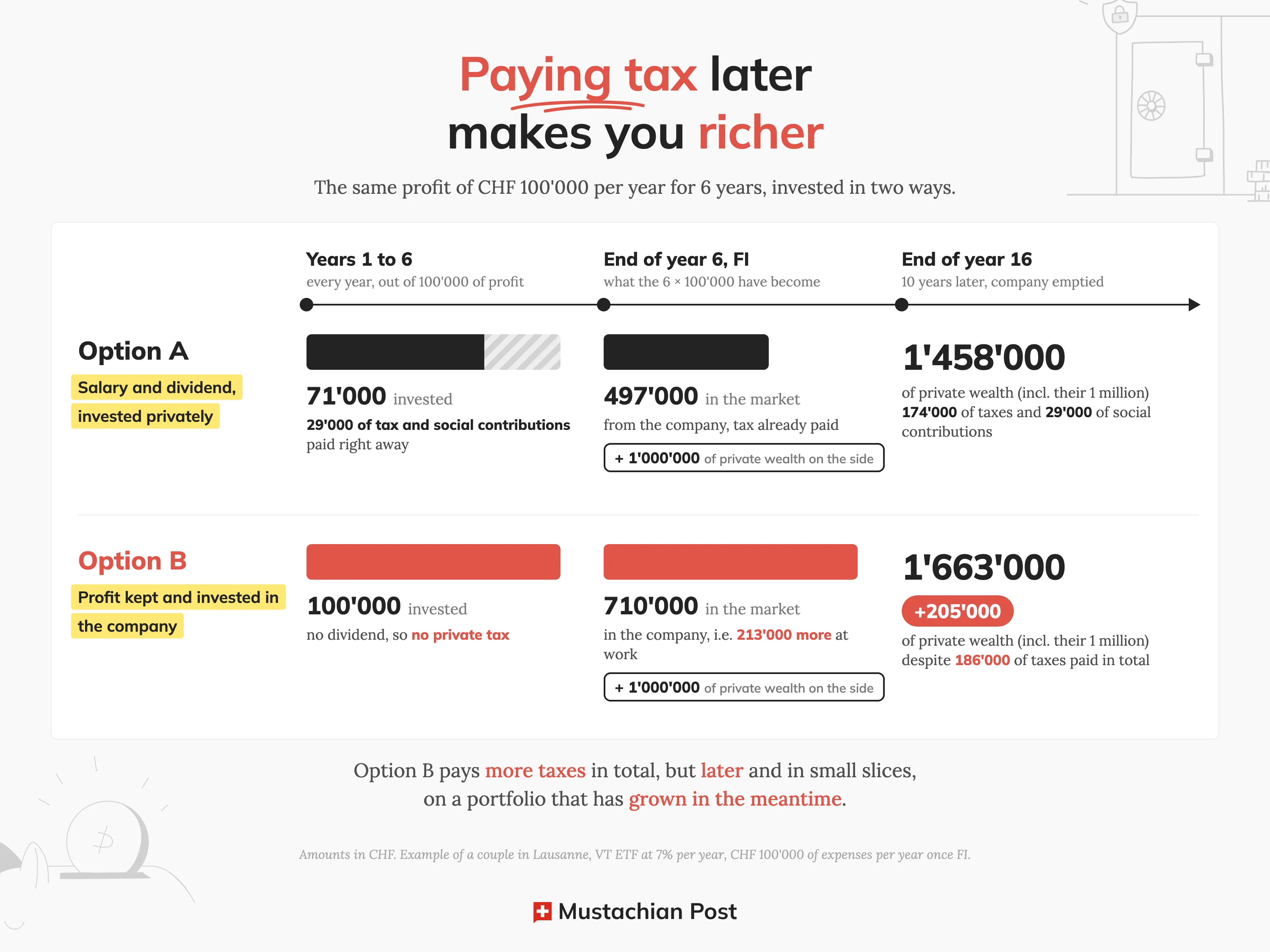
My example with numbers that shows why paying tax later and in small slices leaves me richer than taking everything out every year
And what if you don’t live in Lausanne? I reran the calculation for the 26 cantonal capitals, with each one’s private tax and corporate tax. Option B wins everywhere. The advantage ranges from about CHF 93'000 in Sarnen (Obwalden) to about CHF 283'000 in Liestal (Basel-Landschaft), with CHF 143'000 in Zurich, CHF 152'000 in Bern, and CHF 232'000 in Geneva.
I’m also putting my detailed calculations at the very bottom of the article, right before the FAQ, if you want to redo the math with your own situation (and tell me if you spot any mistake, I’m not an economist by trade!).
So this scenario 1 (option B) corresponds to emptying the cash from your company gently over ten years (after you’re FI). But what happens if you need all your cash at once?
The trap of taking all the cash out of your company at once
Another scenario could be that you tell yourself:
I’ll leave everything in my company, so that once I’m FI, I take out all the cash and pay off my mortgage in one go (because that way, I avoid boring discussions with my banker who doesn’t understand a thing about financial independence…)
Well, in principle, yes, that can be a good plan.
In practice though, it’s a lot less attractive, because option B’s advantage, which optimized our total wealth quite nicely over time, well, it melts like snow in the sun as soon as you take the cash out faster:
| You empty your company in… | Advantage of option B over option A |
|---|---|
| 1 year (all at once) | about CHF 18'000 |
| 5 years | about CHF 134'000 |
| 10 years (my scenario 1) | about CHF 205'000 |
| 20 years | about CHF 363'000 |
As you can see, by taking everything out at once, option B’s advantage drops from CHF 205'000 to CHF 18'000, i.e. eleven times less.
And that makes sense, because a single big dividend of nearly CHF 740'000 lands you at the very top of the private tax scale. And as a result, tax progression eats almost everything the tax deferral had gained (the tax you didn’t pay by leaving the money in your company).
However, we have a problem with this option B of scenario 1 (whether you withdraw over 1, 5, 10, or 20 years), i.e. when we keep everything in the company during years 1-6, and then take the cash out once FI as dividends only…
The trap of dividends without a salary: the AHV (OASI) reclassification
When I got to this point of my blog post, I was so happy to have confirmed that my theoretical plan also held up in practice! And that I knew how I was going to take my cash out of my LLC once I’m FI. Yay!
Except that when I widened my research, I discovered that OASI social security contributions could cause us trouble… (as I hinted above in scenario 1 option A, where we pay ourselves a mini salary).
Basically, if you only take dividends out of your company once FI, the rule is that the OASI can reclassify your dividends as a disguised salary under two conditions:
- No salary paid, or a salary that’s too low for the work done
- A dividend that’s presumed excessive, starting at 10% of the tax value of your shares (that’s THE problem since your company is loaded with cash…)
So you tick both boxes, because you have no salary, and because with a company that has CHF 710'000 of cash to distribute, the critical threshold where the OASI comes after you is CHF 71'000 per year.
So if you pay yourself an annual dividend of CHF 50'000, that’s 7% of CHF 710'000, all good.
But if you want to pay yourself CHF 100'000, that’s 14%, and it’s presumed excessive by the OASI… argh!
So if we want to empty the company in 10 years once FI, we’re bound to break the rule… We’re above it from the 1st year (10.4%), then at 11.5% in the 2nd, 17% in the 5th, and 99% in the last one…
And if you go over, it means the OASI can treat part of your dividend as a disguised salary, and claim social security contributions on it (the employer share and the employee share, i.e. 12.8% of the reclassified amount). The small consolation is that it can only reclassify up to the customary salary for your activity, not necessarily your whole dividend. On the other hand, it can go back up to five years, with 5% interest per year on top.
To put numbers on that, I assumed the worst timing, i.e. the OASI audits you in the first five years after your FI date, claims everything since the start, and then reclassifies every year until the end. For the contribution rate, I used 12.8% (OASI and unemployment insurance). Your compensation office’s administrative fees and the family allowances come on top of that, but it depends on your office so I didn’t include them.
With option B of scenario 1, here’s what it gives over the ten years, depending on what the OASI decides to reclassify:
| What the OASI reclassifies | Contributions to pay over ten years | Remaining advantage of option B |
|---|---|---|
| Nothing (my scenario 1 as is) | CHF 0 | about CHF 205'000 |
| Up to a customary salary of CHF 60'000 per year | about CHF 77'000 | about CHF 131'000 |
| ALL the dividends (the worst case) | about CHF 124'000 | about CHF 70'000 |
N.B. If you redo the subtraction, you won’t land exactly on these numbers. That’s because in the years the OASI reclassifies, you no longer pay OASI contributions as a person not in gainful employment, and conversely the money spent on contributions no longer works for you.
This table shows the maximum the OASI can claim. In practice, it can be less. In ruling BGE 141 V 634 of the Federal Supreme Court, the compensation office only reclassified the part of the dividend above 10% of the company's value. With that reading, the contributions would drop to about CHF 50'000, and option B's advantage would stay at about CHF 172'000.
So the solution to avoid this OASI reclassification is to pay yourself a small salary you can justify for the work you still do in your company (the admin, the bookkeeping, managing the stock portfolio), and the rest as dividends. For example, 25% of a CHF 100'000 position, i.e. CHF 25'000 1 per year. With a salary that matches your workload, the OASI no longer has any reason to reclassify, whatever the dividend.
And if it hurts to pay yourself a salary when you’re FI, know that with no salary at all, you would still have had to pay OASI contributions… Because as long as you haven’t reached the official retirement age, you contribute as a “person not in gainful employment”, based on your wealth. For our couple, that would be about CHF 1'600 per year each, so CHF 3'200 for two. Whereas a salary of CHF 25'000 generates about CHF 2'650 of OASI contributions per year and also covers your spouse (!!), who then has nothing left to pay. I explain all of this in detail in my article OASI contributions after FIRE: how much do I have to pay?
All that being said, I recommend you ask your OASI compensation office for a “ruling” before you get started, say one year before becoming FI, so you can sleep soundly.
And coming back to our scenarios, I’ve prepared a second one for you to avoid this trap of having option B’s dividends reclassified as salary…
Scenario 2: what if your company pays you a small salary after FI?
In our scenario 2, we keep option A as before (taking the company’s profits out during years 1-6 as a small salary + dividends).
For option B, however, instead of taking everything out as dividends over years 7 to 16 and risking an OASI reclassification, we’ll change that by taking the profits out as a small salary + dividends.
And here’s what it gives:
| Option A | Option B of scenario 1 (dividends only) | Option B of scenario 2 (CHF 25'000 salary + dividends) | |
|---|---|---|---|
| Wealth at the end of year 16 | CHF 1'458'000 | CHF 1'663'000 | CHF 1'659'000 |
| Social security contributions paid on the salary, over ten years | - | CHF 0 | CHF 48'000 |
| OASI as a person not in gainful employment, over ten years | CHF 28'000 | CHF 32'000 | CHF 0 |
| Advantage over option A | - | about CHF 205'000 | about CHF 200'500 |
So the small salary lowers option B’s advantage by about CHF 4'500 over ten years (= CHF 205'000 - CHF 200'500). In other words, it comes out almost the same, and that’s the price of peace of mind with the OASI. And it’s still much better than getting reclassified by the OASI in the first place (see the table above).
However, for this calculation to hold in favor of option B, the salary has to stay small. Because if, for example, you go from CHF 25'000 to CHF 50'000 of salary, the advantage drops from CHF 200'500 to about CHF 117'000… (because of the higher social security contributions).
Over ten years, a salary of CHF 25'000 per year generates about CHF 48'000 of social security contributions, whereas a dividend pays none.
But this salary saves you two things. First, the CHF 32'000 of OASI contributions as a person not in gainful employment, which you no longer have to pay. And then about CHF 18'000 of taxes. A salary is taxed at 100% in your hands, versus 70% for a dividend from your own company, but in exchange it reduces your company's tax (over ten years, it goes from about CHF 53'000 to CHF 15'000).
In the end, what the salary costs and what it saves roughly balance out.
OK, so for these two scenarios, my initial theoretical idea of leaving the cash in the company (invested in the stock market, of course!) was the right one. Option B wins every time.
But once you’re FI, we both know that traveling and sipping cocktails, yes, you’ll do that for the first weeks or months… But at some point you’ll get bored. And as Viktor Frankl explains in his book “Man’s Search for Meaning”, humans need a purpose to be happy, and even to live longer according to this study of nearly 7'000 Americans over 50.
So what happens if your company keeps making money after your FI date…?
Scenario 3: what if your company still makes money after FI?
To keep things simple, imagine you quit your job the day you’re FI, but instead of your company no longer bringing in anything, we assume it keeps bringing in CHF 100'000 per year for 10 more years.
And after that, promise, you’ll go raise goats in the Bernese Oberland or only enjoy hikes and your grandchildren (yes, you’ll get old too haha!).
So in this scenario 3, option A doesn’t change one bit. As long as the company makes money (years 1 to 16), we take everything out every year, as a small salary + dividends. And at the end of year 16, when it no longer brings in anything, we close it.
For option B, the logical reflex would be to tell yourself:
Let’s carry on as before! We just pay ourselves the small CHF 25'000 salary to be safe with the OASI, we live on our private million, and we let everything else grow in the company, to push the tax back as late as possible.
Except that when you do the math, it sobers you up fast…
The trap of piling up cash after FI
If option B keeps everything in the company during years 7 to 16, it ends up with about CHF 2'396'000 in it at the end of year 16. And once we’ve emptied it over ten years, it finishes with about CHF 67'000 less than option A.
Yes, less, you read that right!
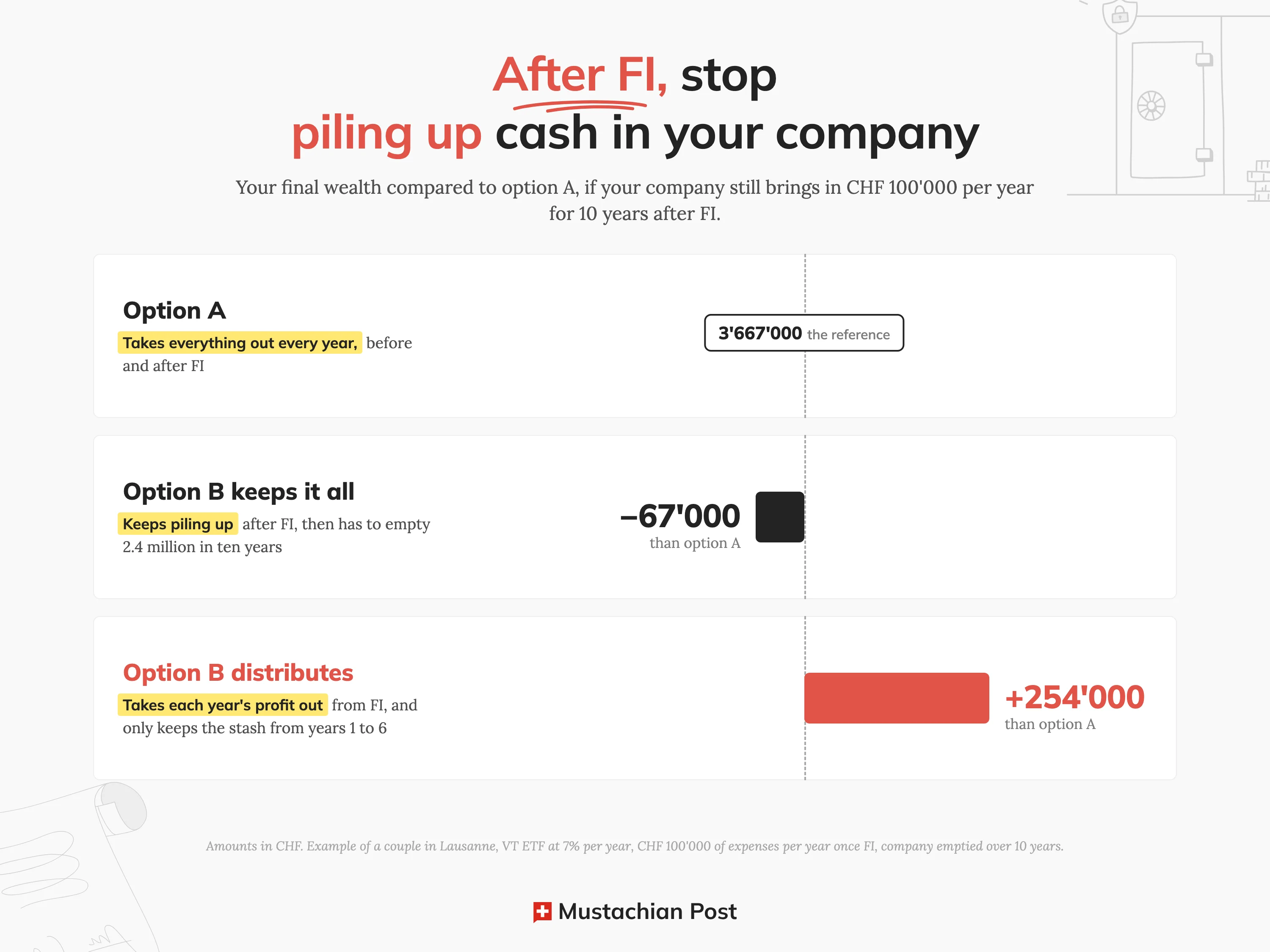
My scenario 3 with numbers, where keeping all the profits in my company after FI costs me CHF 67'000 while distributing them earns me CHF 254'000
The reason is really simple:
- During years 7 to 16, you no longer have your employee salary, so your private tax rate is low. Option A takes advantage of that to take its dividends out cheaply, with CHF 19'000 of tax per year on average
- Option B, which keeps everything, pays almost nothing during those ten years (about CHF 3'700 per year), so it wastes those low-rate “good years”
- But when it has to empty its 2.4 million, that means dividends of CHF 219'000 to CHF 394'000 per year, at the very top of the tax scale, with CHF 44'000 to CHF 115'000 of tax per year… Ouch!!
It’s the same trap as the big dividend taken out at once, except it’s spread over ten years.
So the lesson I take from this is that pushing tax back is only a good deal if you push it toward years when your tax rate is lower. As long as you have your employee salary, keeping the money in the company is smart. Once you’re FI, it’s time to take your profits out.
The right version of option B
So I adapted option B of scenario 3 like this:
- From the FI date, it does the same as option A with each year’s profit, taking it out as a small salary + dividends (which works out well, since that covers a good part of our CHF 100'000 of annual expenses)
- And the only difference left is the stash from years 1 to 6, which we let grow in the company until it no longer brings in anything
In short:
| Scenario 3 | Option A | Option B |
|---|---|---|
| Years 1 to 6 (your job + your company) | Small salary + everything else as dividends | Nothing comes out, everything is invested in the company |
| Years 7 to 16 (you’re FI, your company still brings in money) | Small salary + everything else as dividends | Same as option A, and the stash from years 1 to 6 stays invested in the company |
| End of year 16 (your company no longer brings in anything) | Company closed, everything is held privately | The stash has grown to about CHF 1'358'000 |
| From year 17 | We live on our private wealth | We empty the company bit by bit (small salary + dividends, as in scenario 2) |
And to see whether emptying the company faster or slower changes anything, I ran the calculation over three durations. Let’s imagine you’re FI at 40 (that reminds me of the title of a book ^^), your company keeps bringing in money until you’re 50, and you finish emptying it at 60, 70, or 80:
| You finish emptying your company at… | Wealth with option A | Wealth with option B | Advantage of option B |
|---|---|---|---|
| 60 (in 10 years) | CHF 3'667'000 | CHF 3'922'000 | about CHF 254'000 (+6.9%) |
| 70 (in 20 years) | CHF 5'580'000 | CHF 6'085'000 | about CHF 504'000 (+9.0%) |
| 80 (in 30 years) | CHF 9'252'000 | CHF 9'997'000 | about CHF 746'000 (+8.1%) |
So option B wins at every age, as long as you stop piling up cash the day you’re FI. And the more you spread out the withdrawals, the more the advantage grows in francs, even though as a percentage of your wealth it stays around 7% to 9%.
Three clarifications on these numbers:
- A good part of the advantage comes from the OASI. Once its company is closed, option A no longer has a salary. So our couple contributes as “persons not in gainful employment”, based on its wealth of several million until age 65, i.e. about CHF 6'500 per year for two. Option B, for its part, keeps paying itself its small salary, which covers both spouses as long as the couple’s wealth stays under about 4.5 million. Above that, it also pays OASI contributions on its wealth, minus the CHF 2'650 already paid on its salary. In my calculations, that only happens in the last three years before 65. Of the CHF 254'000 advantage at 60, about CHF 87'000 comes from this, and it’s half of the advantage at 80
- The wealth figures look huge because I didn’t account for inflation… The couple spends CHF 100'000 per year for up to forty years, whereas in real life that amount goes up every year. And since the three rows stop at different ages, CHF at 60 and CHF at 80 don’t have the same value. That’s why I’m also giving you the percentages
- My way of emptying the company is simplified. I take out the same share of the portfolio every year, and since it keeps growing, the last dividends are bigger than the first ones. More even slices would probably do a bit better still, but that doesn’t change the conclusion that option B is the best one
So that’s it for the concrete numbers.
Now you may be wondering what I’m going to do in my own case?
What I take away from this for my own company
I’m simply going to follow option B of scenario 2. Meaning I’ll pay myself a small salary + dividends, spreading the “emptying” of my company’s cash over as long as possible to optimize my taxes as much as I can.
That will spare me the OASI reclassification issue of dividends alone. And, as a bonus, it means I won’t have to pay OASI contributions on my private wealth.
And if my company keeps making money once I’m FI, I’ll once again pick option B of scenario 3. That is, via a small salary + dividends, spread out over time as much as possible too.
The only thing that could change this plan, and make me pay myself more than “just a small salary”, will be my mortgage and my bank’s rules, at my next mortgage renewal. I’ll update this article (or write a new one) when we get to that point :)
And if you skimmed the rest of the article to get to this section, one key point to remember: in this option B where we keep a ton of cash, well, all the calculations only hold as long as you invest all that cash in the stock market with the best possible broker for a legal entity. Because otherwise, the calculations are off without compound interest (and also if you pick a lousy broker that charges you outrageous fees!).
Oh, and just to be clear about the approach, I’m listing the limits of my calculations below (it gives me a record too).
What my calculations don’t take into account
- Wealth tax (privately) and capital tax (in the company). I left them out to keep the tables readable, but I reran the calculation with them, to be sure. The verdict stays the same. Option B stays ahead, with about CHF 28'000 to CHF 32'000 less advantage (about CHF 177'000 instead of CHF 205'000 in scenario 1, and about CHF 168'500 instead of CHF 200'500 in scenario 2). The reason is that your company shares count in your taxable wealth, and that in option B they contain money that hasn’t paid its income tax yet. The company’s capital tax, for its part, is negligible (less than CHF 3'000 in total)
- Accountant fees can vary. I counted CHF 2'000 per year to keep the company alive, plus CHF 2'700 of fees the day you close it (in both options). It can be a bit more if your case is complex, and it also depends on your canton and on whether you use a small accounting firm or a big one. But it stays marginal compared to the other amounts in the calculations
- How your accountant books your ETFs. All my calculations assume your company’s securities are booked at their purchase price, which means their increase in value is only taxed when you sell them. If your accountant books them at market value, the increase is taxed every year, and option B’s advantage shrinks (about CHF 192'000 instead of CHF 205'000 in scenario 1, and about CHF 181'000 instead of CHF 200'500 in scenario 2). By the way, while writing this article, I discovered that my own accountant books my ETFs at market value… So I’m going to ask them whether we can change that along the way, and I recommend you check this with yours before you get started
- A third way to optimize taxes would be to pay yourself more, to increase your 2nd pillar (LPP/BVG), and therefore the amount of 2nd pillar buy-ins available to you. And when you stop paying yourself a salary, you put all of that to work in a vested benefits account invested 100% in stocks. But that locks cash in your 2nd pillar when you’ll need it to fund your financial independence… So that’s why I’m not digging into this option in this article
- Tax laws can change in 20 years. So if I hear about such changes, I’ll do my best to write you a new article with the updated data
There, that’s said ;)
My detailed calculations for scenario 1, year by year
As promised, here are the year-by-year tables for scenario 1.
First, during the FI accumulation phase:
| Year | Profit set aside | Option A (net salary) | Option A (dividend) | Option A (extra private tax) | Option A (total invested privately) | Option B (total invested in the company) |
|---|---|---|---|---|---|---|
| 1 | 100'000 | 22'888 | 76'222 | 28'186 | 70'924 | 100'000 |
| 2 | 100'000 | 22'888 | 76'222 | 28'795 | 146'204 | 206'700 |
| 3 | 100'000 | 22'888 | 76'222 | 29'420 | 226'129 | 320'549 |
| 4 | 100'000 | 22'888 | 76'222 | 30'059 | 311'009 | 442'026 |
| 5 | 100'000 | 22'888 | 76'222 | 30'762 | 401'129 | 571'641 |
| 6 | 100'000 | 22'888 | 76'222 | 31'508 | 496'810 | 709'941 |
A few clarifications on this first table:
- “Option A (extra private tax)” is the additional tax caused by the salary and the dividend from the company, on top of the tax the couple already pays on its other salaries and its wealth.
- The gross salary of CHF 25'000 costs the company CHF 2'649 in employer contributions and CHF 2'112 in employee contributions, hence the CHF 22'888 net. And since a salary is a deductible expense, the company pays a bit less tax on its profit, hence the CHF 76'222 dividend.
- This tax saving on the company side (about CHF 23'000 over 6 years) is deducted from option A’s taxes in the summary table above. That’s why you read CHF 174'000 there, while its total private tax is CHF 197'500
Then come the first ten years of FI, where we empty our company’s profits to cover our cost of living.
Quick reminder so you don’t get lost: in option A, the company was closed at the end of year 6 since it was empty, and we live on our private wealth. In option B, it’s the opposite. Since we took nothing out for six years, the company is still full at the end of year 6, with about CHF 710'000 in it. And it’s only from year 7 that we empty it bit by bit, over ten years:
| Year | Option A (private tax) | Option A (OASI, not in gainful employment) | Option A (private wealth) | Option B (dividend taken out of the company) | Option B (private tax) | Option B (OASI, not in gainful employment) | Option B (private wealth) | Option B (left in the company) |
|---|---|---|---|---|---|---|---|---|
| 7 | 1'886 | 2'756 | 1'491'459 | 74'185 | 8'131 | 3'180 | 1'032'135 | 679'957 |
| 8 | 1'886 | 2'756 | 1'488'631 | 78'496 | 8'907 | 3'180 | 1'070'129 | 643'123 |
| 9 | 1'880 | 2'756 | 1'485'613 | 83'069 | 9'745 | 3'180 | 1'114'594 | 598'686 |
| 10 | 1'880 | 2'756 | 1'482'393 | 87'915 | 10'676 | 3'180 | 1'166'170 | 545'827 |
| 11 | 1'872 | 2'756 | 1'478'958 | 93'040 | 11'685 | 3'180 | 1'225'560 | 483'664 |
| 12 | 1'853 | 2'756 | 1'475'292 | 98'444 | 12'773 | 3'180 | 1'293'515 | 411'256 |
| 13 | 1'846 | 2'756 | 1'471'380 | 104'113 | 13'968 | 3'180 | 1'370'805 | 327'608 |
| 14 | 1'846 | 2'756 | 1'467'207 | 109'999 | 15'260 | 3'180 | 1'458'214 | 231'705 |
| 15 | 1'840 | 2'756 | 1'462'754 | 115'950 | 16'620 | 3'180 | 1'556'439 | 122'615 |
| 16 | 1'820 | 2'756 | 1'458'002 | 121'307 | 18'003 | 3'180 | 1'662'813 | 0 |
Note that in year 7, the starting million of our private wealth comes into play at the FI date. So option A starts at CHF 1 million plus its CHF 496'810, minus the CHF 2'700 of fees for closing its company, and option B at CHF 1 million flat, the rest still being in the company.
Also, the “Option B (dividend taken out of the company)” column is the net amount received, after the company’s tax on the capital gain sold. Option B’s private tax comes next, in its own “Option B (private tax)” column.
And you don’t need to subtract option A’s private tax on top of that. It’s smaller than the US withholding tax, so it’s already included in the 6.7%.
I only gave you the detailed calculations for scenario 1 to keep the article from getting even longer ^^… Scenarios 2 and 3 follow exactly the same mechanics, with the small salary on top.
FAQ
Can you invest in the stock market with a GmbH (LLC) in Switzerland?
Yes, you can invest in the stock market with a GmbH (LLC) in Switzerland. All you need is a Swiss company registered in the commercial register to open a brokerage account for a legal entity (and it’s the same with an SA/AG). Opening it is very similar to opening a private account. The only extra thing is the LEI number your company has to order, then renew every year. I explain all of this in my comparison of the best broker for a company in Switzerland.
What tax does a company pay on its ETFs?
On its ETFs, a company pays profit tax (14% in the canton of Vaud, for example), at two points in time. Every year, on the dividends the ETF pays it. And the day it sells its shares, on the capital gain. As long as it doesn’t sell anything, the increase in value isn’t taxed, provided your accountant books the securities at their purchase price. That’s the big difference with you as a private person, where the capital gain is tax-free.
How much tax do you pay on a dividend from your own company?
On a dividend from your own company, you pay income tax on 70% of the amount if you own at least 10% of the shares (that’s the share counted by federal tax and by the canton of Vaud, other cantons count between 50% like Zurich, Bern, or Zug and 80% like Basel-Stadt for their own tax). The final amount depends on your other income for the year, since the tax staircase decides. In my example, as long as we earn our CHF 160'000 of salaries, the small salary and the CHF 76'000 dividend cost us between CHF 28'000 and CHF 32'000 of extra private tax per year. But once FI, we pay less than CHF 9'000 of private tax in the year we take out a CHF 74'000 dividend. And for the dividends from your ETFs and stocks held privately, I explain everything in my article on Swiss dividend tax.
Salary or dividend from your own company: which is better?
Both, with a small salary first and everything else as dividends. The small salary matches your workload, so that the OASI has no reason to reclassify your dividends as salary (ideally below the CHF 22'680 threshold so you don’t have to join a 2nd pillar pension fund). And the rest goes out as dividends, because a dividend doesn’t pay social security contributions. In my example, that means CHF 25'000 of salary per year. And if you go up to CHF 50'000, the advantage of investing via your company drops from CHF 200'500 to about CHF 117'000. I go through all of this above, in the trap of dividends without a salary.
Which online broker should you choose to invest with your company in Switzerland?
Interactive Brokers is the best online broker to invest with your company in Switzerland. There’s no minimum amount to open an account for your company, and its fees are the lowest I’ve found. As a bonus, it’s the same broker as for your private account, so you don’t have to learn a new platform. You’ll find all the numbers in my comparison of the best broker for a company in Switzerland.
Conclusion
This question I had put aside because it looked complicated turns out to have a rather simple answer in the end.
Yes, it’s smart to invest via your company, as long as you respect the three conditions from the start, namely:
- Take the money out of your company slowly, so that each dividend stays on the bottom steps of your private tax staircase
- Pay yourself a small salary alongside your dividends, so that the OASI has no reason to reclassify them
- Stop piling up cash in your company the day you’re FI, because that’s when your private tax rate is at its lowest to take your profits out
In my example, that means about CHF 200'500 more wealth after 16 years (compared to taking all the company’s profits out every year), just by paying tax later and in small slices.
So that’s what I’m going to do personally, namely start taking the cash out of my LLC only once I’m FI, via a small salary and the rest as dividends. As for the amount, we’ll make it cover our day-to-day expenses, in order to spread these cash withdrawals over as many years as possible (= the best way to let the money work in the stock market for as long as possible, before taxes take their cut).
And if you remember only one action from this article, it’s to calculate your own tax staircase before taking a big amount out of your company. Take your taxable income for the year, add 70% of the dividend you want to pay yourself (or your canton’s percentage, between 50% and 80%), and check on the Swiss Confederation’s tax calculator what it costs you in one go, then spread over five or ten years.
Finally, as I said at the beginning, there are plenty of other possible scenarios. If yours doesn’t look like any of the three in this article, describe it to me in the comments below. I won’t be able to analyze every situation in detail, but it might give me my next case study for a follow-up article ;)
You may want to limit yourself to a 20% part-time position (or 22% to be precise), to stay under the CHF 22'680 limit (2026 figure). Otherwise, if you pay yourself more than that, you have to join a 2nd pillar pension fund… To keep things simple in our case where we’re above that threshold, I counted all the social security contributions on a CHF 25'000 salary in Lausanne in 2026, employer share and employee share (OASI/DI/EO, unemployment insurance, family allowances, the compensation office’s fees, accident insurance, and the 2nd pillar minimum). That comes to about CHF 4'760 per year, i.e. 19% of the salary. ↩︎

Last updated: November 26, 2026