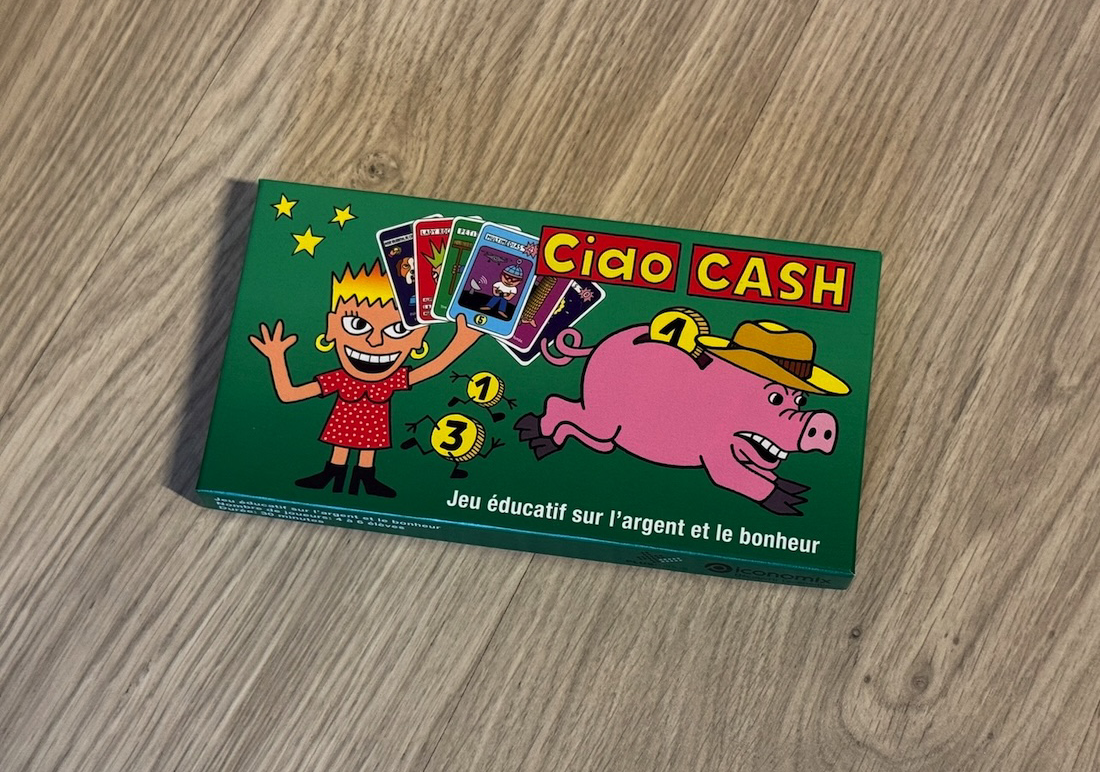
What if you could play a board game, and it would trigger natural discussions about money management with your kids?
Yes, there is such a game: Ciao CASH. It’s a Swiss card game that lets you talk naturally with your children about savings, consumption, debt and even investing.
The game’s biggest strength: it teaches children about the relationship between money and happiness!
Why learning to manage money early changes everything
Teaching your children to manage money between the ages of 5 and 15 encourages healthy financial habits in the future (savings, no debt, etc.).
The scientific literature 1 confirms what seemed logical to me: “The most important policy lesson from our research is that financial education can be effective. [aka has a real impact on children’s future].”
The same economic paper states: “Intervention success depends crucially on increasing education intensity and offering financial education at a teachable moment.”
A concrete, quantified example (if I’d been taught even more about managing my money)
For our example below, I’ll be basing myself on the pocket money figures recommended by the association Budget-conseil Suisse (see my article “How to manage children’s pocket money in Switzerland?”).
So let’s imagine that, from the age of 6, I put aside 50% of everything I receive (pocket money, odd jobs, birthdays).
And as luck would have it, my parents invested this money in the stock market for me with an annual return of 7% (and as soon as I’m old enough to understand investing, I continue to do so).
Years go by.
At the age of 18, I have CHF 3'370. It’s not so much the amount that counts here, but rather the habit of saving.
Then, I start my working life at 20, with no other assets to speak of. But I already have:
- the reflex to save 50% of everything I earn
- the habit of investing in the stock market
- and above all, time on my side (decades)
Then my first salary arrives.
CHF 5'000 a month for my first job. Then it slowly but surely increases.
Compound interest does its job, and I find myself a millionaire at… 34 years old! Without effort, because it’s a habit for me.
And imagine: that’s without any summer jobs. No job bonuses. No division of expenses if you’re a couple or sharing a flat. No continuing education to further increase my salary. Not becoming an entrepreneur. None of the above. Just an ingrained habit taught to me by my parents.
In a table, here is what happens when you set aside 50% of all your income since you were 6 years old and invest it in the stock market:
| Age | CHF per month (50% is invested) | CHF at year-end |
|---|---|---|
| 6 | 4 | 26 |
| 7 | 8 | 80 |
| 8 | 12 | 163 |
| 9 | 16 | 278 |
| 10 | 25 | 458 |
| 11 | 25 | 651 |
| 12 | 30 | 890 |
| 13 | 30 | 1'145 |
| 14 | 40 | 1'482 |
| 15 | 50 | 1'907 |
| 16 | 50 | 2'362 |
| 17 | 50 | 2'849 |
| 18 | 50 | 3'370 |
| 19 | 50 | 3'927 |
| 20 | 50 | 4'523 |
| 21 | 5'000 | 39'615 |
| 22 | 5'000 | 77'164 |
| 23 | 6'000 | 124'296 |
| 24 | 6'000 | 174'727 |
| 25 | 6'500 | 232'166 |
| 26 | 7'000 | 297'103 |
| 27 | 7'000 | 366'586 |
| 28 | 7'500 | 444'410 |
| 29 | 7'500 | 527'682 |
| 30 | 8'500 | 623'738 |
| 31 | 8'500 | 726'518 |
| 32 | 8'500 | 836'492 |
| 33 | 8'500 | 954'164 |
| 34 | 8'500 | 1'080'073 |
So yes, I really wish someone had taught me the 50% rule when I was 6… :)
So that’s all the more reason to find ways to teach our kids about money.
How did we come across Ciao CASH?
While reading about the Swiss Money Week in a newspaper, I came across an article mentioning a certain Sébastien Bétrisey from the Swiss National Bank. He is responsible for the Iconomix community in French- and Italian-speaking Switzerland. Iconomix is the Swiss National Bank’s educational program for economics and social sciences in upper secondary schools.
I thought it would be interesting to meet him in the context of the blog and our desire to instill the best financial education in our children.
One thing led to another, and he told me about Ciao CASH. So, without missing a beat, I brought the game home, and here we are with this article.
As he explained, Ciao CASH lets you talk about money as a family, from different angles:
- Consumption
- Saving
- Debt (bad…)
- Investment (good)
- Life decisions that have an impact on your finances
And all this without complicated numbers, just the mental framework.
Why I wanted to test Ciao CASH with my kids
I’ve seen the economics courses my kids have had, and while it’s a good foundation, it was pretty theoretical.
And then when you’re in class, you might not dare broach certain subjects out of shyness, or because it’s not in the family context.
But with Ciao CASH, you have the main concepts of personal finance, AND the fun aspect.
Well, when my children said to me “Oh, but we know it, we’ve already played it in class… “, it kind of stopped me in my tracks :D
However, they seemed to think that in class, it was a bit boring, whereas with us, it sparked many really interesting discussions. I’ll come to that in a moment.
What exactly is Ciao CASH?
Ciao CASH is a game for teaching children about money management.
The main features are:
- A Swiss card game
- Two to six players (ideal scenario: 4-5 players per deck of cards)
- For children aged 10 and over
- Not moralizing
- Deliberately not too detailed
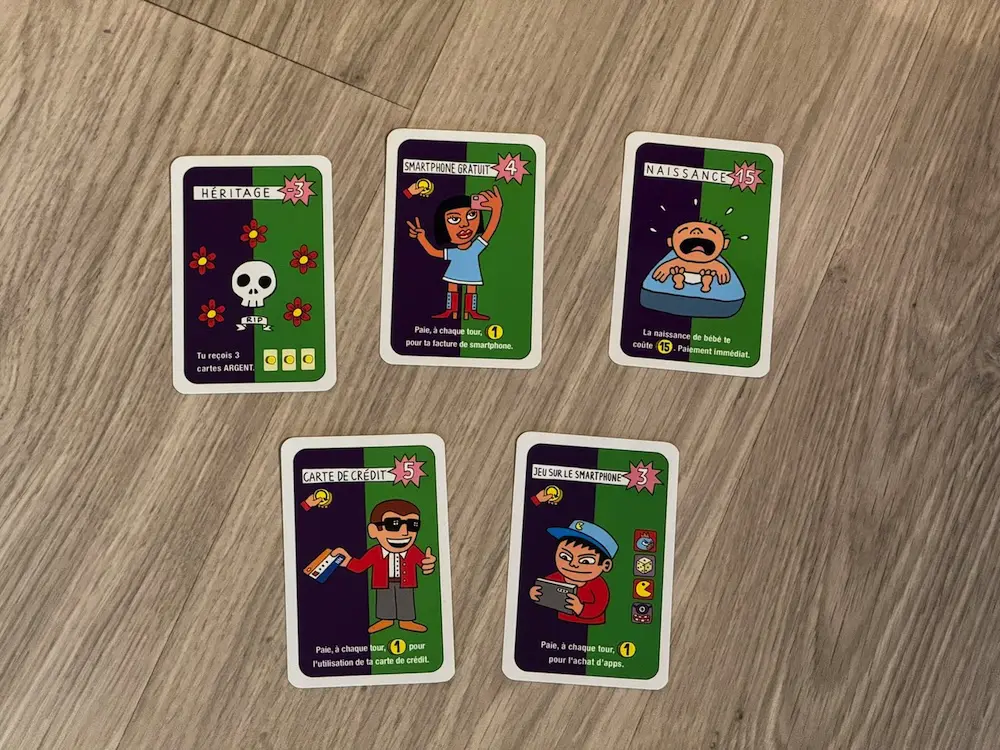
You have different types of cards:
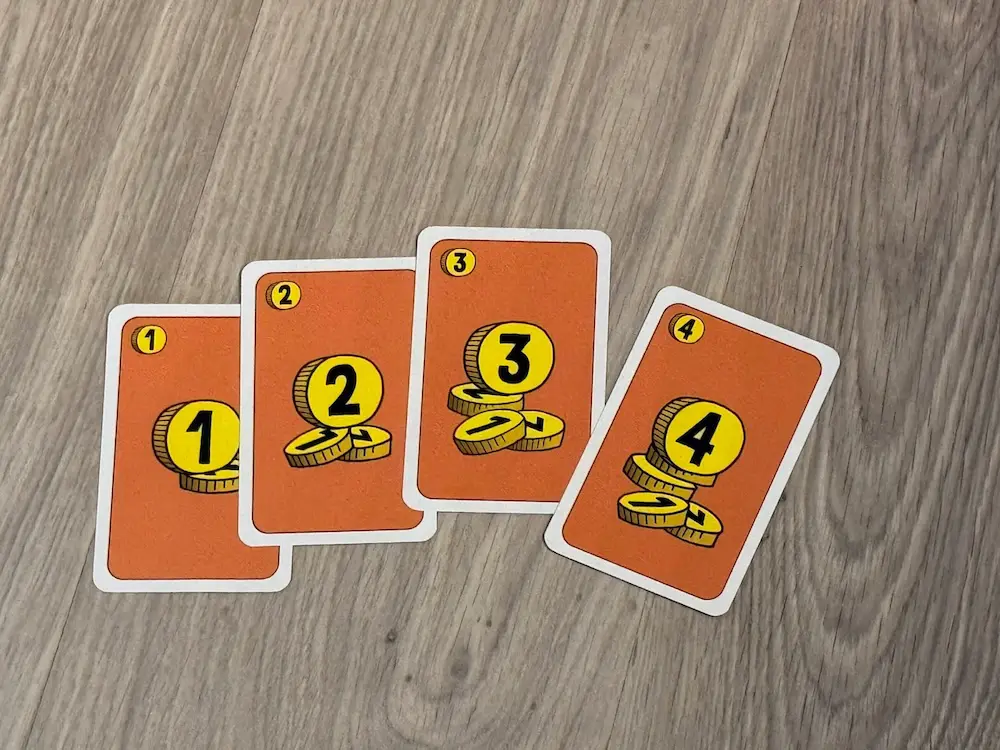
- “Money” (for income)
- “Desire/Surprise” (for unexpected events, both positive and negative, just like in real life)
- “Loan” (not good! haha)
- “Character” (optional card to spice up the game with different personalities who have specific desires to fill)
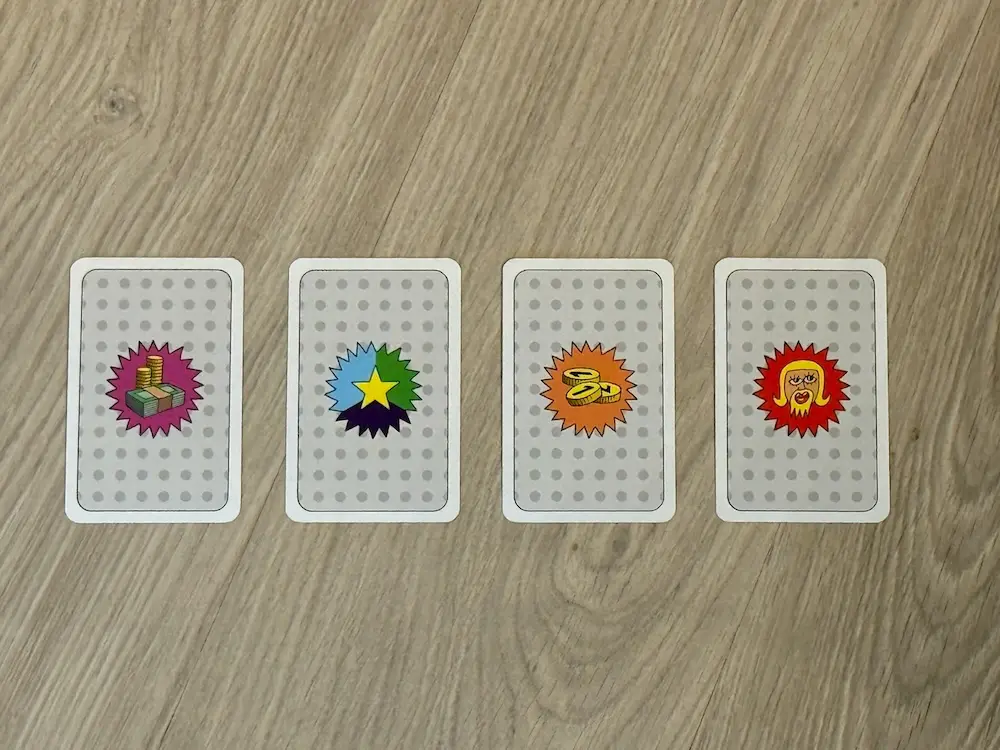
The game aims to accumulate as many points as possible. The points are comprised of money and happiness points! And it’s this latter concept that’s key, compared with Monopoly, for example, where the focus is solely on capital. This allowed us to discuss the important link between money and happiness with our children. And that’s priceless!
What Ciao CASH triggered in our kids
“I’m out of this loan! Life is great!”
I think that’s THE sentence that stuck with me the most. When one of my children finished paying off all his debts at one of Ciao CASH’s first games, and exclaimed ultra-positively, grinning from ear to ear:
I’m out of this loan! Life is great!
Or how to talk about debt and spiraling indebtedness without being moralistic :)
“I’ve been to University, now I get extra pay!” at every turn
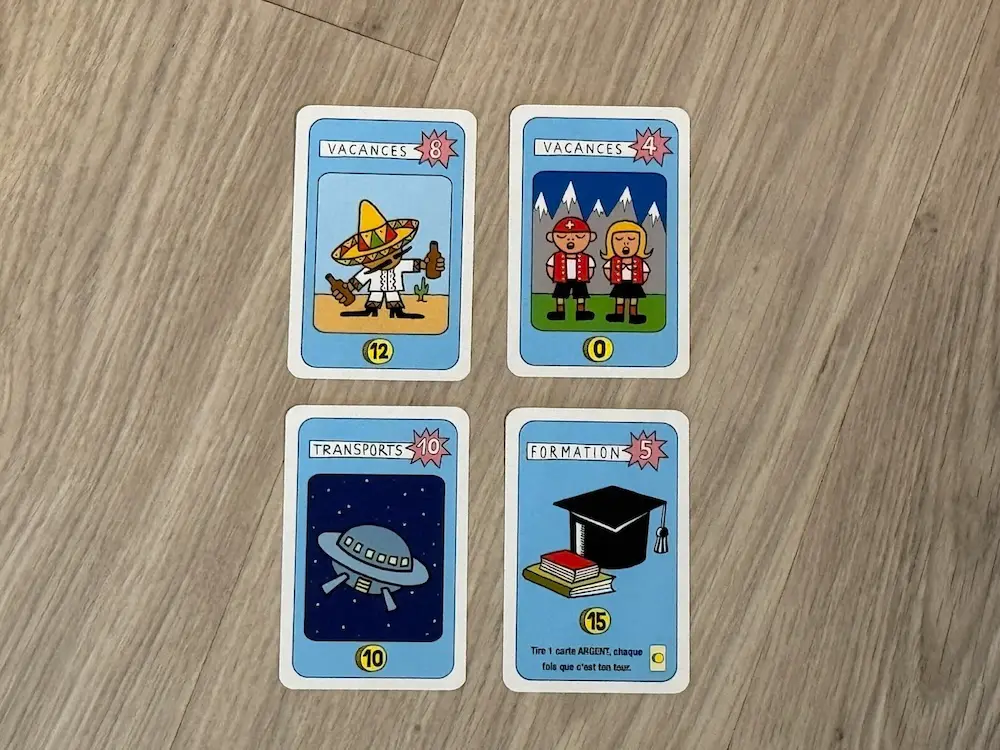
Another aspect was the discussion around studies. Because, in the game, if you opt to study, you get to draw more cash cards. Every turn. Suffice to say, my kids loved studying (virtually at least, ahah!)
Afterwards, I told them about the entrepreneurial path, which could be even more fruitful. More great discussions to be had.
And I was also able to discuss the principle of “always thirsting to learn”. I told them about my own case where, at one point in my studies, it became uninteresting. I was even put off reading. Until I came across non-fiction books about business and things like that. And that helped me a lot in my career, in addition to my studies. I used to explain to my oldest that it was an investment in oneself.
That’s the kind of discussion I enjoyed having with my children.
And many other financial concepts
There are many more concepts in this game. I’ll leave it to you to discover them, such as:
- The randomness of life with “Surprise” cards
- The real estate investment aspect, which is expensive in the game, but pays off handsomely (just like in real life ;))
- Frugality is also subtly addressed, with the example of a “hiking in a tent” vacation, vs. an expensive all-inclusive vacation. I love it!
What surprised me most as a parent
The most surprising thing for me as a parent was the number of topics of discussion we had with our children. And also the depth, because we often made the connection with how Mrs. MP and I acted in daily life, our frugal lifestyle, our aversion to debt, the overconsumption we see all around us. And also investment.
I realized the other surprising point when the children had to choose between short-term pleasures and long-term strategy. In the first part, we let them make their own mistakes. And by the second part, we were guiding them to help them win. And that’s where the game makes all the difference: you don’t say it as a “parent” (aka moralizing your kids), but on the contrary you do it to help them win. As a result, they love it, and above all, they listen to you!
And really, the part where my youngest naturally exclaimed that he was debt-free, that’s when I thought we were on to something.
Do I recommend Ciao CASH to parents?
Yes, I would 100% recommend Ciao CASH to parents with children aged between 8-10 and 14-15.
It’s an excellent basis for discussion. And you need to complement it with other techniques like pocket money and budgeting.
One point to bear in mind: if you don’t agree as a couple on the subject of money, you’d better get your act together first, so that you can talk consistently to your kids. Because if you don’t, the interesting discussions won’t just be with your children ;)
FAQ Ciao CASH
Is Ciao CASH suitable for playing at home?
Yes, Ciao CASH is suitable for family play, even without the school context. On the contrary, I find that children can let loose more and can contextualize discussions by playing with their parents.
How long does a game of Ciao CASH last?
A game of Ciao CASH usually lasts about 30 minutes.
At what age should kids start playing Ciao CASH?
From experience, I’d say from the age of 8-10 upwards, so that children understand the basic mechanisms very quickly.
What languages are available?
The game is available in French, German and Italian.
Where can I buy Ciao CASH (and how much does it cost)?
You can buy the Ciao CASH card game by sending your order to ciaocash@plusminus.ch. The price of a Ciao CASH game is CHF 17.50 (including postage).
Do you have a detailed description of Ciao CASH?
Yes, you’ll find under this link a detailed description of the Swiss game “Ciao CASH” (in German).
What stock market investment strategy do you recommend for children?
You can find the stock market investment strategy we use for our children in this article: “How to invest for your children?”
Conclusion
Frankly, Ciao CASH is a really good card game. It lets you teach your kids the basics of money management. And as we all know, this is one of the fundamental keys to long-term financial success.
And if a simple deck of cards can provoke this kind of discussion at the age of 10, I think we often underestimate our children’s ability to understand money.
So I recommend Ciao CASH 100% if you’ve got kids of your own, to turn them into worthy Mustachians who’ll achieve financial independence by the time they’re 25-30, rather than waiting until they’re 40 like me ;)
If you have any other games like this to teach your kids about money, I’d love to hear from you (via the comments section below, or by return email)!
“Does Financial Education Impact Financial Literacy and Financial Behavior, and If So, When?" by Tim Kaiser and Lukas Menkhoff ↩︎


Last updated: January 8, 2026